Home > Press > Sensitive oscillators could lead to detection of harmful molecules, bacteria
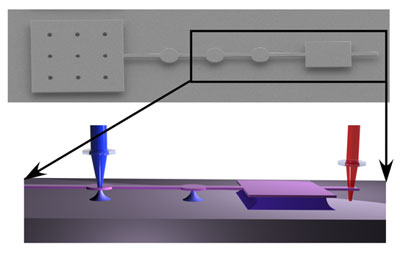 |
| An illustration of the nanoelectromechanical oscillator, with the cantilever on the far right. The inset is a tilted 3-D profile of the structure, which shows the silicon dioxide posts. |
Abstract:
By watching how energy moves across a tiny device akin to a springing diving board, Cornell researchers are a step closer to creating extraordinarily tiny sensors that can instantly recognize harmful substances in air or water.
Sensitive oscillators could lead to detection of harmful molecules, bacteria
Ithaca, NY | Posted on March 11th, 2010The researchers, led by professor of applied and engineering physics Harold Craighead, made a device just 200 nanometers thick and a few microns long with an oscillating cantilever hanging off one end. (A nanometer is one-billionth of a meter; a micron is one-millionth of a meter.) They identified exactly how to tune its sensitivity -- a breakthrough that could lead to advanced sensing technologies.
The experiments detailed online Feb. 8 in Journal of Applied Physics show how these oscillators, which are nanoelectromechanical systems (NEMS), could one day be made into everyday devices by lining up millions of them and treating each cantilever with a certain molecule.
"The big purpose is to be able to drive arrays of these things all in direct synchrony," said first author Rob Ilic, a research associate at the Cornell NanoScale Science and Technology Facility. "They can be functionalized with different chemistries and biomolecules to detect various pathogens -- not just one thing."
The cantilever is like a diving board that resonates at distinct frequencies. In past research, the team has demonstrated that by treating the cantilever with different substances, they can tell what other substances are present. For example, E. coli antibodies attached to the cantilever can detect the presence of E. coli in water.
The researchers have perfected the oscillators' design, Ilic said, by laying their device on top of a layer of silicon dioxide, all of which rest on a silicon substrate. A pad with holes connects pegs of silicon dioxide, lined up like telephone poles, which eventually end at the cantilever.
A laser beam, switched on at the far end from the cantilever, travels down the device and causes the oscillator to wobble. The frequency is then measured by shining another laser on the oscillator and noting patterns in the reflected light.
The "telephone poles" allow the energy to move efficiently across the device by preventing it from buckling or sagging. The design makes it easy to read the resonant frequency of the cantilever.
In this process, the researchers discovered that over short distances, the energy from the laser came in the form of heat, which quickly dissipates. But when the laser was parked hundreds of microns away from the cantilever, the energy came in the form of acoustical waves that traveled through the device, dissipated more slowly, and allowed them to make their device longer.
The research was the result of a collaboration with Slava Krylov of Tel Aviv University. The work was supported by the Defense Advanced Research Projects Agency; the Nanobiotechnology Center, which is funded by the National Science Foundation; and New York state.
####
About Cornell University
Once called "the first American university" by educational historian Frederick Rudolph, Cornell University represents a distinctive mix of eminent scholarship and democratic ideals. Adding practical subjects to the classics and admitting qualified students regardless of nationality, race, social circumstance, gender, or religion was quite a departure when Cornell was founded in 1865.
Today's Cornell reflects this heritage of egalitarian excellence. It is home to the nation's first colleges devoted to hotel administration, industrial and labor relations, and veterinary medicine. Both a private university and the land-grant institution of New York State, Cornell University is the most educationally diverse member of the Ivy League.
For more information, please click here
Contacts:
Media Contact:
Blaine Friedlander
(607) 254-8093
Cornell Chronicle:
Anne Ju
(607) 255-9735
Copyright © Cornell University
If you have a comment, please Contact us.Issuers of news releases, not 7th Wave, Inc. or Nanotechnology Now, are solely responsible for the accuracy of the content.
Bookmark:


| Related News Press |
News and information
 Quantum computer improves AI predictions April 17th, 2026
Flexible sensor gains sensitivity under pressure April 17th, 2026
A reusable chip for particulate matter sensing April 17th, 2026
Detecting vibrational quantum beating in the predissociation dynamics of SF6 using time-resolved photoelectron spectroscopy April 17th, 2026
NEMS
IEDM - CEA-Leti Will Present 11 Papers and Host Workshop on Disruptive Technologies for Data Management November 7th, 2018
UT engineers develop first method for controlling nanomotors: Breakthrough for nanotechnology as UT engineers develop first method for switching the mechanical motion of nanomotors September 21st, 2018
Nano-kirigami: 'Paper-cut' provides model for 3D intelligent nanofabrication July 13th, 2018
One string to rule them all April 17th, 2018
Govt.-Legislation/Regulation/Funding/Policy
Quantum computer improves AI predictions April 17th, 2026
Metasurfaces smooth light to boost magnetic sensing precision January 30th, 2026
New imaging approach transforms study of bacterial biofilms August 8th, 2025
Possible Futures
A fundamentally new therapeutic approach to cystic fibrosis: Nanobody repairs cellular defect April 17th, 2026
UC Irvine physicists discover method to reverse ‘quantum scrambling’ : The work addresses the problem of information loss in quantum computing system April 17th, 2026
Academic/Education
Rice University launches Rice Synthetic Biology Institute to improve lives January 12th, 2024
Multi-institution, $4.6 million NSF grant to fund nanotechnology training September 9th, 2022
Sensors
Flexible sensor gains sensitivity under pressure April 17th, 2026
Tiny nanosheets, big leap: A new sensor detects ethanol at ultra-low levels January 30th, 2026
From sensors to smart systems: the rise of AI-driven photonic noses January 30th, 2026
Sensors innovations for smart lithium-based batteries: advancements, opportunities, and potential challenges August 8th, 2025
Announcements
A fundamentally new therapeutic approach to cystic fibrosis: Nanobody repairs cellular defect April 17th, 2026
UC Irvine physicists discover method to reverse ‘quantum scrambling’ : The work addresses the problem of information loss in quantum computing system April 17th, 2026
Homeland Security
The picture of health: Virginia Tech researchers enhance bioimaging and sensing with quantum photonics June 30th, 2023
Sensors developed at URI can identify threats at the molecular level: More sensitive than a dog's nose and the sensors don't get tired May 21st, 2021
Highly sensitive dopamine detector uses 2D materials August 7th, 2020
Military
Quantum engineers ‘squeeze’ laser frequency combs to make more sensitive gas sensors January 17th, 2025
Chainmail-like material could be the future of armor: First 2D mechanically interlocked polymer exhibits exceptional flexibility and strength January 17th, 2025
Single atoms show their true color July 5th, 2024
NRL charters Navy’s quantum inertial navigation path to reduce drift April 5th, 2024
Nanobiotechnology
A fundamentally new therapeutic approach to cystic fibrosis: Nanobody repairs cellular defect April 17th, 2026
New molecular technology targets tumors and simultaneously silences two ‘undruggable’ cancer genes August 8th, 2025
New imaging approach transforms study of bacterial biofilms August 8th, 2025
Electrifying results shed light on graphene foam as a potential material for lab grown cartilage June 6th, 2025
Alliances/Trade associations/Partnerships/Distributorships
Chicago Quantum Exchange welcomes six new partners highlighting quantum technology solutions, from Chicago and beyond September 23rd, 2022
University of Illinois Chicago joins Brookhaven Lab's Quantum Center June 10th, 2022
 |
||
 |
||
| The latest news from around the world, FREE | ||
 |
||
|
|
||
| Premium Products | ||
 |
||
|
Only the news you want to read!
Learn More |
||
 |
||
|
Full-service, expert consulting
Learn More |
||
|
|
||