Home > Press > A heater made from woven fabrics
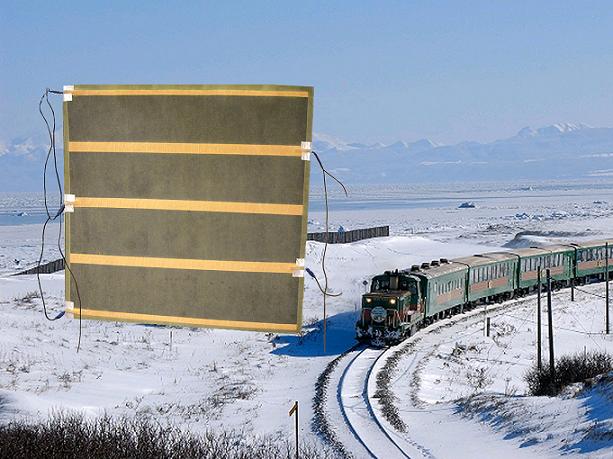 |
| Thanks to the combination of two new dispersion technologies aqueous suspensions of Baytubes® carbon nanotubes (CNTs) can be produced which contain single tubes and thus show a high electrical and thermal conductivity. Multifilament yarns coated with such CNT dispersions can be woven to efficient fabric heaters. Such heaters already performed well in preventing the water in water storage tanks of JR Hokkaido’s “Ryuhyo-Norokko” train from freezing. |
Abstract:
First commercial application of Baytubes® carbon nanotubes in Japan
New dispersion technology enables the full utilization of the electrical and thermal conductivity of carbon nanotubes
A heater made from woven fabrics
Leverkusen | Posted on February 23rd, 2010Aqueous suspensions of carbon nanotubes (CNTs) containing individual tubes offer interesting perspectives for a number of new applications which depend on a high electrical or thermal conductivity, respectively. In particular, this applies to multifilament yarns coated with such CNT dispersions. An interesting development using multifilament yarns is a new fabric heater made by weaving CNTEC® conductive yarns from Kuraray Living Co., Ltd. This fabric generates heat homogeneously all over the surface because of its outstanding conductivity and is supposed to be the first commercial use of Baytubes® CNTs from Bayer MaterialScience in the Japanese market.
The fabric heater is lightweight and thin, compact and shows a long-lasting bending resistance. It can be used for instance for car seats, household electrical appliances, for heating of clothes and as an anti-freezing material. Tests revealed that it may for example be installed in the water storage tank of JR Hokkaido's "Ryuhyo-Norokko" train. Inside this train the temperature drops to around -20 °C in wintertime, because so far no heating devices other than potbelly stoves are available. According to JR Hokkaido railway company the fabric heater performed well in preventing the water from freezing. A seat heating application of the fabric heater is still on trial on another JR Hokkaido train line. It is anticipated that the aqueous dispersions might as well be suitable for the compounding of various kinds of materials.
In the course of their production CNTs usually form large and stable agglomerates where the tubes are tightly entangled to each other. Dispersing such agglomerates into individual tubes which show a maximum of electrical and thermal conductivity has so far been a challenge. Thanks to a new dispersion technology using a zwitterionic surfactant developed and patented by Prof. Dr. Bunshi Fugetsu from Hokkaido University it is now possible to produce stable aqueous suspensions containing CNTs at a mono-dispersed (tubular) level in industrial quantities. To achieve this, a unique method for non-destructive dispersion of CNT agglomerates into individual tubes developed by the Inoac Technical Center Co., Ltd. is applied as well. The products show a stable and homogeneous conductivity and a durability that easily covers the service life that is required for industrial products. Through a combination of both technologies it is possible to disentangle the agglomerates of Baytubes® in an efficient and stable way.
####
About Bayer MaterialScience
With 2008 sales of EUR 9.7 billion, Bayer MaterialScience is among the world’s largest polymer companies. Business activities are focused on the manufacture of high-tech polymer materials and the development of innovative solutions for products used in many areas of daily life. The main segments served are the automotive, electrical and electronics, construction and sports and leisure industries. Bayer MaterialScience has 30 production sites around the globe and employed approximately 15,100 people at the end of 2008. Bayer MaterialScience is a Bayer Group company.
For more information, please click here
Contacts:
Bayer MaterialScience AG
Dr. Frank Rothbarth
Tel.: + 49 214 30-25363
Fax: + 49 214 30-66426
Copyright © Bayer MaterialScience
If you have a comment, please Contact us.Issuers of news releases, not 7th Wave, Inc. or Nanotechnology Now, are solely responsible for the accuracy of the content.
Bookmark:


| Related News Press |
News and information
 Simulating magnetization in a Heisenberg quantum spin chain April 5th, 2024
NRL charters Navy’s quantum inertial navigation path to reduce drift April 5th, 2024
Discovery points path to flash-like memory for storing qubits: Rice find could hasten development of nonvolatile quantum memory April 5th, 2024
Products
Spectradyne Partners with Particle Technology Labs for Measurement Services December 6th, 2018
Mode-Changing MEMS Accelerometer from STMicroelectronics Combines High Measurement Resolution and Ultra-Low Power for Industrial Applications November 7th, 2018
Fat-Repellent Nanolayers Can Make Oven Cleaning Easier October 17th, 2018
Aculon, Inc. Enters into Strategic Partnership Agreement with Henkel Corporation to Supply Key Mobile Device Manufacturers with NanoProof® PCB Waterproof Technology October 17th, 2018
Nanotubes/Buckyballs/Fullerenes/Nanorods/Nanostrings
Tests find no free-standing nanotubes released from tire tread wear September 8th, 2023
Detection of bacteria and viruses with fluorescent nanotubes July 21st, 2023
Announcements
NRL charters Navy’s quantum inertial navigation path to reduce drift April 5th, 2024
Discovery points path to flash-like memory for storing qubits: Rice find could hasten development of nonvolatile quantum memory April 5th, 2024
Automotive/Transportation
Researchers’ approach may protect quantum computers from attacks March 8th, 2024
Tests find no free-standing nanotubes released from tire tread wear September 8th, 2023
Home
Nanomaterials enable dual-mode heating and cooling device: Device could cut HVAC energy use by nearly 20% in the US December 2nd, 2020
Bosch Sensortec launches ideation community to foster and accelerate innovative IoT applications : Creativity hub for customers, partners, developers and makers February 18th, 2019
Iran Develops Water-Repellent Nano-Paint December 5th, 2018
Textiles/Clothing
Protective equipment with graphene nanotubes meets the strictest ESD safety standards March 25th, 2022
Polymer fibers with graphene nanotubes make it possible to heat hard-to-reach, complex-shaped items February 11th, 2022
Flexible material shows potential for use in fabrics to heat, cool July 3rd, 2020
 |
||
 |
||
| The latest news from around the world, FREE | ||
 |
||
|
|
||
| Premium Products | ||
 |
||
|
Only the news you want to read!
Learn More |
||
 |
||
|
Full-service, expert consulting
Learn More |
||
|
|
||