Home > Press > RTI International Develops Technology to Make Energy-Efficient Lighting
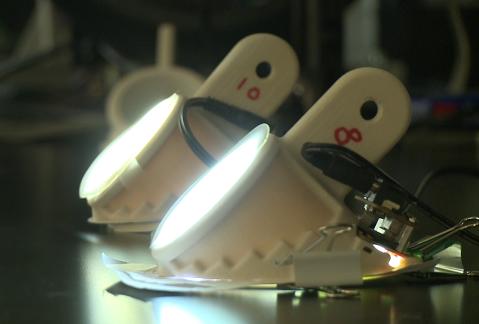 |
| Solid-State Lighting Device |
Abstract:
Nanofiber-based lighting technology provides high-efficiency, environmentally friendly lighting
RTI International Develops Technology to Make Energy-Efficient Lighting
Research Triangle Park, NC | Posted on February 12th, 2010RTI International has developed a revolutionary lighting technology that is more energy efficient than the common incandescent light bulb and does not contain mercury, making it environmentally safer than the compact fluorescent light (CFL) bulb.
At the core of RTI's breakthrough is an advanced nanofiber structure that provides exceptional lighting management. Nanofibers are materials with diameters and surface features much smaller than the human hair but with comparable lengths.
RTI's technology, which was funded in part by the Department of Energy's Solid-State Lighting program, centers around advancements in the nanoscale properties of materials to create high-performance, nanofiber-based reflectors and photoluminescent nanofibers (PLN). When the two nanoscale technologies are combined, a high-efficiency lighting device is produced that is capable of generating in excess of 55 lumens of light output per electrical watt consumed. This efficiency is more than five times greater than that of traditional incandescent bulbs.
"By using flexible photoluminescent nanofiber technologies for light management, RTI has opened the door to the creation of new designs for solid-state lighting applications," says Lynn Davis, Ph.D., director of RTI's Nanoscale Materials Program. "This new class of materials can provide cost-effective, safe and efficient lighting solutions."
Additionally, RTI's technology produces an aesthetically pleasing light with better color rendering properties than is typically found in CFLs. The technology has demonstrated color rendering indices in excess of 90 for warm white, neutral white, and cool white illumination sources.
"Because lighting consumes almost one-fourth of all electricity generated in the United States, our technology could have a significant impact in reducing energy consumption and carbon dioxide emissions," Davis said. "The technology also does not contain mercury, which makes it more environmentally friendly and safer to handle than CFLs and other fluorescent lamps."
RTI is continuing development of this technology and is actively pursuing commercialization opportunities in the marketplace. It is anticipated that commercial products containing this breakthrough will be available in three to five years.
####
About RTI International
RTI International is one of the world's leading research institutes, dedicated to improving the human condition by turning knowledge into practice. Our staff of more than 2,800 provides research and technical expertise to governments and businesses in more than 40 countries in the areas of health and pharmaceuticals, education and training, surveys and statistics, advanced technology, international development, economic and social policy, energy and the environment, and laboratory and chemistry services.
For more information, please click here
Contacts:
Lisa Bistreich: 919-316-3596
Patrick Gibbons: 919-541-6136
Copyright © RTI International
If you have a comment, please Contact us.Issuers of news releases, not 7th Wave, Inc. or Nanotechnology Now, are solely responsible for the accuracy of the content.
Bookmark:


| Related News Press |
News and information
 Simulating magnetization in a Heisenberg quantum spin chain April 5th, 2024
NRL charters Navy’s quantum inertial navigation path to reduce drift April 5th, 2024
Discovery points path to flash-like memory for storing qubits: Rice find could hasten development of nonvolatile quantum memory April 5th, 2024
Good as gold - improving infectious disease testing with gold nanoparticles April 5th, 2024
Display technology/LEDs/SS Lighting/OLEDs
Utilizing palladium for addressing contact issues of buried oxide thin film transistors April 5th, 2024
Light guide plate based on perovskite nanocomposites November 3rd, 2023
Simple ballpoint pen can write custom LEDs August 11th, 2023
Videos/Movies
New X-ray imaging technique to study the transient phases of quantum materials December 29th, 2022
Solvent study solves solar cell durability puzzle: Rice-led project could make perovskite cells ready for prime time September 23rd, 2022
Scientists prepare for the world’s smallest race: Nanocar Race II March 18th, 2022
Visualizing the invisible: New fluorescent DNA label reveals nanoscopic cancer features March 4th, 2022
Govt.-Legislation/Regulation/Funding/Policy
NRL charters Navy’s quantum inertial navigation path to reduce drift April 5th, 2024
Discovery points path to flash-like memory for storing qubits: Rice find could hasten development of nonvolatile quantum memory April 5th, 2024
Chemical reactions can scramble quantum information as well as black holes April 5th, 2024
Possible Futures
Discovery points path to flash-like memory for storing qubits: Rice find could hasten development of nonvolatile quantum memory April 5th, 2024
With VECSELs towards the quantum internet Fraunhofer: IAF achieves record output power with VECSEL for quantum frequency converters April 5th, 2024
Announcements
NRL charters Navy’s quantum inertial navigation path to reduce drift April 5th, 2024
Discovery points path to flash-like memory for storing qubits: Rice find could hasten development of nonvolatile quantum memory April 5th, 2024
Environment
Billions of nanoplastics released when microwaving baby food containers: Exposure to plastic particles kills up to 75% of cultured kidney cells July 21st, 2023
Energy
Development of zinc oxide nanopagoda array photoelectrode: photoelectrochemical water-splitting hydrogen production January 12th, 2024
Shedding light on unique conduction mechanisms in a new type of perovskite oxide November 17th, 2023
Inverted perovskite solar cell breaks 25% efficiency record: Researchers improve cell efficiency using a combination of molecules to address different November 17th, 2023
The efficient perovskite cells with a structured anti-reflective layer – another step towards commercialization on a wider scale October 6th, 2023
 |
||
 |
||
| The latest news from around the world, FREE | ||
 |
||
|
|
||
| Premium Products | ||
 |
||
|
Only the news you want to read!
Learn More |
||
 |
||
|
Full-service, expert consulting
Learn More |
||
|
|
||