Home > Press > Nano imagining takes turn for the better
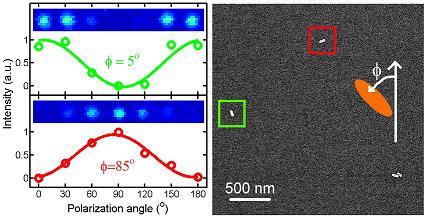 |
| An electron microscope photo from the new paper shows nanorods about 75 nanometers long and 25 nanometers wide on a glass slide at 90-degree angles to each other. An adjacent photothermal image shows them as pixilated smudges. |
Abstract:
Photothermal technique provides new way to track nanoparticles
Nano imagining takes turn for the better
Houston, TX | Posted on February 3rd, 2010Stephan Link wants to understand how nanomaterials align, and his lab's latest work is a step in the right direction.
Link's Rice University group has found a way to use gold nanorods as orientation sensors by combining their plasmonic properties with polarization imaging techniques.
That may make it possible to see and perhaps track single nanoparticles over long periods. It would give researchers new information about materials, including living systems, that incorporate them.
"With a spherical particle, you don't have any information about how it's oriented," said Link, an assistant professor of chemistry and electrical and computer engineering at Rice. "We wanted to see if we could determine the orientation of the nanorods, and eventually we'd like to be able to measure the orientation of the environment they're in. We think this technique could be really useful for that."
Link, primary author Wei-Shun Chang, a Rice research scientist, and their collaborators reported their results this week in the online edition of the Proceedings of the National Academy of Sciences.
Seeing a single nanoparticle is nothing new. A scanning tunneling microscope (STM) can capture images of particles down to a few nanometers; particles tagged with fluorescent molecules can be seen for as long as the fluorophores are active. Link used this latter method to show nanocars rolling at room temperature last year.
But there are problems with each of those techniques. STMs see nanotubes or quantum dots just fine as long as they're more or less isolated on a conductive surface. But in the wild, the particles would get lost amid the clutter of everything else the microscope sees. And while fluorophores can help pick particles out of the crowd, they can deteriorate in as little as 30 seconds, which limits their usefulness.
Gold nanorods can be "lit up" at will. Lasers at particular wavelengths excite surface plasmons that absorb the energy and emit a heat signature that can be detected by a probe laser. Because plasmons are highly polarized along a nanorod's length, reading the signal while turning the polarization of the laser tells researchers precisely how the rod is oriented.
An electron microscope photo from the new paper shows nanorods about 75 nanometers long and 25 nanometers wide on a glass slide at 90-degree angles to each other. An adjacent photothermal image shows them as pixilated smudges. The smudges are strongest when the laser polarization aligns lengthwise with the nanorods, but they disappear when the laser polarization and rods are 90 degrees out of phase.
"With plasmonics, you always have two properties: absorption and scattering," Link said. "Depending on the size, one or the other dominates. What's unique is that it's now possible to do both on the same structure or do it individually -- so we can only measure absorption or only measure scattering."
Nanorods much smaller than 50 nanometers are not detectable by some scattering methods, Link said, but photothermal detection should work with metallic particles as small as five nanometers; this makes them useful for biological applications. "These gold nanorods are biocompatible. They are not toxic to cells," said Chang, noting their similarity to gold nanoshells currently in human cancer therapy trials based on research by Rice scientists Naomi Halas and Jennifer West.
"Our work is more geared to the fundamentals," Link said of the basic nature of his group's research. "Maybe we can optimize the conditions, and then a physician or somebody who's engineering a probe can take it from there.
"Our place is a little further down the chain of development. I'm happy with that."
Co-authors of the paper are Rice graduate students Ji Won Ha and Liane Slaughter. The Robert A. Welch Foundation and 3M supported the work.
View the paper at www.pnas.org/content/early/2010/01/25/0910127107.abstract.
####
About Rice University
Located in Houston, Rice University is consistently ranked one of America's best teaching and research universities. Known for its "unconventional wisdom," Rice is distinguished by its: size -- 3,102 undergraduates and 2,237 graduate students; selectivity -- 12 applicants for each place in the freshman class; resources -- an undergraduate student-to-faculty ratio of 5-to-1; sixth largest endowment per student among American private research universities; residential college system, which builds communities that are both close-knit and diverse; and collaborative culture, which crosses disciplines, integrates teaching and research, and intermingles undergraduate and graduate work.
For more information, please click here
Contacts:
David Ruth
Associate Director for National Media Relations
Rice University
Direct: 713-348-6327
Cell: 612-702-9473
Copyright © Rice University
If you have a comment, please Contact us.Issuers of news releases, not 7th Wave, Inc. or Nanotechnology Now, are solely responsible for the accuracy of the content.
Bookmark:


| Related News Press |
News and information
 Simulating magnetization in a Heisenberg quantum spin chain April 5th, 2024
NRL charters Navy’s quantum inertial navigation path to reduce drift April 5th, 2024
Discovery points path to flash-like memory for storing qubits: Rice find could hasten development of nonvolatile quantum memory April 5th, 2024
Possible Futures
Discovery points path to flash-like memory for storing qubits: Rice find could hasten development of nonvolatile quantum memory April 5th, 2024
With VECSELs towards the quantum internet Fraunhofer: IAF achieves record output power with VECSEL for quantum frequency converters April 5th, 2024
Nanotubes/Buckyballs/Fullerenes/Nanorods/Nanostrings
Tests find no free-standing nanotubes released from tire tread wear September 8th, 2023
Detection of bacteria and viruses with fluorescent nanotubes July 21st, 2023
Nanomedicine
New micromaterial releases nanoparticles that selectively destroy cancer cells April 5th, 2024
Good as gold - improving infectious disease testing with gold nanoparticles April 5th, 2024
Researchers develop artificial building blocks of life March 8th, 2024
Sensors
Discoveries
Chemical reactions can scramble quantum information as well as black holes April 5th, 2024
New micromaterial releases nanoparticles that selectively destroy cancer cells April 5th, 2024
Utilizing palladium for addressing contact issues of buried oxide thin film transistors April 5th, 2024
Announcements
NRL charters Navy’s quantum inertial navigation path to reduce drift April 5th, 2024
Discovery points path to flash-like memory for storing qubits: Rice find could hasten development of nonvolatile quantum memory April 5th, 2024
Tools
Ferroelectrically modulate the Fermi level of graphene oxide to enhance SERS response November 3rd, 2023
The USTC realizes In situ electron paramagnetic resonance spectroscopy using single nanodiamond sensors November 3rd, 2023
Quantum Dots/Rods
A new kind of magnetism November 17th, 2023
IOP Publishing celebrates World Quantum Day with the announcement of a special quantum collection and the winners of two prestigious quantum awards April 14th, 2023
Qubits on strong stimulants: Researchers find ways to improve the storage time of quantum information in a spin rich material January 27th, 2023
NIST’s grid of quantum islands could reveal secrets for powerful technologies November 18th, 2022
Nanobiotechnology
New micromaterial releases nanoparticles that selectively destroy cancer cells April 5th, 2024
Good as gold - improving infectious disease testing with gold nanoparticles April 5th, 2024
Researchers develop artificial building blocks of life March 8th, 2024
 |
||
 |
||
| The latest news from around the world, FREE | ||
 |
||
|
|
||
| Premium Products | ||
 |
||
|
Only the news you want to read!
Learn More |
||
 |
||
|
Full-service, expert consulting
Learn More |
||
|
|
||