Home > Press > Smart Coating Opens Door To Safer Hip, Knee and Dental Implants
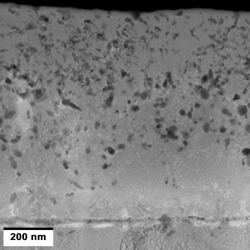 |
| Cross-sectional transmission electron microscope image of the functionally graded smart coating with nano-silver particles distributed throughout the entire thickness of the coating. |
Abstract:
Researchers at North Carolina State University have developed a "smart coating" that helps surgical implants bond more closely with bone and ward off infection.
Smart Coating Opens Door To Safer Hip, Knee and Dental Implants
Raleigh, NC | Posted on February 3rd, 2010When patients have hip, knee or dental replacement surgery, they run the risk of having their bodies reject the implant. But the smart coating developed at NC State mitigates that risk by fostering bone growth into the implant. The coating creates a crystalline layer next to the implant, and a mostly amorphous outer layer that touches the surrounding bone. The amorphous layer dissolves over time, releasing calcium and phosphate, which encourages bone growth.
"The bone grows into the coating as the amorphous layer dissolves, resulting in improved bonding, or osseointegration," says Dr. Afsaneh Rabiei, an NC State associate professor of mechanical and aerospace engineering, associate faculty member of biomedical engineering and co-author of a paper describing the research. This bonding also makes the implant more functional, because the bonding helps ensure that the bone and the implant do a better job of sharing the load.
"We call it a smart coating because we can tailor the rate at which the amorphous layer dissolves to match the bone growth rate of each patient," Rabiei says. This is important because people have very different rates of bone growth. For example, young people's bones tend to grow far faster than the bones of older adults.
The researchers have also incorporated silver nanoparticles throughout the coating to ward off infections. Currently, implant patients are subjected to an intense regimen of antibiotics to prevent infection immediately following surgery. However, the site of the implant will always remain vulnerable to infection. But by incorporating silver into the coating, the silver particles will act as antimicrobial agents as the amorphous layer dissolves, Rabiei says. This will not only limit the amount of antibiotics patients will need following surgery, but will provide protection from infection at the implant site for the life of the implant. Moreover, the silver is released more quickly right after surgery, when there is more risk of infection, due to the faster dissolution of the amorphous layer of the coating. Silver release will slow down while the patient is healing. "That is another reason why we call it smart coating," Rabiei says.
The research was funded by the National Science Foundation, and was accomplished with assistance from the Center for Nanophase Materials Sciences and Shared Research Equipment User Facilities at Oak Ridge National Laboratory.
The research, "Functionally graded hydroxyapatite coatings doped with antibacterial components," was co-authored by Rabiei, former NC State Ph.D. student Xiao Bai, and Oak Ridge National Laboratory researchers Karren More and Christopher Rouleau. The research is published online by Acta BioMaterialia.
####
About North Carolina State University
With more than 31,000 students and nearly 8,000 faculty and staff, North Carolina State University is a comprehensive university known for its leadership in education and research, and globally recognized for its science, technology, engineering and mathematics leadership.
NC State students, faculty and staff are focused. As one of the leading land-grant institutions in the nation, NC State is committed to playing an active and vital role in improving the quality of life for the citizens of North Carolina, the nation and the world.
For more information, please click here
Contacts:
Matt Shipman
News Services
919.515.6386
Dr. Afsaneh Rabiei
919.513.2674
Copyright © North Carolina State University
If you have a comment, please Contact us.Issuers of news releases, not 7th Wave, Inc. or Nanotechnology Now, are solely responsible for the accuracy of the content.
Bookmark:


| Related News Press |
News and information
 Simulating magnetization in a Heisenberg quantum spin chain April 5th, 2024
NRL charters Navy’s quantum inertial navigation path to reduce drift April 5th, 2024
Discovery points path to flash-like memory for storing qubits: Rice find could hasten development of nonvolatile quantum memory April 5th, 2024
Govt.-Legislation/Regulation/Funding/Policy
NRL charters Navy’s quantum inertial navigation path to reduce drift April 5th, 2024
Discovery points path to flash-like memory for storing qubits: Rice find could hasten development of nonvolatile quantum memory April 5th, 2024
Chemical reactions can scramble quantum information as well as black holes April 5th, 2024
Possible Futures
Discovery points path to flash-like memory for storing qubits: Rice find could hasten development of nonvolatile quantum memory April 5th, 2024
With VECSELs towards the quantum internet Fraunhofer: IAF achieves record output power with VECSEL for quantum frequency converters April 5th, 2024
Nanomedicine
New micromaterial releases nanoparticles that selectively destroy cancer cells April 5th, 2024
Good as gold - improving infectious disease testing with gold nanoparticles April 5th, 2024
Researchers develop artificial building blocks of life March 8th, 2024
Announcements
NRL charters Navy’s quantum inertial navigation path to reduce drift April 5th, 2024
Discovery points path to flash-like memory for storing qubits: Rice find could hasten development of nonvolatile quantum memory April 5th, 2024
Nanobiotechnology
New micromaterial releases nanoparticles that selectively destroy cancer cells April 5th, 2024
Good as gold - improving infectious disease testing with gold nanoparticles April 5th, 2024
Researchers develop artificial building blocks of life March 8th, 2024
Dental
Innovations in dentistry: Navigational surgery, robotics, and nanotechnology October 2nd, 2020
First measurement of electron energy distributions, could enable sustainable energy technologies June 5th, 2020
Gas storage method could help next-generation clean energy vehicles: Tremendous amounts of hydrogen and methane can be stored in nanoscopic pores April 17th, 2020
 |
||
 |
||
| The latest news from around the world, FREE | ||
 |
||
|
|
||
| Premium Products | ||
 |
||
|
Only the news you want to read!
Learn More |
||
 |
||
|
Full-service, expert consulting
Learn More |
||
|
|
||