Home > Press > Funding to push battery technology from Argonne Laboratory to marketplace
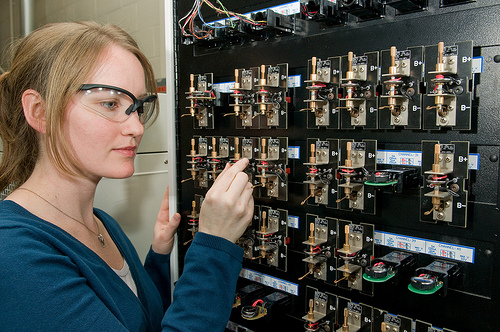 |
| Argonne researcher Lynn Trahey loads a coin-sized cell on a testing unit used to evaluate electrochemical cycling performance in batteries. Photo by Wes Agresta / Courtesy Argonne National Laboratory. |
Abstract:
After more than a decade of experience in lithium-ion battery research, scientists at the U.S. Department of Energy's Argonne National Laboratory know well the challenges of getting manufacturers interested in advanced materials for their batteries.
Funding to push battery technology from Argonne Laboratory to marketplace
Argonne, IL | Posted on February 1st, 2010The laboratory will soon be able to greatly accelerate this process thanks to money from the American Recovery and Reinvestment Act (ARRA).
Argonne was recently awarded $8.8 million in ARRA funding to construct three battery research and development facilities: a Battery Prototype Cell Fabrication Facility, a Materials Production Scale-Up Facility and a Post-Test Analysis Facility.
The laboratory's research will focus on battery materials and batteries for hybrid electric vehicles, plug-in hybrid electric vehicles and all other electric vehicles.
"These facilities will create a direct pipeline between materials researchers and battery developers," said Dennis Dees, an electrochemical engineer at Argonne who will help oversee the Prototype Cell Fabrication Facility. "This will greatly reduce the time to get battery improvements into production."
Dees said the laboratory will spend $1 million on equipment designed to improve the quality and evaluate the performance of newly fabricated cells.
Gregory Krumdick, principal systems engineer at Argonne, will lead the Materials Production Scale-Up Facility.
He said the purpose of the facility is to develop manufacturing processes for producing advanced battery materials in sufficient quantity for industrial-scale testing.
"Processes developed in the lab are not always suitable for large-scale production," Krumdick said. "This facility will provide the means to scale up these processes, as well as to actually produce larger quantities of the materials for evaluation."
His arm of the project will receive $5.8 million of the ARRA award.
"Argonne has developed a great number of new and innovative battery materials but most never make it to industrial production," he said. "This facility will be the link to connect the bench-scale research with the battery manufacturing industry."
Ira Bloom, a chemist at Argonne, will run the Post-Test Analysis Facility, which is slated to receive $2 million in ARRA funding.
"Post-test analysis is the natural extension of the battery testing that Argonne has been doing for many years," he said. "As a battery ages during use or testing, performance degrades and changes occur in the battery materials. Post-test analysis lets us see what physical changes occurred."
Bloom said his facility, which will be up and running in the next two years, will help scientists and engineers understand exactly what changed, so they can improve the battery's performance and life.
####
About Argonne National Laboratory
Argonne National Laboratory seeks solutions to pressing national problems in science and technology. The nation's first national laboratory, Argonne conducts leading-edge basic and applied scientific research in virtually every scientific discipline. Argonne researchers work closely with researchers from hundreds of companies, universities, and federal, state and municipal agencies to help them solve their specific problems, advance America 's scientific leadership and prepare the nation for a better future. With employees from more than 60 nations, Argonne is managed by UChicago Argonne, LLC for the U.S. Department of Energy's Office of Science.
For more information, please click here
Contacts:
Jo Napolitano
630/252-5823
Copyright © Argonne National Laboratory
If you have a comment, please Contact us.Issuers of news releases, not 7th Wave, Inc. or Nanotechnology Now, are solely responsible for the accuracy of the content.
Bookmark:


| Related News Press |
News and information
 Simulating magnetization in a Heisenberg quantum spin chain April 5th, 2024
NRL charters Navy’s quantum inertial navigation path to reduce drift April 5th, 2024
Discovery points path to flash-like memory for storing qubits: Rice find could hasten development of nonvolatile quantum memory April 5th, 2024
Openings/New facilities/Groundbreaking/Expansion
OCSiAl expands its graphene nanotube production capacities to Europe June 17th, 2022
GLOBALFOUNDRIES Moves Corporate Headquarters to its Most Advanced Semiconductor Manufacturing Facility in New York April 27th, 2021
Oxford Instruments Plasma Technology relocates to advanced manufacturing facility: Move driven by exceptional business growth February 12th, 2021
Govt.-Legislation/Regulation/Funding/Policy
NRL charters Navy’s quantum inertial navigation path to reduce drift April 5th, 2024
Discovery points path to flash-like memory for storing qubits: Rice find could hasten development of nonvolatile quantum memory April 5th, 2024
Chemical reactions can scramble quantum information as well as black holes April 5th, 2024
Announcements
NRL charters Navy’s quantum inertial navigation path to reduce drift April 5th, 2024
Discovery points path to flash-like memory for storing qubits: Rice find could hasten development of nonvolatile quantum memory April 5th, 2024
Tools
Ferroelectrically modulate the Fermi level of graphene oxide to enhance SERS response November 3rd, 2023
The USTC realizes In situ electron paramagnetic resonance spectroscopy using single nanodiamond sensors November 3rd, 2023
Automotive/Transportation
Researchers’ approach may protect quantum computers from attacks March 8th, 2024
Tests find no free-standing nanotubes released from tire tread wear September 8th, 2023
Battery Technology/Capacitors/Generators/Piezoelectrics/Thermoelectrics/Energy storage
What heat can tell us about battery chemistry: using the Peltier effect to study lithium-ion cells March 8th, 2024
A battery’s hopping ions remember where they’ve been: Seen in atomic detail, the seemingly smooth flow of ions through a battery’s electrolyte is surprisingly complicated February 16th, 2024
 |
||
 |
||
| The latest news from around the world, FREE | ||
 |
||
|
|
||
| Premium Products | ||
 |
||
|
Only the news you want to read!
Learn More |
||
 |
||
|
Full-service, expert consulting
Learn More |
||
|
|
||