Home > Press > Nanometric butterfly wings created
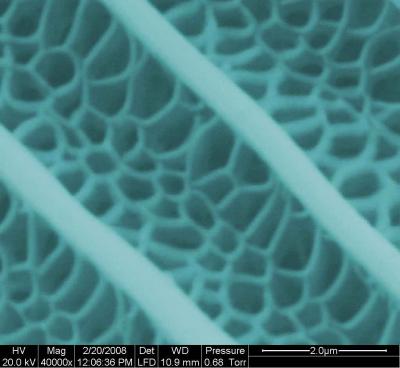 |
| This is a section of a butterfly wing under a microscope. Credit: The Pennsylvania State University/ SINC. |
Abstract:
A team of researchers from the State University of Pennsylvania (USA) and the Universidad Autónoma de Madrid (UAM) have developed a technique to replicate biological structures, such as butterfly wings, on a nano scale. The resulting biomaterial could be used to make optically active structures, such as optical diffusers for solar panels.
Nanometric butterfly wings created
Spain & Pennsylvania | Posted on October 8th, 2009Insects' colours and their iridescence (the ability to change colours depending on the angle) or their ability to appear metallic are determined by tiny nano-sized photonic structures (1 nanometre=10-9 m) which can be found in their cuticle. Scientists have focused on these biostructures to develop devices with light emitting properties that they have just presented in the journal Bioinspiration & Biomimetics.
"This technique was developed at the Materials Research Institute of the State University of Pennsylvania and it enables replicas of biological structures to be made on a nanometric scale", Raúl J. Martín-Palma, lecturer at the Department of Applied Physics of the UAM and co-author of the study explains to SINC.
The researchers have created "free-standing replicas of fragile, laminar, chitinous biotemplates", that is, copies of the nano structures of butterfly wings. The appearance of these appendices usually depends more on their periodical nanometric structure (which determines the "physical" colour) than on the pigments in the wings (which establish the "chemical" colour).
In order to create new biomaterial, the team used compounds based on Germanium, Selenium and Stibium (GeSeSb) and employed a technique called Conformal-Evaporated-Film-by-Rotation (CEFR), which combines thermal evaporation and substrate rotation in a low pressure chamber. They also used immersion in an aqueous orthophosphoric acid solution to dissolve the chitin (substance typically found in the exoskeleton of insects and other arthropods).
The methods used to date to replicate bio structures are very limited when it comes to obtaining effective copies on a nanometric scale and they often damage the original biostructure because they are used in corrosive atmospheres or at high temperatures. The new technique "totally" overcomes these problems, as it is employed at room temperature and does not require the use of toxic substances.
Martín-Palma points out that the structures resulting from replicating the biotemplate of butterfly wings could be used to make various optically active structures, such as optical diffusers or coverings that maximise solar cell light absorption, or other types of devices. "Furthermore, the technique can be used to replicate other biological structures, such as beetle shells or the compound eyes of flies, bees and wasps," the researcher says.
The compound eyes of certain insects are sound candidates for a large number of applications as they provide great angular vision. "The development of miniature cameras and optical sensors based on these organs would make it possible for them to be installed in small spaces in cars, mobile telephones and displays, apart from having uses in areas such as medicine (the development of endoscopes) and security (surveillance)", Martín-Palma says.
References
Akhlesh Lakhtakia, Raúl J. Martín-Palma, Michael A. Motyka y Carlo G. Pantano. "Fabrication of free-standing replicas of fragile, laminar, chitinous biotemplates". Bioinspiration & Biomimetics 4 (3): 034001, septiembre de 2009.
####
For more information, please click here
Contacts:
SINC
34-914-251-820
Copyright © SINC
If you have a comment, please Contact us.Issuers of news releases, not 7th Wave, Inc. or Nanotechnology Now, are solely responsible for the accuracy of the content.
Bookmark:


| Related News Press |
News and information
 Quantum computer improves AI predictions April 17th, 2026
Flexible sensor gains sensitivity under pressure April 17th, 2026
A reusable chip for particulate matter sensing April 17th, 2026
Detecting vibrational quantum beating in the predissociation dynamics of SF6 using time-resolved photoelectron spectroscopy April 17th, 2026
Possible Futures
A fundamentally new therapeutic approach to cystic fibrosis: Nanobody repairs cellular defect April 17th, 2026
UC Irvine physicists discover method to reverse ‘quantum scrambling’ : The work addresses the problem of information loss in quantum computing system April 17th, 2026
Nanomedicine
A fundamentally new therapeutic approach to cystic fibrosis: Nanobody repairs cellular defect April 17th, 2026
New molecular technology targets tumors and simultaneously silences two ‘undruggable’ cancer genes August 8th, 2025
New imaging approach transforms study of bacterial biofilms August 8th, 2025
Electrifying results shed light on graphene foam as a potential material for lab grown cartilage June 6th, 2025
Sensors
Flexible sensor gains sensitivity under pressure April 17th, 2026
Tiny nanosheets, big leap: A new sensor detects ethanol at ultra-low levels January 30th, 2026
From sensors to smart systems: the rise of AI-driven photonic noses January 30th, 2026
Sensors innovations for smart lithium-based batteries: advancements, opportunities, and potential challenges August 8th, 2025
Announcements
A fundamentally new therapeutic approach to cystic fibrosis: Nanobody repairs cellular defect April 17th, 2026
UC Irvine physicists discover method to reverse ‘quantum scrambling’ : The work addresses the problem of information loss in quantum computing system April 17th, 2026
Homeland Security
The picture of health: Virginia Tech researchers enhance bioimaging and sensing with quantum photonics June 30th, 2023
Sensors developed at URI can identify threats at the molecular level: More sensitive than a dog's nose and the sensors don't get tired May 21st, 2021
Highly sensitive dopamine detector uses 2D materials August 7th, 2020
Military
Quantum engineers ‘squeeze’ laser frequency combs to make more sensitive gas sensors January 17th, 2025
Chainmail-like material could be the future of armor: First 2D mechanically interlocked polymer exhibits exceptional flexibility and strength January 17th, 2025
Single atoms show their true color July 5th, 2024
NRL charters Navy’s quantum inertial navigation path to reduce drift April 5th, 2024
Automotive/Transportation
Decoding hydrogen‑bond network of electrolyte for cryogenic durable aqueous zinc‑ion batteries January 30th, 2026
Sensors innovations for smart lithium-based batteries: advancements, opportunities, and potential challenges August 8th, 2025
Simple algorithm paired with standard imaging tool could predict failure in lithium metal batteries August 8th, 2025
Aerospace/Space
Decoding hydrogen‑bond network of electrolyte for cryogenic durable aqueous zinc‑ion batteries January 30th, 2026
ICFO researchers overcome long-standing bottleneck in single photon detection with twisted 2D materials August 8th, 2025
Onion-like nanoparticles found in aircraft exhaust May 14th, 2025
Nanobiotechnology
A fundamentally new therapeutic approach to cystic fibrosis: Nanobody repairs cellular defect April 17th, 2026
New molecular technology targets tumors and simultaneously silences two ‘undruggable’ cancer genes August 8th, 2025
New imaging approach transforms study of bacterial biofilms August 8th, 2025
Electrifying results shed light on graphene foam as a potential material for lab grown cartilage June 6th, 2025
Photonics/Optics/Lasers
Metasurfaces smooth light to boost magnetic sensing precision January 30th, 2026
From sensors to smart systems: the rise of AI-driven photonic noses January 30th, 2026
Solar/Photovoltaic
Spinel-type sulfide semiconductors to operate the next-generation LEDs and solar cells For solar-cell absorbers and green-LED source October 3rd, 2025
KAIST researchers introduce new and improved, next-generation perovskite solar cell November 8th, 2024
Groundbreaking precision in single-molecule optoelectronics August 16th, 2024
Development of zinc oxide nanopagoda array photoelectrode: photoelectrochemical water-splitting hydrogen production January 12th, 2024
 |
||
 |
||
| The latest news from around the world, FREE | ||
 |
||
|
|
||
| Premium Products | ||
 |
||
|
Only the news you want to read!
Learn More |
||
 |
||
|
Full-service, expert consulting
Learn More |
||
|
|
||