Home > Press > Nanotubes find niche in electric switches: Study finds nanotube structures could improve electric motors
 |
Abstract:
Researchers in the United States and Finland have found that carbon nanotubes can significantly improve the performance of electrical contacts that are common in millions of motors used in a variety of electrical applications. Findings published this month in Advanced Materials conclude that "brush contacts" made of carbon nanotubes had 10 times less resistance than did the carbon-copper composite brushes commonly used today.
Nanotubes find niche in electric switches: Study finds nanotube structures could improve electric motors
Houston, TX | Posted on March 10th, 2009New research from Rice University and the University of Oulu in Oulu, Finland, finds that carbon nanotubes could significantly improve the performance of electrical commutators that are common in electric motors and generators.
The research, which appeared online this month in the journal Advanced Materials, finds that "brush contact" pads made of carbon nanotubes had 10 times less resistance than did the carbon-copper composite brushes commonly used today. Brush contacts are an integral part of "commutators," or spinning electrical switches used in many battery-powered electrical devices, such as cordless drills.
"The findings show that nanotubes have a great deal of practical relevance as brush contacts," said lead researcher Pulickel Ajayan, Rice's Benjamin M. and Mary Greenwood Anderson Professor in Mechanical Engineering and Materials Science. "The technology is widely used in industry, both in consumer gadgets as well as larger electrical machinery, so this could be a very interesting, near-term application for nanotubes." The combination of mechanical and electrical properties of nanotubes makes this possible.
The carbon nanotubes used in the study are hollow tubes of pure carbon that are about 30 nanometers in diameter. By comparison, a human hair is about 100,000 nanometers in diameter. In addition to being small, nanotubes are also extremely lightweight and durable, and they are excellent conductors of heat and electricity.
Because of these properties, the researchers decided to test nanotubes as brush contacts. Brush contacts are conducting pads held against a spinning metal disc or rod by spring-loaded arms. Current is passed from the spinning disc through the brush contacts to other parts of the device.
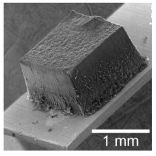
To test the feasibility of using carbon nanotube brush contacts, the research team replaced the ordinary copper-carbon composite brushes of an electric motor with small blocks that contain millions of carbon nanotubes. Under an electron microscope, these millimeter-square blocks look like a tightly packed forest.
From Ajayan's previous work, the team knew that these nanotube forests react something like a "memory foam" pillow; they regain their shape very quickly after they are compressed.
"This elasticity is something that's not found in existing composites that are used for brush contacts, and that's the essence of why the nanotube brush contacts perform better: They keep much more of their surface area in contact with the spinning disc," said Robert Vajtai, faculty fellow at Rice. Vajtai worked on the study with Ajayan and a group of researchers in Finland led by University of Oulu Researcher Krisztian Kordas.
The team believes that the improved contact between the surface of the spinning disc and the brush accounts for the 90 percent reduction in lost energy.
Co-authors on the paper also included Geza Toth, Jani Mäklin, Niina Halonen, Jaakko Palosaari, Jari Juuti and Heli Jantunen, all of the University of Oulu, and Gregory Sawyer of the University of Florida.
Support for the research was provided by the Academy of Finland, the University of Oulu's Micro and Nanotechnology Center, the Air Force Office of Scientific Research and the Semiconductor Research Corporation.
####
About Rice University
Who Knew? (explore.rice.edu/explore/Who_Knew.asp)
Located in Houston, Rice University is consistently ranked one of America's best teaching and research universities. Known for its "unconventional wisdom," Rice is distinguished by its: size -- 3,001 undergraduates and 2,144 graduate students; selectivity -- 12 applicants for each place in the freshman class; resources -- an undergraduate student-to-faculty ratio of 5-to-1; sixth largest endowment per student among American private research universities; residential college system, which builds communities that are both close-knit and diverse; and collaborative culture, which crosses disciplines, integrates teaching and research, and intermingles undergraduate and graduate work.
For more information, please click here
Contacts:
Jade Boyd
Associate Director and Science Editor
Office of Public Affairs/News & Media Relations
Rice University
(office) 713-348-6778
(cell) 713-302-2447
Copyright © Rice University
If you have a comment, please Contact us.Issuers of news releases, not 7th Wave, Inc. or Nanotechnology Now, are solely responsible for the accuracy of the content.
Bookmark:


| Related News Press |
News and information
 Quantum computer improves AI predictions April 17th, 2026
Flexible sensor gains sensitivity under pressure April 17th, 2026
A reusable chip for particulate matter sensing April 17th, 2026
Detecting vibrational quantum beating in the predissociation dynamics of SF6 using time-resolved photoelectron spectroscopy April 17th, 2026
Nanoelectronics
Lab to industry: InSe wafer-scale breakthrough for future electronics August 8th, 2025
Interdisciplinary: Rice team tackles the future of semiconductors Multiferroics could be the key to ultralow-energy computing October 6th, 2023
Key element for a scalable quantum computer: Physicists from Forschungszentrum Jülich and RWTH Aachen University demonstrate electron transport on a quantum chip September 23rd, 2022
Reduced power consumption in semiconductor devices September 23rd, 2022
Discoveries
Quantum computer improves AI predictions April 17th, 2026
Flexible sensor gains sensitivity under pressure April 17th, 2026
A reusable chip for particulate matter sensing April 17th, 2026
Detecting vibrational quantum beating in the predissociation dynamics of SF6 using time-resolved photoelectron spectroscopy April 17th, 2026
Announcements
A fundamentally new therapeutic approach to cystic fibrosis: Nanobody repairs cellular defect April 17th, 2026
UC Irvine physicists discover method to reverse ‘quantum scrambling’ : The work addresses the problem of information loss in quantum computing system April 17th, 2026
Research partnerships
Lab to industry: InSe wafer-scale breakthrough for future electronics August 8th, 2025
HKU physicists uncover hidden order in the quantum world through deconfined quantum critical points April 25th, 2025
 |
||
 |
||
| The latest news from around the world, FREE | ||
 |
||
|
|
||
| Premium Products | ||
 |
||
|
Only the news you want to read!
Learn More |
||
 |
||
|
Full-service, expert consulting
Learn More |
||
|
|
||