Home > Press > Gold Nanostars Outshine the Competition
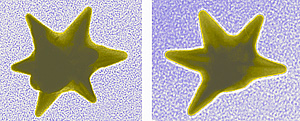 |
| NIST scientists found that gold and silver nanostars improved the sensitivity of Surface Enhanced Raman Spectroscopy (SERS) 10 to 100,000 times that of other commonly used nanoparticles. These uniquely shaped nanoparticles may one day be used in a range of applications from disease diagnostics to contraband identification. Color added for clarity.
Credit: NIST |
Abstract:
Novel nanoparticles being tested at the National Institute of Standards and Technology (NIST) have researchers seeing stars. In a recent paper,* NIST scientists used surface-enhanced Raman spectroscopy (SERS) to demonstrate that gold nanostars exhibit optical qualities that make them superior for chemical and biological sensing and imaging. These uniquely shaped nanoparticles may one day be used in a range of applications from disease diagnostics to contraband identification.
Gold Nanostars Outshine the Competition
GAITHERSBURG, MD | Posted on October 15th, 2008SERS relies on metallic nanoparticles, most commonly gold and silver, to amplify signals from molecules present in only trace quantities. For these types of experiments, scientists shine laser light on an aqueous solution containing the nanoparticles and the molecule of interest and monitor the scattered light. The detailed characteristics of both the molecule and the nanoparticle affect the strength of scattered light, which contains an identifying fingerprint for the molecule known as its vibrational signature. With nanoparticles amplifying the signature, it is possible to detect a very low concentration of molecules in a solution.
The NIST team tested the optical properties of the nanostars using two target molecules, 2-mercaptopyridine and crystal violet. These molecules were selected because of their structural similarity to biological molecules and their large number of delocalized electrons, a characteristic that lends itself to SERS. NIST researchers found that the Raman signal of 2-mercaptopyridine was 100,000 stronger when nanostars were present in the solution. The stars were also shown to be particularly capable of enhancing the signature of crystal violet, delivering a signal about 10 times stronger than the previous winner, nanorods. Both the nanostars and the nanorods outperformed the nanospheres commonly used for Raman enhancement.
NIST physicist Angela Hight Walker and her team perfected the process for making gold nanostars, building them from the bottom-up using surface alterations to manipulate their growth and control their shape. Once suspended in a solution, the team guided the nanostars to gather together to form multiple "hot spots," where the enhancement is dramatically larger than for a single nanostar.
According to Hight Walker, the fact that they can now be created en masse and have desirable optical properties should prompt researchers to examine their possible applications, perhaps eventually making them the stars of the nanoworld.
* E. Nalbant Esenturk and A. R. Hight Walker. Surface-enhanced Raman scattering spectroscopy via gold nanostars. Journal of Raman Spectroscopy, published online Sept. 24, 2008, DOI: 10.1002/jrs.2084.
Edited on Oct. 15, 2008, to correct caption.
####
About NIST
Founded in 1901, NIST is a non-regulatory federal agency within the U.S. Department of Commerce. NIST's mission is to promote U.S. innovation and industrial competitiveness by advancing measurement science, standards, and technology in ways that enhance economic security and improve our quality of life.
For more information, please click here
Contacts:
Mark Esser
(301) 975-8735
Copyright © NIST
If you have a comment, please Contact us.Issuers of news releases, not 7th Wave, Inc. or Nanotechnology Now, are solely responsible for the accuracy of the content.
Bookmark:


| Related News Press |
News and information
 Simulating magnetization in a Heisenberg quantum spin chain April 5th, 2024
NRL charters Navy’s quantum inertial navigation path to reduce drift April 5th, 2024
Discovery points path to flash-like memory for storing qubits: Rice find could hasten development of nonvolatile quantum memory April 5th, 2024
Good as gold - improving infectious disease testing with gold nanoparticles April 5th, 2024
Law enforcement/Anti-Counterfeiting/Security/Loss prevention
With VECSELs towards the quantum internet Fraunhofer: IAF achieves record output power with VECSEL for quantum frequency converters April 5th, 2024
Researchers’ approach may protect quantum computers from attacks March 8th, 2024
Imaging
Nanoscale CL thermometry with lanthanide-doped heavy-metal oxide in TEM March 8th, 2024
The USTC realizes In situ electron paramagnetic resonance spectroscopy using single nanodiamond sensors November 3rd, 2023
Observation of left and right at nanoscale with optical force October 6th, 2023
Govt.-Legislation/Regulation/Funding/Policy
NRL charters Navy’s quantum inertial navigation path to reduce drift April 5th, 2024
Discovery points path to flash-like memory for storing qubits: Rice find could hasten development of nonvolatile quantum memory April 5th, 2024
Chemical reactions can scramble quantum information as well as black holes April 5th, 2024
Nanomedicine
New micromaterial releases nanoparticles that selectively destroy cancer cells April 5th, 2024
Good as gold - improving infectious disease testing with gold nanoparticles April 5th, 2024
Researchers develop artificial building blocks of life March 8th, 2024
Discoveries
Chemical reactions can scramble quantum information as well as black holes April 5th, 2024
New micromaterial releases nanoparticles that selectively destroy cancer cells April 5th, 2024
Utilizing palladium for addressing contact issues of buried oxide thin film transistors April 5th, 2024
Announcements
NRL charters Navy’s quantum inertial navigation path to reduce drift April 5th, 2024
Discovery points path to flash-like memory for storing qubits: Rice find could hasten development of nonvolatile quantum memory April 5th, 2024
 |
||
 |
||
| The latest news from around the world, FREE | ||
 |
||
|
|
||
| Premium Products | ||
 |
||
|
Only the news you want to read!
Learn More |
||
 |
||
|
Full-service, expert consulting
Learn More |
||
|
|
||