Home > Press > Hybrid Plastics Achieves a Milestone with Nanoscopic Materials for Suppression of Tin Whiskers from Lead-free Solders
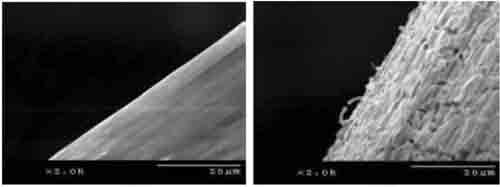 |
| Tin Whiskers with Short-Stop and without Short-Stop (20 µm) |
Abstract:
Hybrid Plastics under sponsorship from The National Science Foundation, Electronics Division, has reached a milestone by producing the first conformal coating capable of suppressing tin whiskers. Lead-free electronics are ubiquitous. Consequently, so is the potential of electronic short circuits from conductive tin whiskers which grow from lead-free solder joints and interconnects.
Hybrid Plastics Achieves a Milestone with Nanoscopic Materials for Suppression of Tin Whiskers from Lead-free Solders
Hattiesburg, MS: | Posted on September 23rd, 2008The POSS® Short-Stop is optically transparent, colorless and available as a sprayable coating for application to OEM and repair of electronic circuits. The new materials were developed under a Small Business Innovation Research (SBIR) contract between Hybrid Plastics Inc., subcontractor Michigan State University and collaborator Vista Engineering. The effort was focused on solving a well-recognized problem of lead-free solders - the growth of conductive tin-whiskers.
Depending on the spacing of interconnects and environmental stress, conductive tin whiskers may grow long enough to create short circuits that cause electronic systems to malfunction or become permanently damaged. The solution was enabled through incorporation of mercapto functionalized Polyhedral Oligomeric Silsesquioxane (POSS) nanocages into polyimide coatings. The mercapto groups bind to the metal surface, protonate through the metal oxide layer and bind to the underlying tin atoms thereby mitigating compressive stress and nucleation of whisker growth. In the event that tin whiskers do grow, a tough high modulus polyimide surface coating is also utilized to force collapse of the whisker and thereby physically isolate whiskers against short-circuiting or detachment.
POSS® [Polyhedral Oligomeric Silsesquioxanes] is a revolutionary new Nanotechnology based on silicon-derived building blocks that provide nanometer-scale control to dramatically improve the thermal and mechanical properties of traditional polymers while offering easy incorporation using existing manufacturing protocols. These compounds have an average diameter of just 1.5 nanometers, or billionth of a meter. POSS® nanomaterials can be used both as direct replacements for hydrocarbon based materials or as low-density performance additives to traditional plastics. They release no VOCs, and, thereby, produce no odor or air pollution. They are biocompatible, recyclable, non-flammable, and competitively priced with traditional polymer feedstocks. POSS® Nanostructured® materials can be readily incorporated into virtually any existing polymer system through blending, grafting or copolymerization.
POSS® nanoscopic chemical technology provides unique opportunities to create revolutionary material combinations through melding the desirable properties of ceramics and polymers at the 1 nm level. These new materials will enable the circumvention of classic material performance trade-offs by accessing new properties and exploiting the synergy between materials that only occur when the length-scale of morphology and the fundamental physics associated with a property coincide on the nanoscale. These POSS® nanobuilding-blocks were hailed by R&D magazine as one of the 100 globally most technologically significant new products for the year 2000. Hybrid Plastics was one of five finalists in Small Times Magazine's 2002 Best of Small Tech Award. In December 2005, a Presidential Determination deemed POSS® Nanotechnology to be in the strategic national interest of the United States.
####
About Hybrid Plastics
Polyhedral Oligomeric Silsesquioxane®
Ten years ago, we pioneered the development of an entirely new chemical technology for plastics. This technology bridges the property space between hydrocarbon-based plastics and ceramics. It imparts new or improved properties to materials through the controlled reinforcement of polymer chains at the molecular level (nanoscale). This technology is leading the way to the next generation of plastics.
The products and information you find here are just the beginning. We have expertise in chemical deritivization, custom compounding, and custom formulations. We offer full technical support for selection and cost-effective incorperation of POSS® technology into your products.
For more information, please click here
Contacts:
Carl Hagstrom
Chief Operating Officer
Hybrid Plastics, Inc.
55 W. L. Runnels Industrial Drive
Hattiesburg, MS 39401
Tel: 601.544.3466
Fax: 601.545.3103
Copyright © Hybrid Plastics
If you have a comment, please Contact us.Issuers of news releases, not 7th Wave, Inc. or Nanotechnology Now, are solely responsible for the accuracy of the content.
Bookmark:


| Related News Press |
News and information
 Simulating magnetization in a Heisenberg quantum spin chain April 5th, 2024
NRL charters Navy’s quantum inertial navigation path to reduce drift April 5th, 2024
Discovery points path to flash-like memory for storing qubits: Rice find could hasten development of nonvolatile quantum memory April 5th, 2024
Govt.-Legislation/Regulation/Funding/Policy
NRL charters Navy’s quantum inertial navigation path to reduce drift April 5th, 2024
Discovery points path to flash-like memory for storing qubits: Rice find could hasten development of nonvolatile quantum memory April 5th, 2024
Chemical reactions can scramble quantum information as well as black holes April 5th, 2024
Chip Technology
Discovery points path to flash-like memory for storing qubits: Rice find could hasten development of nonvolatile quantum memory April 5th, 2024
Utilizing palladium for addressing contact issues of buried oxide thin film transistors April 5th, 2024
HKUST researchers develop new integration technique for efficient coupling of III-V and silicon February 16th, 2024
Nanoelectronics
Interdisciplinary: Rice team tackles the future of semiconductors Multiferroics could be the key to ultralow-energy computing October 6th, 2023
Key element for a scalable quantum computer: Physicists from Forschungszentrum Jülich and RWTH Aachen University demonstrate electron transport on a quantum chip September 23rd, 2022
Reduced power consumption in semiconductor devices September 23rd, 2022
Atomic level deposition to extend Moore’s law and beyond July 15th, 2022
Announcements
NRL charters Navy’s quantum inertial navigation path to reduce drift April 5th, 2024
Discovery points path to flash-like memory for storing qubits: Rice find could hasten development of nonvolatile quantum memory April 5th, 2024
 |
||
 |
||
| The latest news from around the world, FREE | ||
 |
||
|
|
||
| Premium Products | ||
 |
||
|
Only the news you want to read!
Learn More |
||
 |
||
|
Full-service, expert consulting
Learn More |
||
|
|
||