Home > Press > Nanotomography: Crystal clear
 |
Abstract:
X-rays from a synchrotron can produce incredible high-resolution three-dimensional images of nanoscale crystal structures
Researchers have combined medical imaging equipment with radiation from a particle accelerator to produce a powerful new method for three-dimensional (3D) imaging. The technique, developed by YU Shuhong, TIAN Yangchao and co-workers at the University of Science and Technology of China in Hefei,CAS, has already produced remarkable 3D renderings of a copper sulphide crystal, and could find many applications in materials development and the life sciences.
Nanotomography: Crystal clear
China | Posted on August 29th, 2008 Electron microscopes can provide detailed two-dimensional information on functional nanostructures, but are limited in applications involving complex 3D shapes. On the other hand, X-rays can penetrate to great depths and are used in medical computed-tomography scans to take images in slices that are then compiled to render a 3D image.
Yu, Tian and co-workers used the beamline from the National Synchrotron Radiation Laboratory in Hefei to provide a very powerful X-ray flux. The beam was carefully manipulated to make 3D images of a recently discovered type of copper sulphide crystal.
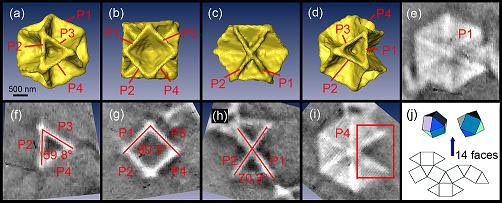
The images show that the crystal is made up of four hexagonal plates about 200 nanometres thick (pictured). Together they form a cuboctahedron - a polyhedron with six square and eight triangular faces.
The image details indicate that the X-ray technique is useful to image nanomaterials with complex structures. (adapted from Nature China)
####
About Chinese Academy of Sciences
CAS strives to build itself into a scientific research base at advanced international level, a base for fostering and bringing up advanced S&T talents, and a base for promoting the development of China's high and new technology industries. By 2010, CAS will have about 80 national institutes noted for their powerful capacities in S&T innovation and sustainable development or with distinctive features; thirty of them will become internationally acknowledged, high-level research institutions, and three to five will be world class.
For more information, please click here
Contacts:
Chinese Academy of Sciences
Add: 52 Sanlihe Rd., Beijing China
Postcode: 100864
Tel: 86 10 68597289
Fax: 86 10 68512458
Chief-Editor's Information:
Guo Haiyan
Editor
Bulletin of Chinese Academy of Sciences
CAS Institute of Policy & Management
P.O.Box 8712, Beijing 100080, China.
Copyright © Chinese Academy of Sciences
If you have a comment, please Contact us.Issuers of news releases, not 7th Wave, Inc. or Nanotechnology Now, are solely responsible for the accuracy of the content.
Bookmark:


| Related News Press |
News and information
 Simulating magnetization in a Heisenberg quantum spin chain April 5th, 2024
NRL charters Navy’s quantum inertial navigation path to reduce drift April 5th, 2024
Discovery points path to flash-like memory for storing qubits: Rice find could hasten development of nonvolatile quantum memory April 5th, 2024
Imaging
Nanoscale CL thermometry with lanthanide-doped heavy-metal oxide in TEM March 8th, 2024
The USTC realizes In situ electron paramagnetic resonance spectroscopy using single nanodiamond sensors November 3rd, 2023
Observation of left and right at nanoscale with optical force October 6th, 2023
Discoveries
Chemical reactions can scramble quantum information as well as black holes April 5th, 2024
New micromaterial releases nanoparticles that selectively destroy cancer cells April 5th, 2024
Utilizing palladium for addressing contact issues of buried oxide thin film transistors April 5th, 2024
Announcements
NRL charters Navy’s quantum inertial navigation path to reduce drift April 5th, 2024
Discovery points path to flash-like memory for storing qubits: Rice find could hasten development of nonvolatile quantum memory April 5th, 2024
 |
||
 |
||
| The latest news from around the world, FREE | ||
 |
||
|
|
||
| Premium Products | ||
 |
||
|
Only the news you want to read!
Learn More |
||
 |
||
|
Full-service, expert consulting
Learn More |
||
|
|
||