Home > Press > Learn About ‘NIST and Nanosoccer’ from New Web Site and Video
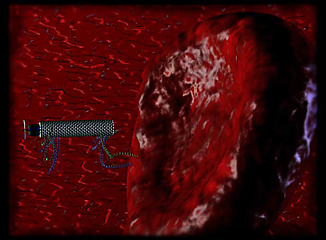 |
| From the video “Bend It Like NIST”, artist rendition of a tiny robot approaching a malfunctioning red blood cell in order to destroy it. NIST-organized soccer competitions for microbots provide a venue for testing agility, maneuverability, response to computer control and the ability to move objects—all skills that future miniaturized “surgeons” will need.
Still Credit: Constantinos Mavroidis, BionanoRobotics Laboratory, Northeastern University |
Abstract:
If you love soccer but don't want to wait until the next World Cup in 2010 to satisfy your appetite for the most popular game on Earth, the National Institute of Standards and Technology (NIST) has the answer—though the nourishment comes in very small bites.
Learn About ‘NIST and Nanosoccer’ from New Web Site and Video
GAITHERSBURG, MD | Posted on May 29th, 2008Nanosoccer—the Lilliputian competition where computer-driven "nanobots" the size of dust mites challenge one another on fields no bigger than a grain of rice—will celebrate its first birthday this summer, and NIST is marking the anniversary with a new Web site at www.nist.gov/public_affairs/calmed/nanosoccer.html. Highlighting the site is a link to the recently produced video, "Bend It Like NIST: Tiny Soccer Players Pave Way for Microbots," a 2-minute program that demonstrates how nanosoccer "road tests" agility, maneuverability, response to computer control and the ability to move objects—all skills that future miniaturized robot workers will need for tasks such as microsurgery within the human body or the manufacturing of atom-sized components for microscopic electronic devices.
The soccer nanobots are operated by remote control under an optical microscope. They move in response to changing magnetic fields or electrical signals transmitted across the microchip arena. Although the bots are a few tens of micrometers to a few hundred micrometers long, they are considered "nanoscale" because their masses range from a few nanograms to a few hundred nanograms. They are manufactured from materials such as aluminum, nickel, gold, silicon and chromium.
The new "NIST and Nanosoccer" Web site features summaries of the first two events in nanosoccer history: the July 2007 debut demonstration and competition at the international RoboCup in Atlanta, Ga., and the just-concluded demonstration at the RoboCup U.S. Open in Pittsburgh, Pa.
NIST jointly organized these "Nanogram League" events with RoboCup, an international organization dedicated to fostering innovations and advances in artificial intelligence and intelligent robotics by using the game of soccer as a testing ground. NIST's goal in coordinating competitions between the world's smallest robots is to show the feasibility and accessibility of technologies for fabricating MicroElectroMechanical Systems (MEMS), tiny mechanical devices built onto semiconductor chips and measured in micrometers (millionth of a meter).
Next up on the nanosoccer schedule is the first official Nanogram League competition for soccer nanobots at the July 2009 international RoboCup event in Austria. Academic institutions interested in organizing nanosoccer teams for the contest should contact Craig McGray, , (301) 975-4110.
####
About NIST
From automated teller machines and atomic clocks to mammograms and semiconductors, innumerable products and services rely in some way on technology, measurement, and standards provided by the National Institute of Standards and Technology.
Founded in 1901, NIST is a non-regulatory federal agency within the U.S. Department of Commerce. NIST's mission is to promote U.S. innovation and industrial competitiveness by advancing measurement science, standards, and technology in ways that enhance economic security and improve our quality of life.
For more information, please click here
Contacts:
Michael E. Newman
(301) 975-3025
Copyright © NIST
If you have a comment, please Contact us.Issuers of news releases, not 7th Wave, Inc. or Nanotechnology Now, are solely responsible for the accuracy of the content.
Bookmark:


| Related Links |
| Related News Press |
News and information
 Decoding hydrogen‑bond network of electrolyte for cryogenic durable aqueous zinc‑ion batteries January 30th, 2026
COF scaffold membrane with gate‑lane nanostructure for efficient Li+/Mg2+ separation January 30th, 2026
Videos/Movies
ICFO researchers overcome long-standing bottleneck in single photon detection with twisted 2D materials August 8th, 2025
New X-ray imaging technique to study the transient phases of quantum materials December 29th, 2022
Solvent study solves solar cell durability puzzle: Rice-led project could make perovskite cells ready for prime time September 23rd, 2022
Scientists prepare for the world’s smallest race: Nanocar Race II March 18th, 2022
Announcements
Decoding hydrogen‑bond network of electrolyte for cryogenic durable aqueous zinc‑ion batteries January 30th, 2026
COF scaffold membrane with gate‑lane nanostructure for efficient Li+/Mg2+ separation January 30th, 2026
Human Interest/Art
New 2D multifractal tools delve into Pollock's expressionism January 17th, 2025
Drawing data in nanometer scale September 30th, 2022
Scientists prepare for the world’s smallest race: Nanocar Race II March 18th, 2022
Graphene nanotubes revolutionize touch screen use for prosthetic hands August 3rd, 2021
 |
||
 |
||
| The latest news from around the world, FREE | ||
 |
||
|
|
||
| Premium Products | ||
 |
||
|
Only the news you want to read!
Learn More |
||
 |
||
|
Full-service, expert consulting
Learn More |
||
|
|
||