Home > Press > Femtogram-level chemical measurements now possible, U. of I. team reports
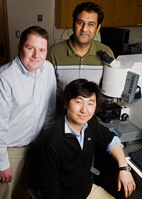 |
| William King, professor of mechanical science and engineering, left; Rohit Bhargava, professor of bioengineering; and Keunhan Park, postdoctoral research associate, have demonstrated a method for simultaneous structural and chemical characterization of samples at the femtogram level (a femtogram is one quadrillionth of a gram) and below. |
Abstract:
Finding a simple and convenient technique that combines nanoscale structural measurements and chemical identification has been an elusive goal. With current analytical instruments, spatial resolution is too low, signal-to-noise ratio too poor, sample preparation too complex or sample size too large to be of good service.
Femtogram-level chemical measurements now possible, U. of I. team reports
CHAMPAIGN, IL | Posted on March 27th, 2008 Now, researchers at the University of Illinois have demonstrated a method for simultaneous structural and chemical characterization of samples at the femtogram level (a femtogram is one quadrillionth of a gram) and below.
The measurement technique combines the extraordinary resolution of atomic force microscopy and the excellent chemical identification of infrared spectroscopy.
"We demonstrated that imaging, extraction and chemical analysis of femtogram samples can be achieved using a heated cantilever probe in an atomic force microscope," said William P. King, a Kritzer Faculty Scholar and professor of mechanical science and engineering.
King and colleagues describe the technique in a paper accepted for publication in the journal Analytical Chemistry, and posted on its Web site.
The new technique hinges upon a special silicon cantilever probe with an integrated heater-thermometer. The cantilever tip temperature can be precisely controlled over a temperature range of 25 to 1,000 degrees Celsius.
Using the cantilever probe, researchers can selectively image and extract a very small sample of the material to be analyzed. The mass of the sample can be determined by a cantilever resonance technique.
To analyze the sample, the heater temperature is raised to slightly above the melting point of the sample material. The material is then analyzed by complementary Raman or Fourier transform infrared spectroscopic imaging, which provides a molecular characterization of samples down to femtogram level in minutes.
"Fourier transform infrared and Raman spectroscopic imaging have become commonplace in the last five to ten years," said Rohit Bhargava, a professor of bioengineering. "Our method combines atomic force microscopy with spectroscopic imaging to provide data that can be rapidly used for spectral analyses for exceptionally small sample sizes."
To clean the tip for reuse, the tip is heated to well above the decomposition temperature of the sample - a technique similar to that used in self-cleaning ovens.
"Since the tip can be heated to 1,000 degrees Celsius, most organic materials can be readily vaporized and removed in this manner," King said.
As a demonstration of the technique, the researchers scanned a piece of paraffin with their probe, and removed a sample for analysis. They then used Raman and Fourier transform infrared spectroscopy to chemically analyze the sample. After analysis, the paraffin was removed by thermal decomposition, allowing reuse of the probe.
"We anticipate this approach will help bridge the gap between nanoscale structural analysis and conventional molecular spectroscopy," King said, "and in a manner widely useful to most analytical laboratories."
With King and Bhargava, co-authors of the paper are postdoctoral researcher and lead author Keunhan Park and postdoctoral research associate Jung Chul Lee. All four researchers are affiliated with the university's Beckman Institute.
The work was funded by the National Science Foundation through the Center for Nanoscale Chemical-Electrical-Mechanical Manufacturing Systems, and by the U. of I.
####
About University of Illinois
At Illinois, research shapes the campus identity, stimulates classroom instruction and serves as a springboard for public engagement activities throughout the world. Opportunities abound for graduate students to develop independent projects and launch their own careers as researchers while working alongside faculty and assisting in their research. Illinois continues its long tradition of groundbreaking accomplishments with remarkable new discoveries and achievements that inspire and enrich the lives of people around the world.
For more information, please click here
Contacts:
James E. Kloeppel
Physical Sciences Editor
217-244-1073
William King
217-244-3864
Copyright © University of Illinois
If you have a comment, please Contact us.Issuers of news releases, not 7th Wave, Inc. or Nanotechnology Now, are solely responsible for the accuracy of the content.
Bookmark:


| Related News Press |
News and information
 Simulating magnetization in a Heisenberg quantum spin chain April 5th, 2024
NRL charters Navy’s quantum inertial navigation path to reduce drift April 5th, 2024
Discovery points path to flash-like memory for storing qubits: Rice find could hasten development of nonvolatile quantum memory April 5th, 2024
Imaging
Nanoscale CL thermometry with lanthanide-doped heavy-metal oxide in TEM March 8th, 2024
The USTC realizes In situ electron paramagnetic resonance spectroscopy using single nanodiamond sensors November 3rd, 2023
Observation of left and right at nanoscale with optical force October 6th, 2023
Discoveries
Chemical reactions can scramble quantum information as well as black holes April 5th, 2024
New micromaterial releases nanoparticles that selectively destroy cancer cells April 5th, 2024
Utilizing palladium for addressing contact issues of buried oxide thin film transistors April 5th, 2024
Announcements
NRL charters Navy’s quantum inertial navigation path to reduce drift April 5th, 2024
Discovery points path to flash-like memory for storing qubits: Rice find could hasten development of nonvolatile quantum memory April 5th, 2024
Tools
Ferroelectrically modulate the Fermi level of graphene oxide to enhance SERS response November 3rd, 2023
The USTC realizes In situ electron paramagnetic resonance spectroscopy using single nanodiamond sensors November 3rd, 2023
 |
||
 |
||
| The latest news from around the world, FREE | ||
 |
||
|
|
||
| Premium Products | ||
 |
||
|
Only the news you want to read!
Learn More |
||
 |
||
|
Full-service, expert consulting
Learn More |
||
|
|
||