Home > Press > Berkeley Nanotechnology Pioneer to Receive $500,000 Waterman Award
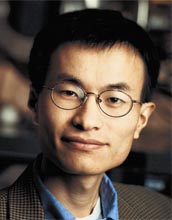 |
| Chemist Peidong Yang, of the University of California, Berkeley, is the 2007 winner of the National Science Foundation's Alan T. Waterman Award. Credit: Peidong Yang, University of California, Berkeley |
Abstract:
Annual prize from NSF recognizes outstanding young individual who is revolutionizing research
Berkeley Nanotechnology Pioneer to Receive $500,000 Waterman Award
Berkeley, CA | Posted on May 14th, 2007The National Science Foundation (NSF) has chosen Peidong Yang, a chemist at the University of California, Berkeley, to receive the 2007 Alan T. Waterman Award. A nanotechnology expert, Yang has pioneered research on nanowires, strings of atoms that show promise for a range of high-technology devices, from tiny lasers and computer circuits to inexpensive solar panels and biological sensors.
The annual Waterman award recognizes an outstanding young researcher in any field of science or engineering supported by NSF. Candidates may not be more than 35 years old, or 7 years beyond receiving a doctorate and must stand out for their individual achievements. In addition to a medal, the awardee receives a grant of $500,000 over a 3-year period for scientific research or advanced study in their field.
"Not only did Yang develop powerful methods to synthesize 1-dimensional semiconductor nanostructures, he continues to demonstrate such creative energy when exploring fundamental physical and chemical principles, such as the basic science needed to transform developments in fields ranging from sensors and molecular computers to biotechnology," said David Nelson, director of NSF's Solid-State Chemistry Program and one of the officers who has supported Yang's research.
In a relatively short time, Yang has created one of the nation's leading laboratories for the study of nanowires. Like nanotubes, nanowires are filaments only molecules wide with nearly miraculous properties, yet nanowires lack a hollow core and are proving generally easier to create and manipulate. Yang's research team has developed novel, efficient ways to create particularly sophisticated nanowires and complex nanowire arrays.
"As we were dealing with a new class of nanostructure, naturally there were many fundamental questions and challenges that needed to be addressed," said Yang. "For example, how could we make them in a controlled manner? Do they have interesting chemical and physical properties? We are lucky that we are among the first few groups who started to address and answer some of these interesting questions."
By controlling the self-assembly of the wires and their orientation, Yang and his colleagues have created devices such as a wire only a hundred nanometers (billionths of a meter) wide that fires ultraviolet laser light; a patchwork of oriented nanowires that shows promise for shrinking the next generation of computer chips; and a nanowire array that has properties akin to solar panels but could potentially cost far less and is manufactured using an environmentally friendly process.
"Nanowires represent a rich family of functional materials," said Yang. "It is now possible to design and synthesize nanowires with quite complex structures based on progress made in the past couple of years. This type of control in nanostructural engineering has generated a rich collection of fascinating properties and functionalities, including nanoscale lasers, nanowire-based transistors, sensors and solar cells. These nanowire materials will have a particularly significant impact in areas such as energy conversion and solid state lighting."
Peidong Yang was born and raised in the Chinese city of Suzhou, leaving to study chemistry at the University of science and Technology of China in Hefei in 1988. Earning his Ph.D. degeree from Harvard in 1997, Yang then traveled to UC, Santa Barbara in 1997, and arrived at UC-Berkeley in 1999. In a short time, Yang has established himself as a rising star, publishing widely and receiving such awards as the NSF Young Investigator Award, the Alfred P. Sloan research fellowship, the Arnold and Mabel Beckman Young Investigator Award, the MRS Young Investigator Award, the Julius Springer Prize for Applied Physics, and the American Chemical Society's Pure Chemistry Award.
Following the award ceremony at the U.S. State Department on May 14th, NSF will host Yang and a distinguished panel on May 15th in a teleconference for journalists on emerging nanotechnologies. The program will highlight laboratory developments poised to become marketable products in the future. Information is available in the On the Nano Horizon: Emerging Technologies media advisory.
In addition to his Waterman award, Yang has received support from NSF through grants 0352750 and 0092086 and as co-principal investigator for the NSF Center Of Integrated Nanomechanical Systems Nanoscale Science and Engineering Center.
-NSF-
Peidong Yang
Department of Chemistry
Department of Materials Science and Engineering
University of California, Berkeley
(510) 643-1545
http://www.cchem.berkeley.edu/~pdygrp/main.html
Peidong Yang received a B.S. in chemistry from the University of Science and Technology of China in 1993 and a Ph.D. in chemistry from Harvard University in 1997. Following postdoctoral research at the University of California, Santa Barbara, Yang joined the faculty in the department of Chemistry at the University of California, Berkeley in 1999. Currently associate professor in the Department of Chemistry, Materials Science and Engineering, he is also the deputy director for the Center of Integrated Nanomechanical Systems. Yang also serves as an associate editor for the Journal of the American Chemical Society (ACS). In addition to the 2007 NSF Waterman Award, Yang has received the NSF Young Investigator Award, the Alfred P. Sloan research fellowship, the Arnold and Mabel Beckman Young Investigator Award, the MRS Young Investigator Award, the Julius Springer Prize for Applied Physics, and the ACS Pure Chemistry Award. Yang's main research interests focus on one-dimensional semiconductor nanostructures and their applications in nanophotonics, nanoelectronics, energy conversion and nanofluidics.
####
About National Science Foundation
The National Science Foundation (NSF) is an independent federal agency that supports fundamental research and education across all fields of science and engineering, with an annual budget of $5.91 billion. NSF funds reach all 50 states through grants to nearly 1,700 universities and institutions. Each year, NSF receives about 40,000 competitive requests for funding, and makes nearly 10,000 new funding awards. The NSF also awards over $400 million in professional and service contracts yearly.
Receive official NSF news electronically through the e-mail delivery and notification system, MyNSF (formerly the Custom News Service). To subscribe, visit http://www.nsf.gov/mynsf/ and fill in the information under "new users".
For more information, please click here
Contacts:
Media Contacts
Joshua A. Chamot, NSF (703) 292-7730
Robert Sanders, University of California, Berkeley (510) 643-6998
Program Contacts
Jimmy Hsia, NSF (703) 292-7020
David L. Nelson, NSF (703) 292-4932
Mayra N. Montrose, NSF (703) 292-4757
Principal Investigators
Peidong Yang, University of California, Berkeley (510) 643-1545
Copyright © National Science Foundation
If you have a comment, please Contact us.Issuers of news releases, not 7th Wave, Inc. or Nanotechnology Now, are solely responsible for the accuracy of the content.
Bookmark:


| Related Links |
 Science and Engineering Statistics
| Related News Press |
Chip Technology
Discovery points path to flash-like memory for storing qubits: Rice find could hasten development of nonvolatile quantum memory April 5th, 2024
Utilizing palladium for addressing contact issues of buried oxide thin film transistors April 5th, 2024
HKUST researchers develop new integration technique for efficient coupling of III-V and silicon February 16th, 2024
Self Assembly
Liquid crystal templated chiral nanomaterials October 14th, 2022
Nanoclusters self-organize into centimeter-scale hierarchical assemblies April 22nd, 2022
Atom by atom: building precise smaller nanoparticles with templates March 4th, 2022
Nanostructures get complex with electron equivalents: Nanoparticles of two different sizes break away from symmetrical designs January 14th, 2022
Sensors
Nanoelectronics
Interdisciplinary: Rice team tackles the future of semiconductors Multiferroics could be the key to ultralow-energy computing October 6th, 2023
Key element for a scalable quantum computer: Physicists from Forschungszentrum Jülich and RWTH Aachen University demonstrate electron transport on a quantum chip September 23rd, 2022
Reduced power consumption in semiconductor devices September 23rd, 2022
Atomic level deposition to extend Moore’s law and beyond July 15th, 2022
Announcements
NRL charters Navy’s quantum inertial navigation path to reduce drift April 5th, 2024
Discovery points path to flash-like memory for storing qubits: Rice find could hasten development of nonvolatile quantum memory April 5th, 2024
Energy
Development of zinc oxide nanopagoda array photoelectrode: photoelectrochemical water-splitting hydrogen production January 12th, 2024
Shedding light on unique conduction mechanisms in a new type of perovskite oxide November 17th, 2023
Inverted perovskite solar cell breaks 25% efficiency record: Researchers improve cell efficiency using a combination of molecules to address different November 17th, 2023
The efficient perovskite cells with a structured anti-reflective layer – another step towards commercialization on a wider scale October 6th, 2023
Grants/Sponsored Research/Awards/Scholarships/Gifts/Contests/Honors/Records
Discovery points path to flash-like memory for storing qubits: Rice find could hasten development of nonvolatile quantum memory April 5th, 2024
Chemical reactions can scramble quantum information as well as black holes April 5th, 2024
Solar/Photovoltaic
Development of zinc oxide nanopagoda array photoelectrode: photoelectrochemical water-splitting hydrogen production January 12th, 2024
Shedding light on unique conduction mechanisms in a new type of perovskite oxide November 17th, 2023
Inverted perovskite solar cell breaks 25% efficiency record: Researchers improve cell efficiency using a combination of molecules to address different November 17th, 2023
Charged “molecular beasts” the basis for new compounds: Researchers at Leipzig University use “aggressive” fragments of molecular ions for chemical synthesis November 3rd, 2023
 |
||
 |
||
| The latest news from around the world, FREE | ||
 |
||
|
|
||
| Premium Products | ||
 |
||
|
Only the news you want to read!
Learn More |
||
 |
||
|
Full-service, expert consulting
Learn More |
||
|
|
||