Home > Press > Enhancing transverse thermoelectric conversion performance in magnetic materials with tilted structural design: A new approach to developing practical thermoelectric technologies
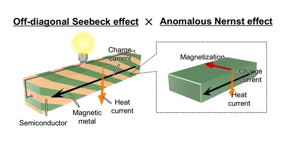 |
| Schematics of artificially tilted multilayer for transverse thermoelectric conversion developed in this research. Credit Takamasa Hirai, National Institute for Materials Science; Ken-ichi Uchida, National Institute for Materials Science |
Abstract:
1. A research team from NIMS and UTokyo has proposed and demonstrated that the transverse magneto-thermoelectric conversion in magnetic materials can be utilized with much higher performance than previously by developing artificial materials comprising alternately and obliquely stacked multilayers of a magnetic metal and semiconductor.
Enhancing transverse thermoelectric conversion performance in magnetic materials with tilted structural design: A new approach to developing practical thermoelectric technologies
Tokyo, Japan | Posted on December 13th, 20242. When a temperature gradient is applied to a magnetic conductor, a charge current is generated in a direction orthogonal to directions of both temperature gradient and magnetization of the magnetic conductor. This transverse magneto-thermoelectric phenomenon, known as the anomalous Nernst effect (ANE), has attracted considerable interest for potentially versatile, durable, and low-cost thermoelectric applications. Currently, the search for new magnetic materials focusing on topological natures of materials is being actively pursued with the aim of further improving the performance of ANE. Despite these efforts, no material has yet been identified with the performance of ANE at room temperature exceeding that of a cobalt-based topological magnet, i.e., Co2MnGa, reported in 2018, limiting further progress in this field. In addition, even this current record-high performance of Co2MnGa would have to be improved around more than 100 times for practical thermoelectric applications.
3. This research team recently developed an artificially tilted multilayer composed of alternating layers of a magnetic metal and semiconductor to simultaneously exhibit both the off-diagonal Seebeck effect (ODSE) and ANE (see Figure). Here, ODSE realizes the transverse thermoelectric conversion arising from tilted multilayer structures without the need for external magnetic fields or magnetization. The team demonstrated that the dimensionless figure of merit for ANE in the artificial material was improved by more than one order, compared to that of the same single magnetic metal alone, owing to the synergetic action of ANE and ODSE. These findings indicate that factors, such as certain physical parameters and structures, which have not been the focus of previous studies on ANE, are important for improving the performance of transverse thermoelectric conversion.
4. This research provides new guidelines for the design of new materials for transverse thermoelectric conversion materials based on structural design, as well as new ways of utilizing ANE, from a completely different perspective from the previous research. Based on these guidelines, the research team aims to develop artificial materials with high thermoelectric performance for practical applications such as power generation using waste heat and electronic cooling and heat sensing technologies.
***
5. This project was carried out by Takamasa Hirai (Researcher, Research Center for Magnetic and Spintronic Materials (CMSM), NIMS), Fuyuki Ando (Special Researcher, CMSM, NIMS), Hossein Sepehri-Amin (Group Leader, CMSM, NIMS) and Ken-ichi Uchida (Distinguished Group Leader, CMSM, NIMS; Professor, Department of Advanced Materials Science, Graduate School of Frontier Sciences, UTokyo).
This work was supported by ERATO “Uchida Magnetic Thermal Management Materials Project” from JST, Japan.
6. This research was published in Nature Communications, an open access journal, at 7:00 pm on November 14, 2024, Japan Time.
####
For more information, please click here
Contacts:
Media Contact
Yasufumi Nakamichi
National Institute for Materials Science, Japan
Office: 81-29-859-2105
Expert Contacts
Takamasa Hirai
National Institute for Materials Science
Ken-ichi Uchida
National Institute for Materials Science
Copyright © National Institute for Materials Science, Japan
If you have a comment, please Contact us.Issuers of news releases, not 7th Wave, Inc. or Nanotechnology Now, are solely responsible for the accuracy of the content.
Bookmark:


| Related Links |
| Related News Press |
News and information
 Researchers develop molecular qubits that communicate at telecom frequencies October 3rd, 2025
Next-generation quantum communication October 3rd, 2025
"Nanoreactor" cage uses visible light for catalytic and ultra-selective cross-cycloadditions October 3rd, 2025
Magnetism/Magnons
Researchers develop molecular qubits that communicate at telecom frequencies October 3rd, 2025
Possible Futures
Spinel-type sulfide semiconductors to operate the next-generation LEDs and solar cells For solar-cell absorbers and green-LED source October 3rd, 2025
Chip Technology
Lab to industry: InSe wafer-scale breakthrough for future electronics August 8th, 2025
A 1960s idea inspires NBI researchers to study hitherto inaccessible quantum states June 6th, 2025
Programmable electron-induced color router array May 14th, 2025
Materials/Metamaterials/Magnetoresistance
First real-time observation of two-dimensional melting process: Researchers at Mainz University unveil new insights into magnetic vortex structures August 8th, 2025
Researchers unveil a groundbreaking clay-based solution to capture carbon dioxide and combat climate change June 6th, 2025
A 1960s idea inspires NBI researchers to study hitherto inaccessible quantum states June 6th, 2025
Institute for Nanoscience hosts annual proposal planning meeting May 16th, 2025
Announcements
Rice membrane extracts lithium from brines with greater speed, less waste October 3rd, 2025
Researchers develop molecular qubits that communicate at telecom frequencies October 3rd, 2025
Next-generation quantum communication October 3rd, 2025
"Nanoreactor" cage uses visible light for catalytic and ultra-selective cross-cycloadditions October 3rd, 2025
Battery Technology/Capacitors/Generators/Piezoelectrics/Thermoelectrics/Energy storage
Rice membrane extracts lithium from brines with greater speed, less waste October 3rd, 2025
Sensors innovations for smart lithium-based batteries: advancements, opportunities, and potential challenges August 8th, 2025
Deciphering local microstrain-induced optimization of asymmetric Fe single atomic sites for efficient oxygen reduction August 8th, 2025
 |
||
 |
||
| The latest news from around the world, FREE | ||
 |
||
|
|
||
| Premium Products | ||
 |
||
|
Only the news you want to read!
Learn More |
||
 |
||
|
Full-service, expert consulting
Learn More |
||
|
|
||