Home > Press > Faster design -- better catalysts: New method facilitates research on fuel cell catalysts
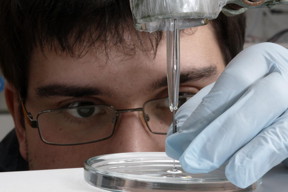 |
| Not the complete platinum surface is catalytically active, but only some especially exposed areas, so-called active centers. Measurement of a platinum electrode with a hanging meniscus configuration. CREDIT: Wenzel Schuermann, Technical University of Munich |
Abstract:
While the cleaning of car exhausts is among the best known applications of catalytic processes, it is only the tip of the iceberg. Practically the entire chemical industry relies on catalytic reactions. Therefore, catalyst design plays a key role in improving these processes. An international team of scientists has now developed a concept, that elegantly correlates geometric and adsorption properties. They validated their approach by designing a new platinum-based catalyst for fuel cell applications.
Faster design -- better catalysts: New method facilitates research on fuel cell catalysts
Muenchen, Germany | Posted on October 9th, 2015Hydrogen would be an ideal energy carrier: Surplus wind power could split water into its elements. The hydrogen could power fuel cell-driven electric cars with great efficiency. While the only exhaust would be water, the range could be as usual. But fuel cell vehicles are still a rare exception. The required platinum (Pt) is extremely expensive and the world's annual output would not suffice for all cars.
A key component of the fuel cell is the platinum catalyst that is used to reduce oxygen. It is well known that not the entire surface but only a few particularly exposed areas of the platinum, the so-called active centers, are catalytically active.
A team of scientists from the Technical University of Munich and the Ruhr University Bochum (Germany), the Ecole normale superieure (ENS) de Lyon, Centre national de la recherche scientifique (CNRS), Universite Claude Bernard Lyon 1 (France) and Leiden University (Netherlands) have set out to determine what constitutes an active center.
Studying the model
A common method used in developing catalysts and in modeling the processes that take place on their surfaces is computer simulation. But as the number of atoms increases, quantum chemical calculations quickly become extremely complex.
With their new methodology called "coordination-activity plots" the research team presents an alternative solution that elegantly correlates geometric and adsorption properties. It is based on the "generalized coordination number" (GCN), which counts the immediate neighbors of an atom and the coordination numbers of its neighbors.
Calculated with the new approach, a typical Pt (111) surface has a GCN value of 7.5. According to the coordination-activity plot, the optimal catalyst should, however, achieve a value of 8.3. The required larger number of neighbors can be obtained by inducing atomic-size cavities into the platinum surface, for example.
Successful practical test
In order to validate the accuracy of their new methodology, the researchers computationally designed a new type of platinum catalyst for fuel cell applications. The model catalysts were prepared experimentally using three different synthesis methods. In all three cases, the catalysts showed up to three and a half times greater catalytic activity.
"This work opens up an entirely new way for catalyst development: the design of materials based on geometric rationales which are more insightful than their energetic equivalents," says Federico Calle-Vallejo. "Another advantage of the method is that it is based clearly on one of the basic principles of chemistry: coordination numbers. This significantly facilitates the experimental implementation of computational designs."
"With this knowledge, we might be able to develop nanoparticles that contain significantly less platinum or even include other catalytically active metals," says Professor Aliaksandr S. Bandarenka, tenure track professor at Technical University of Munich. "And in future we might be able to extend our method to other catalysts and processes, as well."
###
The research was funded by the European Union's Fuel Cells and Hydrogen (FCH) Initiative, the Netherlands Organization for Scientific Research (NWO), the German Research Council (via SFB 749, the Cluster of Excellence Nanosystems Initiative Munich (NIM) and Ruhr Explores Solvation (RESOLV)) and the Helmholtz Energy Alliance.
Publication:
Finding optimal surface sites on heterogeneous catalysts by counting nearest neighbors, Federico Calle-Vallejo, Jakub Tymoczko, Viktor Colic, Quang Huy Vu, Marcus D. Pohl, Karina Morgenstern, David Loffreda, Philippe Sautet, Wolfgang Schuhmann, Aliaksandr S. Bandarenka. Science, october 9., 2015 - DOI : 10.1126/science.aab3501
####
For more information, please click here
Contacts:
Dr. Andreas Battenberg
49-892-891-0510
Copyright © Technische Universitaet Muenchen
If you have a comment, please Contact us.Issuers of news releases, not 7th Wave, Inc. or Nanotechnology Now, are solely responsible for the accuracy of the content.
Bookmark:


| Related News Press |
News and information
 Quantum computer improves AI predictions April 17th, 2026
Flexible sensor gains sensitivity under pressure April 17th, 2026
A reusable chip for particulate matter sensing April 17th, 2026
Detecting vibrational quantum beating in the predissociation dynamics of SF6 using time-resolved photoelectron spectroscopy April 17th, 2026
Chemistry
Projecting light to dispense liquids: A new route to ultra-precise microdroplets January 30th, 2026
From sensors to smart systems: the rise of AI-driven photonic noses January 30th, 2026
"Nanoreactor" cage uses visible light for catalytic and ultra-selective cross-cycloadditions October 3rd, 2025
Cambridge chemists discover simple way to build bigger molecules – one carbon at a time June 6th, 2025
Govt.-Legislation/Regulation/Funding/Policy
Quantum computer improves AI predictions April 17th, 2026
Metasurfaces smooth light to boost magnetic sensing precision January 30th, 2026
New imaging approach transforms study of bacterial biofilms August 8th, 2025
Possible Futures
A fundamentally new therapeutic approach to cystic fibrosis: Nanobody repairs cellular defect April 17th, 2026
UC Irvine physicists discover method to reverse ‘quantum scrambling’ : The work addresses the problem of information loss in quantum computing system April 17th, 2026
Announcements
A fundamentally new therapeutic approach to cystic fibrosis: Nanobody repairs cellular defect April 17th, 2026
UC Irvine physicists discover method to reverse ‘quantum scrambling’ : The work addresses the problem of information loss in quantum computing system April 17th, 2026
Interviews/Book Reviews/Essays/Reports/Podcasts/Journals/White papers/Posters
A fundamentally new therapeutic approach to cystic fibrosis: Nanobody repairs cellular defect April 17th, 2026
UC Irvine physicists discover method to reverse ‘quantum scrambling’ : The work addresses the problem of information loss in quantum computing system April 17th, 2026
Automotive/Transportation
Decoding hydrogen‑bond network of electrolyte for cryogenic durable aqueous zinc‑ion batteries January 30th, 2026
Sensors innovations for smart lithium-based batteries: advancements, opportunities, and potential challenges August 8th, 2025
Simple algorithm paired with standard imaging tool could predict failure in lithium metal batteries August 8th, 2025
Fuel Cells
Deciphering local microstrain-induced optimization of asymmetric Fe single atomic sites for efficient oxygen reduction August 8th, 2025
Current and Future Developments in Nanomaterials and Carbon Nanotubes: Applications of Nanomaterials in Energy Storage and Electronics October 28th, 2022
Grants/Sponsored Research/Awards/Scholarships/Gifts/Contests/Honors/Records
Quantum computer improves AI predictions April 17th, 2026
Detecting vibrational quantum beating in the predissociation dynamics of SF6 using time-resolved photoelectron spectroscopy April 17th, 2026
Metasurfaces smooth light to boost magnetic sensing precision January 30th, 2026
 |
||
 |
||
| The latest news from around the world, FREE | ||
 |
||
|
|
||
| Premium Products | ||
 |
||
|
Only the news you want to read!
Learn More |
||
 |
||
|
Full-service, expert consulting
Learn More |
||
|
|
||