Home > Press > Hitachi's advanced HT7700 120kV TEM becomes more powerful!
 |
Abstract:
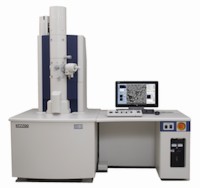
The introduction of the new objective lens option and a new STEM version makes Hitachi's HT7700 the most powerful 120 kV TEM currently available, as well as the most intuitive. Now the ground-breaking HT7700 is just as well suited to the low accelerating voltage, high resolution examination of engineered light element materials as the advanced biomedical and biological samples for which it is already known.
Hitachi's advanced HT7700 120kV TEM becomes more powerful!
Royston, UK | Posted on October 2nd, 2012The new high resolution pole piece option for the HT7700 utilises Hitachi's unique double-gap objective lens technology, together with minimised spherical aberration to provide enhanced resolution - the best in class for a 120 kV instrument. This makes it especially suited to high resolution imaging of light element materials where lower voltages provide improved contrast and reduced damage. Exceptional imaging is possible even at voltages as low as 40 kV.
The HT7700 continues to offer fully digital imaging, with a wide range of fully integrated and semi integrated CCD camera systems to ensure that the best camera is available for the application. A high sensitivity real-time digital CCD camera enables all microscope operations to be performed through the graphical user interface - including setup, alignment, image adjustment and image acquisition.
An optional high performance Scanning Transmission Electron Microscope (STEM) system further enhances the analytical capabilities of the HT7700. This integrates seamlessly with HT7700 operation and provides powerful brightfield and darkfield imaging. The high magnification and large Field-Of-View STEM is ideal for high-resolution lattice imaging, bulk crystal structure, and nanoparticle analysis. With an intuitive STEM GUI and automation capabilities, spatially resolved EDX, analytical imaging and thick section analysis are all made routine. All STEM images are instantly archived in Hitachi's EMIP database software.
####
For more information, please click here
Contacts:
Press Enquiries:
In Press Public Relations Ltd
PO Box 24
Royston, Herts, SG8 6TT
Tel: +44 1763 262621
www.inpress.co.uk
Other Enquiries:
Copyright © Hitachi High-Technologies
If you have a comment, please Contact us.Issuers of news releases, not 7th Wave, Inc. or Nanotechnology Now, are solely responsible for the accuracy of the content.
Bookmark:


| Related News Press |
News and information
 Quantum computer improves AI predictions April 17th, 2026
Flexible sensor gains sensitivity under pressure April 17th, 2026
A reusable chip for particulate matter sensing April 17th, 2026
Detecting vibrational quantum beating in the predissociation dynamics of SF6 using time-resolved photoelectron spectroscopy April 17th, 2026
Imaging
Simple algorithm paired with standard imaging tool could predict failure in lithium metal batteries August 8th, 2025
Software
Visualizing nanoscale structures in real time: Open-source software enables researchers to see materials in 3D while they're still on the electron microscope August 19th, 2022
Luisier wins SNSF Advanced Grant to develop simulation tools for nanoscale devices July 8th, 2022
Oxford Instruments’ Atomfab® system is production-qualified at a market-leading GaN power electronics device manufacturer December 17th, 2021
Announcements
A fundamentally new therapeutic approach to cystic fibrosis: Nanobody repairs cellular defect April 17th, 2026
UC Irvine physicists discover method to reverse ‘quantum scrambling’ : The work addresses the problem of information loss in quantum computing system April 17th, 2026
Tools
Metasurfaces smooth light to boost magnetic sensing precision January 30th, 2026
From sensors to smart systems: the rise of AI-driven photonic noses January 30th, 2026
Japan launches fully domestically produced quantum computer: Expo visitors to experience quantum computing firsthand August 8th, 2025
 |
||
 |
||
| The latest news from around the world, FREE | ||
 |
||
|
|
||
| Premium Products | ||
 |
||
|
Only the news you want to read!
Learn More |
||
 |
||
|
Full-service, expert consulting
Learn More |
||
|
|
||