Home > Press > Nanoparticles found in moon glass bubbles explain weird lunar soil behaviour
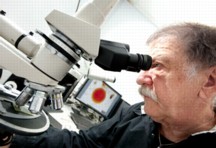 |
| Dr Marek Zbik |
Abstract:
A stunning discovery by QUT soil scientist Marek Zbik of nano particles inside bubbles of glass in lunar soil could solve the mystery of why the moon's surface topsoil has many unusual properties.
You can see what is inside the lunar bubble with 3D glasses.
Nanoparticles found in moon glass bubbles explain weird lunar soil behaviour
Brisbane, Australia | Posted on June 12th, 2012Dr Zbik, from Queensland University of Technology's Science and Engineering Faculty, said scientists had long observed the strange behaviour of lunar soil but had not taken much notice of the nano and submicron particles found in the soil and their source was unknown.
Dr Zbik took the lunar soil samples to Taiwan where he could study the glass bubbles without breaking them using a new technique for studying nano materials call synchrotron-based nano tomography to look at the particles. Nano tomography is a transmission X-ray microscope which enables 3D images of nano particles to be made.
"We were really surprised at what we found," Dr Zbik said.
"Instead of gas or vapour inside the bubbles, which we would expect to find in such bubbles on Earth, the lunar glass bubbles were filled with a highly porous network of alien-looking glassy particles that span the bubbles' interior.
"It appears that the nano particles are formed inside bubbles of molten rocks when meteorites hit the lunar surface. Then they are released when the glass bubbles are pulverised by the consequent bombardment of meteorites on the moon's surface.
"This continuous pulverising of rocks on the lunar surface and constant mixing develop a type of soil which is unknown on Earth."
Dr Zbik said nano particles behaved according to the laws of quantum physics which were completely different from so called 'normal' physics' laws. Because of this, materials containing nano particles behave strangely according to our current understanding.
"Nano particles are so tiny, it is their size and not what they are made of that accounts for their exceptional properties.
"We don't understand a lot about quantum physics yet but it could be that these nano particles, when liberated from their glass bubble, mix with the other soil constituents and give lunar soil its unusual properties.
"Lunar soil is electro-statically charged so it hovers above the surface; it is extremely chemically active; and it has low thermal conductivity eg it can be 160 degrees above the surface but -40 degrees two metres below the surface.
"It is also very sticky and brittle such that its particles wear the surface off metal and glass."
Dr Zbik said the moon had no atmosphere to cushion the impact of meteorites like Earth had.
"When they hit the moon there is a very violent reaction. Huge temperatures are generated which melts the rock. The pressure goes and a vacuum is created. Bubbles occur in the molten glass rock like soft drink bubbles trying to escape the bottle.
"Our work now is to understand how those particles evolve from this process. It may also lead us to completely different way of manufacturing nanomaterials."
Dr Zbik and his research team's study was published in the International Scholarly Research Network Astronomy and Astrophysics.
####
About Queensland University of Technology
Queensland University of Technology (QUT) is a highly successful Australian university with an applied emphasis in courses and research. Based in Brisbane with a global outlook, it has 40,000 students, including 6000 from overseas (QUT Statistics), and an annual budget of more than AU$500 million.
For more information, please click here
Contacts:
Niki Widdowson
QUT media officer
61 07 3138 2999
Copyright © Queensland University of Technology
If you have a comment, please Contact us.Issuers of news releases, not 7th Wave, Inc. or Nanotechnology Now, are solely responsible for the accuracy of the content.
Bookmark:


| Related News Press |
News and information
 Quantum computer improves AI predictions April 17th, 2026
Flexible sensor gains sensitivity under pressure April 17th, 2026
A reusable chip for particulate matter sensing April 17th, 2026
Detecting vibrational quantum beating in the predissociation dynamics of SF6 using time-resolved photoelectron spectroscopy April 17th, 2026
Videos/Movies
ICFO researchers overcome long-standing bottleneck in single photon detection with twisted 2D materials August 8th, 2025
New X-ray imaging technique to study the transient phases of quantum materials December 29th, 2022
Solvent study solves solar cell durability puzzle: Rice-led project could make perovskite cells ready for prime time September 23rd, 2022
Scientists prepare for the world’s smallest race: Nanocar Race II March 18th, 2022
Discoveries
Quantum computer improves AI predictions April 17th, 2026
Flexible sensor gains sensitivity under pressure April 17th, 2026
A reusable chip for particulate matter sensing April 17th, 2026
Detecting vibrational quantum beating in the predissociation dynamics of SF6 using time-resolved photoelectron spectroscopy April 17th, 2026
Announcements
A fundamentally new therapeutic approach to cystic fibrosis: Nanobody repairs cellular defect April 17th, 2026
UC Irvine physicists discover method to reverse ‘quantum scrambling’ : The work addresses the problem of information loss in quantum computing system April 17th, 2026
Aerospace/Space
Decoding hydrogen‑bond network of electrolyte for cryogenic durable aqueous zinc‑ion batteries January 30th, 2026
ICFO researchers overcome long-standing bottleneck in single photon detection with twisted 2D materials August 8th, 2025
Onion-like nanoparticles found in aircraft exhaust May 14th, 2025
 |
||
 |
||
| The latest news from around the world, FREE | ||
 |
||
|
|
||
| Premium Products | ||
 |
||
|
Only the news you want to read!
Learn More |
||
 |
||
|
Full-service, expert consulting
Learn More |
||
|
|
||