Home > Press > New Nanostructure for Batteries Keeps Going and Going ...
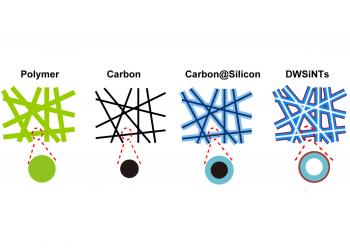 |
| The new double-walled silicon nanotube anode is made by a clever four-step process: Polymer nanofibers (green) are made, then heated (with, and then without, air) until they are reduced to carbon (Image courtesy Hui Wu, Stanford, and Yi Cui) |
Abstract:
For more than a decade, scientists have tried to improve lithium-based batteries by replacing the graphite in one terminal with silicon, which can store 10 times more charge. But after just a few charge/discharge cycles, the silicon structure would crack and crumble, rendering the battery useless.
New Nanostructure for Batteries Keeps Going and Going ...
Menlo Park, CA | Posted on May 10th, 2012Now a team led by materials scientist Yi Cui of Stanford and SLAC has found a solution: a cleverly designed double-walled nanostructure that lasts more than 6,000 cycles, far more than needed by electric vehicles or mobile electronics.
"This is a very exciting development toward our goal of creating smaller, lighter and longer-lasting batteries than are available today," Cui said. The results were published March 25 in Nature Nanotechnology.
Lithium-ion batteries are widely used to power devices from electric vehicles to portable electronics because they can store a relatively large amount of energy in a relatively lightweight package. The battery works by controlling the flow of lithium ions through a fluid electrolyte between its two terminals, called the anode and cathode.
The promise - and peril - of using silicon as the anode in these batteries comes from the way the lithium ions bond with the anode during the charging cycle. Up to four lithium ions bind to each of the atoms in a silicon anode - compared to just one for every six carbon atoms in today's graphite anode - which allows it to store much more charge.
However, it also swells the anode to as much as four times its initial volume. What's more, some of the electrolyte reacts with the silicon, coating it and inhibiting further charging. When lithium flows out of the anode during discharge, the anode shrinks back to its original size and the coating cracks, exposing fresh silicon to the electrolyte.
Within just a few cycles, the strain of expansion and contraction, combined with the electrolyte attack, destroys the anode through a process called "decrepitation."
Over the past five years, Cui's group has progressively improved the durability of silicon anodes by making them out of nanowires and then hollow silicon nanoparticles. His latest design consists of a double-walled silicon nanotube coated with a thin layer of silicon oxide, a very tough ceramic material.
This strong outer layer keeps the outside wall of the nanotube from expanding, so it stays intact. Instead, the silicon swells harmlessly into the hollow interior, which is also too small for electrolyte molecules to enter. After the first charging cycle, it operates for more than 6,000 cycles with 85 percent capacity remaining.
Cui said future research is aimed at simplifying the process for making the double-wall silicon nanotubes. Others in his group are developing new high-performance cathodes to combine with the new anode to form a battery with five times the performance of today's lithium-ion technology.
In 2008, Cui founded a company, Amprius, which licensed rights to Stanford's patents for his silicon nanowire anode technology. Its near-term goal is to produce a battery with double the energy density of today's lithium-ion batteries.
####
For more information, please click here
Copyright © SLAC National Accelerator Laboratory,
If you have a comment, please Contact us.Issuers of news releases, not 7th Wave, Inc. or Nanotechnology Now, are solely responsible for the accuracy of the content.
Bookmark:


| Related News Press |
News and information
 Quantum computer improves AI predictions April 17th, 2026
Flexible sensor gains sensitivity under pressure April 17th, 2026
A reusable chip for particulate matter sensing April 17th, 2026
Detecting vibrational quantum beating in the predissociation dynamics of SF6 using time-resolved photoelectron spectroscopy April 17th, 2026
Laboratories
Researchers develop molecular qubits that communicate at telecom frequencies October 3rd, 2025
A battery’s hopping ions remember where they’ve been: Seen in atomic detail, the seemingly smooth flow of ions through a battery’s electrolyte is surprisingly complicated February 16th, 2024
Govt.-Legislation/Regulation/Funding/Policy
Quantum computer improves AI predictions April 17th, 2026
Metasurfaces smooth light to boost magnetic sensing precision January 30th, 2026
New imaging approach transforms study of bacterial biofilms August 8th, 2025
Nanotubes/Buckyballs/Fullerenes/Nanorods/Nanostrings/Nanosheets
Tiny nanosheets, big leap: A new sensor detects ethanol at ultra-low levels January 30th, 2026
Enhancing power factor of p- and n-type single-walled carbon nanotubes April 25th, 2025
Chainmail-like material could be the future of armor: First 2D mechanically interlocked polymer exhibits exceptional flexibility and strength January 17th, 2025
Innovative biomimetic superhydrophobic coating combines repair and buffering properties for superior anti-erosion December 13th, 2024
Discoveries
Quantum computer improves AI predictions April 17th, 2026
Flexible sensor gains sensitivity under pressure April 17th, 2026
A reusable chip for particulate matter sensing April 17th, 2026
Detecting vibrational quantum beating in the predissociation dynamics of SF6 using time-resolved photoelectron spectroscopy April 17th, 2026
Announcements
A fundamentally new therapeutic approach to cystic fibrosis: Nanobody repairs cellular defect April 17th, 2026
UC Irvine physicists discover method to reverse ‘quantum scrambling’ : The work addresses the problem of information loss in quantum computing system April 17th, 2026
Patents/IP/Tech Transfer/Licensing
Getting drugs across the blood-brain barrier using nanoparticles March 3rd, 2023
Metasurfaces control polarized light at will: New research unlocks the hidden potential of metasurfaces August 13th, 2021
Arrowhead Pharmaceuticals Announces Closing of Agreement with Takeda November 27th, 2020
Energy
Sensors innovations for smart lithium-based batteries: advancements, opportunities, and potential challenges August 8th, 2025
Simple algorithm paired with standard imaging tool could predict failure in lithium metal batteries August 8th, 2025
Automotive/Transportation
Decoding hydrogen‑bond network of electrolyte for cryogenic durable aqueous zinc‑ion batteries January 30th, 2026
Sensors innovations for smart lithium-based batteries: advancements, opportunities, and potential challenges August 8th, 2025
Simple algorithm paired with standard imaging tool could predict failure in lithium metal batteries August 8th, 2025
Battery Technology/Capacitors/Generators/Piezoelectrics/Thermoelectrics/Energy storage
Decoding hydrogen‑bond network of electrolyte for cryogenic durable aqueous zinc‑ion batteries January 30th, 2026
COF scaffold membrane with gate‑lane nanostructure for efficient Li+/Mg2+ separation January 30th, 2026
MXene nanomaterials enter a new dimension Multilayer nanomaterial: MXene flakes created at Drexel University show new promise as 1D scrolls January 30th, 2026
 |
||
 |
||
| The latest news from around the world, FREE | ||
 |
||
|
|
||
| Premium Products | ||
 |
||
|
Only the news you want to read!
Learn More |
||
 |
||
|
Full-service, expert consulting
Learn More |
||
|
|
||