Home > Press > Prof Lauded for Groundbreaking Semiconductor Work: American Physical Society Award Recognizes Advances in Infrared Spectroscopy
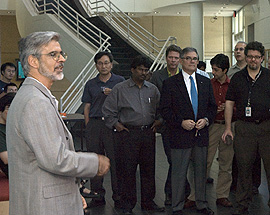 |
| Dr. Yves Chabal (left) is head of the Materials Science and Engineering Department in the Erik Jonsson School of Engineering and Computer Science at UT Dallas. |
Abstract:
The American Physical Society has awarded a UT Dallas researcher one of the society's highest honors, recognizing Dr. Yves Chabal's development of methods to better understand processes that take place on the silicon surface that is literally the platform for the multibillion-dollar semiconductor industry.
Prof Lauded for Groundbreaking Semiconductor Work: American Physical Society Award Recognizes Advances in Infrared Spectroscopy
Dallas, TX | Posted on October 19th, 2008"Yves's development of infrared spectroscopy in the 1980s to understand the processes that occur on silicon surfaces during semiconductor manufacturing changed how everyone in the semiconductor industry does their work," said Bruce Gnade, vice president for research at UT Dallas. "His work has had tremendous impact. In the world of infrared spectroscopy of semiconductor surfaces,Yves is the world's expert."
Dr. Chabal is head of the Materials Science and Engineering Department in the Erik Jonsson School of Engineering and Computer Science at UT Dallas and the first holder of the school's Texas Instruments Distinguished University Chair in Nanoelectronics.
The Davisson-Germer Prize is a biennial award given to recognize and encourage outstanding work in atomic or surface physics. Dr. Chabal was chosen as the 2009 recipient of the prize "for the individual development and collaborative application of fundamental surface infrared spectroscopy and quantum chemical methods to silicon surface reactions important in microelectronics," according to the society's official announcement.
Dr. Chabal and his co-recipient of the award, Krishnan Raghavachari of Indiana University, were colleagues at Bell Labs, where Dr. Chabal spent 22 years prior to joining Rutgers University in 2003. The State of Texas Emerging Technology Fund's Nanoelectronics Research Superiority Initiative was instrumental in bringing Dr. Chabal to UT Dallas from Rutgers earlier this year.
"Yves Chabal is a perfect example of the kind of outstanding researchers whom we are committed to attracting to UT Dallas as we advance toward becoming one of the nation's top research universities," said UT Dallas Provost Dr. Hobson Wildenthal. "This well-deserved honor is a tribute to Dr. Chabal's past work, but I think it is also a harbinger of the great things we will see emerge from his lab in the future."
####
About UT Dallas
With more than 2,600 students, nearly 100 faculty and over $27 million in research funding, the Erik Jonsson School of Engineering and Computer Science at UT Dallas is in the midst of a $300 million public-private initiative that includes the recent completion of a 192,000-square-foot interdisciplinary research building. Named after Texas Instruments co-founder J. Erik Jonsson, the school awards degrees in electrical engineering, computer science, telecommunications engineering, computer engineering, software engineering, and materials science and engineering.
For more information, please click here
Contacts:
David Moore
UT Dallas
(972) 883-4183
or
Office of Media Relations
UT Dallas
(972) 883-2155
Copyright © UT Dallas
If you have a comment, please Contact us.Issuers of news releases, not 7th Wave, Inc. or Nanotechnology Now, are solely responsible for the accuracy of the content.
Bookmark:


| Related News Press |
News and information
 Quantum computer improves AI predictions April 17th, 2026
Flexible sensor gains sensitivity under pressure April 17th, 2026
A reusable chip for particulate matter sensing April 17th, 2026
Detecting vibrational quantum beating in the predissociation dynamics of SF6 using time-resolved photoelectron spectroscopy April 17th, 2026
Academic/Education
Rice University launches Rice Synthetic Biology Institute to improve lives January 12th, 2024
Multi-institution, $4.6 million NSF grant to fund nanotechnology training September 9th, 2022
Chip Technology
A reusable chip for particulate matter sensing April 17th, 2026
Metasurfaces smooth light to boost magnetic sensing precision January 30th, 2026
Announcements
A fundamentally new therapeutic approach to cystic fibrosis: Nanobody repairs cellular defect April 17th, 2026
UC Irvine physicists discover method to reverse ‘quantum scrambling’ : The work addresses the problem of information loss in quantum computing system April 17th, 2026
Tools
Metasurfaces smooth light to boost magnetic sensing precision January 30th, 2026
From sensors to smart systems: the rise of AI-driven photonic noses January 30th, 2026
Japan launches fully domestically produced quantum computer: Expo visitors to experience quantum computing firsthand August 8th, 2025
Grants/Sponsored Research/Awards/Scholarships/Gifts/Contests/Honors/Records
Quantum computer improves AI predictions April 17th, 2026
Detecting vibrational quantum beating in the predissociation dynamics of SF6 using time-resolved photoelectron spectroscopy April 17th, 2026
Metasurfaces smooth light to boost magnetic sensing precision January 30th, 2026
 |
||
 |
||
| The latest news from around the world, FREE | ||
 |
||
|
|
||
| Premium Products | ||
 |
||
|
Only the news you want to read!
Learn More |
||
 |
||
|
Full-service, expert consulting
Learn More |
||
|
|
||