Home > Press > With a jolt, 'nanonails' go from repellant to wettable
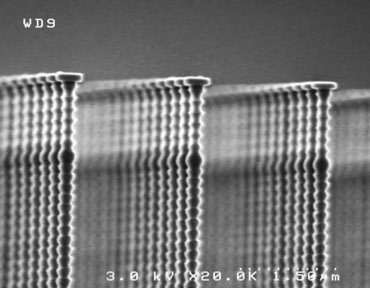 |
| Silicon "nanonails" created by Tom Krupenkin and J. Ashley Taylor of University of Wisconsin-Madison's Department of Mechanical Engineering, form the basis of a novel surface that repels virtually all liquids, including water, solvents, detergents and oils. When electrical current is applied, the liquids slip past the nail heads and between the shanks of the nails and wet the entire surface. The surface may have applications in biomedical devices such as "labs-on-a-chip" and in extending the life of batteries. Photo by: courtesy Tom Krupenkin |
Abstract:
Sculpting a surface composed of tightly packed nanostructures that resemble tiny nails, University of Wisconsin-Madison engineers and their colleagues from Bell Laboratories have created a material that can repel almost any liquid.
With a jolt, 'nanonails' go from repellant to wettable
Madison, WI | Posted on January 30th, 2008 Add a jolt of electricity, and the liquid on the surface slips past the heads of the nanonails and spreads out between their shanks, wetting the surface completely.
The new material, which was reported this month in Langmuir, a journal of the American Chemical Society, could find use in biomedical applications such as "lab-on-a- chip" technology, the manufacture of self-cleaning surfaces, and could help extend the working life of batteries as a way to turn them off when not in use.
UW-Madison mechanical engineers Tom Krupenkin and J. Ashley Taylor and their team etched a silicon wafer to create a forest of conductive silicon shanks and non-conducting silicon oxide heads. Intriguingly, the ability of the surface of the structure to repel water, oil, and solvents rests on the nanonail geometry.
"It turns out that what's important is not the chemistry of the surface, but the topography of the surface," Krupenkin explains, noting that the overhang of the nail head is what gives his novel surface its dual personality.
A surface of posts, he notes, creates a platform so rough at the nanoscale that "liquid only touches the surface at the extreme ends of the posts. It's almost like sitting on a layer of air."
####
For more information, please click here
Contacts:
Tom Krupenkin
(608) 890-1948
Copyright © University of Wisconsin-Madison
If you have a comment, please Contact us.Issuers of news releases, not 7th Wave, Inc. or Nanotechnology Now, are solely responsible for the accuracy of the content.
Bookmark:


| Related News Press |
News and information
 Quantum computer improves AI predictions April 17th, 2026
Flexible sensor gains sensitivity under pressure April 17th, 2026
A reusable chip for particulate matter sensing April 17th, 2026
Detecting vibrational quantum beating in the predissociation dynamics of SF6 using time-resolved photoelectron spectroscopy April 17th, 2026
Discoveries
Quantum computer improves AI predictions April 17th, 2026
Flexible sensor gains sensitivity under pressure April 17th, 2026
A reusable chip for particulate matter sensing April 17th, 2026
Detecting vibrational quantum beating in the predissociation dynamics of SF6 using time-resolved photoelectron spectroscopy April 17th, 2026
Announcements
A fundamentally new therapeutic approach to cystic fibrosis: Nanobody repairs cellular defect April 17th, 2026
UC Irvine physicists discover method to reverse ‘quantum scrambling’ : The work addresses the problem of information loss in quantum computing system April 17th, 2026
Battery Technology/Capacitors/Generators/Piezoelectrics/Thermoelectrics/Energy storage
Decoding hydrogen‑bond network of electrolyte for cryogenic durable aqueous zinc‑ion batteries January 30th, 2026
COF scaffold membrane with gate‑lane nanostructure for efficient Li+/Mg2+ separation January 30th, 2026
MXene nanomaterials enter a new dimension Multilayer nanomaterial: MXene flakes created at Drexel University show new promise as 1D scrolls January 30th, 2026
 |
||
 |
||
| The latest news from around the world, FREE | ||
 |
||
|
|
||
| Premium Products | ||
 |
||
|
Only the news you want to read!
Learn More |
||
 |
||
|
Full-service, expert consulting
Learn More |
||
|
|
||