Home > Press > Superconducting nanowire single-photon detectors: Next big thing in blood flow measurement: Novel detector system improves sensitivity for measurement of cerebral blood flow
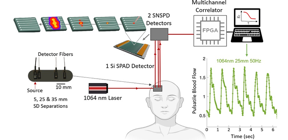 |
| In a new study, researchers from Massachusetts General Hospital developed a superconducting nanowire single photon detector (SNSPD)-based diffuse correlation spectroscopy (DCS) device with a high signal-to-noise ratio and high sensitivity for blood flow. This study marks one of the first-ever applications of SNSPDs in a biomedical setting. The figure shows the setup for blood flow measurement using SNSPD- and SPAD-based DCS devices. CREDIT Ozana et al., doi 10.1117/1.NPh.8.3.035006. |
Abstract:
In order to function properly, the brain requires a steady flow of blood through the cerebral arteries and veins, which deliver oxygen and nutrients and also remove metabolic byproducts. Therefore, cerebral blood flow is considered a vital and sensitive marker of cerebrovascular function. Optical methods offer a noninvasive approach for measuring cerebral blood flow. Diffuse correlation spectroscopy (DCS), a method gaining popularity, involves the illumination of tissues with near-infrared laser rays. The light is scattered by the movement of red blood cells and the resulting pattern formed is analyzed by a detector to determine blood flow.
Superconducting nanowire single-photon detectors: Next big thing in blood flow measurement: Novel detector system improves sensitivity for measurement of cerebral blood flow
Bellingham, WA | Posted on August 20th, 2021The ideal operating conditions for accurate measurement are: 1) large source–detector (SD) separation (>30 mm), 2) high acquisition rates, and 3) longer wavelengths (>1000 nm). However, current DCS devices—which use single-photon avalanche photodiode (SPAD) detectors—cannot attain that ideal. Due to high signal-to-noise ratio and low photon efficiency, they cannot allow an SD separation greater than 25 mm or wavelength greater than 900 nm.
To enable the operation of DCS devices under ideal conditions, researchers from Massachusetts General Hospital, Harvard Medical School, and MIT Lincoln Laboratory recently proposed the use of superconducting nanowire single-photon detectors (SNSPDs) in DCS devices.
SNSPDs, first demonstrated 20 years ago, consist of a thin film of superconducting material with excellent single-photon sensitivity and detection efficiency. Commonly used in telecommunications, optical quantum information, and space communications, SNSPDs are seldom used in biomedicine. SNSPDs outperform SPADs in multiple parameters, such as time resolution, photon efficiency, and range of wavelength sensitivity.
To demonstrate the operational superiority of the new SNSPD-DCS system, the researchers conducted cerebral blood flow measurements on 11 participants using both SNSPD-DCS and SPAD-DCS systems provided by Quantum Opus. The SNSPD-DCS system operated at a wavelength of 1064 nm with two SNSPD detectors, whereas the SPAD-DCS system operated at 850 nm.
The SNSPD-based DCS system showed significant improvement in SNR compared to the conventional SPAD-based DCS. This improvement was attributable to two factors. First, with illumination at 1064 nm, the SNSPD detectors received seven to eight times more photons than SPAD detectors at 850 nm did. Second, SNSPD has a higher photon detection efficiency (88 percent) than SPAD's photon detection efficiency of 58 percent. While the SPAD-DCS could only allow signal acquisition at 1 Hz at 25 mm SD separation owing to low SNR, the 16 times increase in SNR for the SNSPD-DCS system allowed signal acquisition at 20 Hz at the same SD separation allowing clear detection of arterial pulses.
As cerebral blood flow sensitivity increases substantially for measurements taken at larger SD separation, the researchers also performed measurements at 35 mm SD separation. The SNSPD-DCS system recorded a 31.6 percent relative increase in blood flow sensitivity. In contrast, the SPAD-DCS system could not be operated at 35 mm SD separation because of its low SNR.
Finally, the performance of the SNSPD-DCS system was validated by measurements taken during breath-holding and hyperventilation exercises. Theoretically, blood flow increases during the first 30 seconds of breath-holding and slowly returns to normal thereafter. During hyperventilation, blood flow to the scalp increases and blood flow to the brain decreases. SNSPD-DCS measurements showed an increase of 69 percent and a decrease of 18.5 percent in relative cerebral blood flow for breath-holding and hyperventilation, respectively. These measurements are in agreement with those obtained from PET and MRI studies.
The SNSPD-DCS system facilitates higher photon collection, larger SD separations, and higher acquisition rates, leading to better accuracy. Given these advantages, this novel system may allow for a noninvasive and more precise measurement of cerebral blood flow—an important marker of cerebrovascular function—for adult clinical applications.
####
For more information, please click here
Contacts:
Daneet Steffens
Office: 360-685-5478
Copyright © SPIE
If you have a comment, please Contact us.Issuers of news releases, not 7th Wave, Inc. or Nanotechnology Now, are solely responsible for the accuracy of the content.
Bookmark:


| Related Links |
| Related News Press |
News and information
 Quantum computer improves AI predictions April 17th, 2026
Flexible sensor gains sensitivity under pressure April 17th, 2026
A reusable chip for particulate matter sensing April 17th, 2026
Detecting vibrational quantum beating in the predissociation dynamics of SF6 using time-resolved photoelectron spectroscopy April 17th, 2026
Superconductivity
MXene nanomaterials enter a new dimension Multilayer nanomaterial: MXene flakes created at Drexel University show new promise as 1D scrolls January 30th, 2026
Possible Futures
A fundamentally new therapeutic approach to cystic fibrosis: Nanobody repairs cellular defect April 17th, 2026
UC Irvine physicists discover method to reverse ‘quantum scrambling’ : The work addresses the problem of information loss in quantum computing system April 17th, 2026
Nanomedicine
A fundamentally new therapeutic approach to cystic fibrosis: Nanobody repairs cellular defect April 17th, 2026
New molecular technology targets tumors and simultaneously silences two ‘undruggable’ cancer genes August 8th, 2025
New imaging approach transforms study of bacterial biofilms August 8th, 2025
Electrifying results shed light on graphene foam as a potential material for lab grown cartilage June 6th, 2025
Discoveries
Quantum computer improves AI predictions April 17th, 2026
Flexible sensor gains sensitivity under pressure April 17th, 2026
A reusable chip for particulate matter sensing April 17th, 2026
Detecting vibrational quantum beating in the predissociation dynamics of SF6 using time-resolved photoelectron spectroscopy April 17th, 2026
Announcements
A fundamentally new therapeutic approach to cystic fibrosis: Nanobody repairs cellular defect April 17th, 2026
UC Irvine physicists discover method to reverse ‘quantum scrambling’ : The work addresses the problem of information loss in quantum computing system April 17th, 2026
Interviews/Book Reviews/Essays/Reports/Podcasts/Journals/White papers/Posters
A fundamentally new therapeutic approach to cystic fibrosis: Nanobody repairs cellular defect April 17th, 2026
UC Irvine physicists discover method to reverse ‘quantum scrambling’ : The work addresses the problem of information loss in quantum computing system April 17th, 2026
Photonics/Optics/Lasers
Metasurfaces smooth light to boost magnetic sensing precision January 30th, 2026
From sensors to smart systems: the rise of AI-driven photonic noses January 30th, 2026
 |
||
 |
||
| The latest news from around the world, FREE | ||
 |
||
|
|
||
| Premium Products | ||
 |
||
|
Only the news you want to read!
Learn More |
||
 |
||
|
Full-service, expert consulting
Learn More |
||
|
|
||