Home > Press > Research breakthrough could be significant for quantum computing future: Irish-based scientists confirm crucial characteristic of new superconductor material
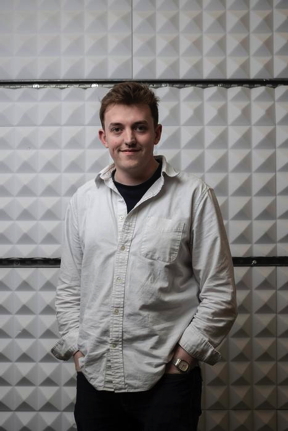 |
| Joe Carroll, a PhD researcher working with Prof. of Quantum Physics Séamus Davis at the Macroscopic Quantum Matter Group laboratory in University College Cork, lead author on a paper have discovered a spatially modulating superconducting state in a new and unusual superconductor Uranium Ditelluride (UTe2). CREDIT Clare Keogh/UCC |
Abstract:
Scientists using one of the world’s most powerful quantum microscopes have made a discovery that could have significant consequences for the future of computing.
Research breakthrough could be significant for quantum computing future: Irish-based scientists confirm crucial characteristic of new superconductor material
Cork, Ireland | Posted on June 30th, 2023Researchers at the Macroscopic Quantum Matter Group laboratory in University College Cork (UCC) have discovered a spatially modulating superconducting state in a new and unusual superconductor Uranium Ditelluride (UTe2). This new superconductor may provide a solution to one of quantum computing’s greatest challenges.
Their finding has been published in the prestigious journal Nature.
Lead author Joe Carroll, a PhD researcher working with UCC Prof. of Quantum Physics Séamus Davis, explains the subject of the paper.
“Superconductors are amazing materials which have many strange and unusual properties. Most famously they allow electricity to flow with zero resistance. That is, if you pass a current through them they don’t start to heat up, in fact, they don’t dissipate any energy despite carrying a huge current. They can do this because instead of individual electrons moving through the metal we have pairs of electrons which bind together. These pairs of electrons together form macroscopic quantum mechanical fluid.”
“What our team found was that some of the electron pairs form a new crystal structure embedded in this background fluid. These types of states were first discovered by our group in 2016 and are now called Electron Pair-Density Waves. These Pair Density Waves are a new form of superconducting matter the properties of which we are still discovering.”
“What is particularly exciting for us and the wider community is that UTe2 appears to be a new type of superconductor. Physicists have been searching for a material like it for nearly 40 years. The pairs of electrons appear to have intrinsic angular momentum. If this is true, then what we have detected is the first Pair-Density Wave composed of these exotic pairs of electrons.”
When asked about the practical implications of this work Mr. Carroll explained;
“There are indications that UTe2 is a special type of superconductor that could have huge consequences for quantum computing.”
“Typical, classical, computers use bits to store and manipulate information. Quantum computers rely on quantum bits or qubits to do the same. The problem facing existing quantum computers is that each qubit must be in a superposition with two different energies - just as Schrödinger’s cat could be called both ‘dead’ and ‘alive’. This quantum state is very easily destroyed by collapsing into the lowest energy state – ‘dead’ - thereby cutting off any useful computation.
“This places huge limits on the application of quantum computers. However, since its discovery five years ago there has been a huge amount of research on UTe2 with evidence pointing to it being a superconductor which may be used as a basis for topological quantum computing. In such materials there is no limit on the lifetime of the qubit during computation opening up many new ways for more stable and useful quantum computers. In fact, Microsoft have already invested billions of dollars into topological quantum computing so this is a well-established theoretical science already.” he said.
“What the community has been searching for is a relevant topological superconductor; UTe2 appears to be that.”
“What we’ve discovered then provides another piece to the puzzle of UTe2. To make applications using materials like this we must understand their fundamental superconducting properties. All of modern science moves step by step. We are delighted to have contributed to the understanding of a material which could bring us closer to much more practical quantum computers.”
Congratulating the research team at the Macroscopic Quantum Matter Group Laboratory in University College Cork, Professor John F. Cryan, Vice President Research and Innovation said:
“This important discovery will have significant consequences for the future of quantum computing. In the coming weeks, the University will launch UCC Futures - Future Quantum and Photonics and research led by Professor Seamus Davis and the Macroscopic Quantum Matter Group, with the use of one of the world's most powerful microscopes, will play a crucial role in this exciting initiative.”
####
For more information, please click here
Contacts:
Eoin Hahessy
University College Cork
Cell: 00353860468950
Copyright © University College Cork
If you have a comment, please Contact us.Issuers of news releases, not 7th Wave, Inc. or Nanotechnology Now, are solely responsible for the accuracy of the content.
Bookmark:


| Related Links |
| Related News Press |
News and information
 Quantum computer improves AI predictions April 17th, 2026
Flexible sensor gains sensitivity under pressure April 17th, 2026
A reusable chip for particulate matter sensing April 17th, 2026
Detecting vibrational quantum beating in the predissociation dynamics of SF6 using time-resolved photoelectron spectroscopy April 17th, 2026
Quantum Physics
Detecting vibrational quantum beating in the predissociation dynamics of SF6 using time-resolved photoelectron spectroscopy April 17th, 2026
Beyond silicon: Electronics at the scale of a single molecule January 30th, 2026
Superconductivity
Imaging
Possible Futures
A fundamentally new therapeutic approach to cystic fibrosis: Nanobody repairs cellular defect April 17th, 2026
UC Irvine physicists discover method to reverse ‘quantum scrambling’ : The work addresses the problem of information loss in quantum computing system April 17th, 2026
Chip Technology
A reusable chip for particulate matter sensing April 17th, 2026
Metasurfaces smooth light to boost magnetic sensing precision January 30th, 2026
Quantum Computing
Quantum computer improves AI predictions April 17th, 2026
UC Irvine physicists discover method to reverse ‘quantum scrambling’ : The work addresses the problem of information loss in quantum computing system April 17th, 2026
Researchers develop molecular qubits that communicate at telecom frequencies October 3rd, 2025
Discoveries
Quantum computer improves AI predictions April 17th, 2026
Flexible sensor gains sensitivity under pressure April 17th, 2026
A reusable chip for particulate matter sensing April 17th, 2026
Detecting vibrational quantum beating in the predissociation dynamics of SF6 using time-resolved photoelectron spectroscopy April 17th, 2026
Announcements
A fundamentally new therapeutic approach to cystic fibrosis: Nanobody repairs cellular defect April 17th, 2026
UC Irvine physicists discover method to reverse ‘quantum scrambling’ : The work addresses the problem of information loss in quantum computing system April 17th, 2026
Interviews/Book Reviews/Essays/Reports/Podcasts/Journals/White papers/Posters
A fundamentally new therapeutic approach to cystic fibrosis: Nanobody repairs cellular defect April 17th, 2026
UC Irvine physicists discover method to reverse ‘quantum scrambling’ : The work addresses the problem of information loss in quantum computing system April 17th, 2026
Tools
Metasurfaces smooth light to boost magnetic sensing precision January 30th, 2026
From sensors to smart systems: the rise of AI-driven photonic noses January 30th, 2026
Japan launches fully domestically produced quantum computer: Expo visitors to experience quantum computing firsthand August 8th, 2025
 |
||
 |
||
| The latest news from around the world, FREE | ||
 |
||
|
|
||
| Premium Products | ||
 |
||
|
Only the news you want to read!
Learn More |
||
 |
||
|
Full-service, expert consulting
Learn More |
||
|
|
||