Home > Press > Non-linear effects in coupled optical microcavities
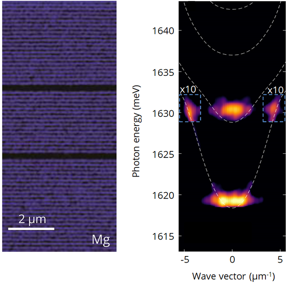 |
| On the left: a spatial cross-section of the studied structure. Two optical microcavities (broad black stripes) are visible, surrounded by a multilayer Bragg mirrors. The image shows the spatial distribution of magnesium. It was obtained in a transmission electron microscope in the measurement of energy dispersion X-ray spectroscopy. On the right: angularly resolved emission spectrum of a system of two coupled optical microcavities recorded for excitation power above the polariton lasing threshold. The white lines represent the calculated polariton levels. Parametric polariton scattering is visible as bright points inside the blue rectangles. (Source: K. Sobczak, CNBCh UW, K. Sawicki, Faculty of Physics UW) CREDIT K. Sobczak, CNBCh UW, K. Sawicki, Faculty of Physics UW |
Abstract:
Scientists from the Faculty of Physics of the University of Warsaw demonstrated exciton-polariton lasing and parametric scattering of exciton-polaritons in a system of coupled optical microcavities. The results have been published in the prestigious journal "Nanophotonics".
Non-linear effects in coupled optical microcavities
Warsaw, Poland | Posted on August 5th, 2021Exciton-polaritons are quasiparticles formed by a strong coupling between excitons and photons in a semiconductor. Their bosonic nature and non-linear interactions allow the observation of fascinating phenomena such as Bose-Einstein condensation of polaritons and polariton lasing, which, unlike typical lasering, occurs without occupation inversion.
Coupled microcavity systems, such as those based on two coupled optical microcavities, offer a promising multi-level platform for basic research and practical applications. The unique structure consisting of several dozen of layers with the precisely defined thickness (each with an accuracy of a few nanometers) was fabricated in the MBE laboratory at the Faculty of Physics, University of Warsaw.
In the presented work, we study non-linear effects in a system of two coupled optical microcavities. Bose-Einstein condensation of polaritons and polariton lasing occur at the two lowest energy levels of an overall four-level system. This is a surprising result in the context of what has previously been observed in single microcavities, where condensation took place in the system's ground state. Emission dynamics measurements have shown that in the present case the condensates of different energies share the same lasing threshold, but do not appear simultaneously, i.e. they form and disappear subsequently, one by one. Moreover, the transition to the condensate state is accompanied by an energy-degenerate parametric scattering of polaritons, i.e. the one in which the state of the crystal is preserved before and after the scattering process - explains Krzysztof Sawicki. In previous studies on coupled microcavities, parametric scattering was obtained using strictly resonant excitation. The non-resonant excitation used in the present work enables spectral separation of the signal from the excitation laser, which is a promising result from the point of view of implementing sources of entangled photons based on polaritons.
Previously, a coupled microcavity system was used to demonstrate energy transfer over 2 micrometers, mediated by polariton states. This is a record distance taking into account the typical nanometer scale of interaction between excitons in a semiconductor. We expect our results to open the way to the research on new types of non-linear effects in multi-level polariton systems. Our work is essential for such rapidly developing fields as, for example, all-optical quantum computing, since the non-linear interactions in a multi-level system may enable the implementation of logic systems based on polaritons – adds Jan Suffczynski.
For more information, please contact with Krzysztof Sawicki or Jan Suffczynski from the Laboratory of Ultrafast MagnetoSpectoscopy (LUMS).
Physics and astronomy at the University of Warsaw appeared in 1816 as part of the then Faculty of Philosophy. In 1825, the Astronomical Observatory was established. Currently, the Faculty of Physics at the University of Warsaw consists of the following institutes: Experimental Physics, Theoretical Physics, Geophysics, the Department of Mathematical Methods and the Astronomical Observatory. The research covers almost all areas of modern physics, on scales from quantum to cosmological. The Faculty's research and teaching staff consist of over 200 academic teachers, 81 of whom are professors. About 1,000 students and over 170 doctoral students study at the Faculty of Physics at the University of Warsaw.
####
For more information, please click here
Contacts:
Agata Meissner
Office: 48-225-532-573
Expert Contact
Jan Suffczynski
Office: +48 225532707
Copyright © University of Warsaw
If you have a comment, please Contact us.Issuers of news releases, not 7th Wave, Inc. or Nanotechnology Now, are solely responsible for the accuracy of the content.
Bookmark:


| Related Links |
| Related News Press |
News and information
 Quantum computer improves AI predictions April 17th, 2026
Flexible sensor gains sensitivity under pressure April 17th, 2026
A reusable chip for particulate matter sensing April 17th, 2026
Detecting vibrational quantum beating in the predissociation dynamics of SF6 using time-resolved photoelectron spectroscopy April 17th, 2026
Possible Futures
A fundamentally new therapeutic approach to cystic fibrosis: Nanobody repairs cellular defect April 17th, 2026
UC Irvine physicists discover method to reverse ‘quantum scrambling’ : The work addresses the problem of information loss in quantum computing system April 17th, 2026
Chip Technology
A reusable chip for particulate matter sensing April 17th, 2026
Metasurfaces smooth light to boost magnetic sensing precision January 30th, 2026
Optical computing/Photonic computing
ICFO researchers overcome long-standing bottleneck in single photon detection with twisted 2D materials August 8th, 2025
Programmable electron-induced color router array May 14th, 2025
Nanoelectronics
Lab to industry: InSe wafer-scale breakthrough for future electronics August 8th, 2025
Interdisciplinary: Rice team tackles the future of semiconductors Multiferroics could be the key to ultralow-energy computing October 6th, 2023
Key element for a scalable quantum computer: Physicists from Forschungszentrum Jülich and RWTH Aachen University demonstrate electron transport on a quantum chip September 23rd, 2022
Reduced power consumption in semiconductor devices September 23rd, 2022
Discoveries
Quantum computer improves AI predictions April 17th, 2026
Flexible sensor gains sensitivity under pressure April 17th, 2026
A reusable chip for particulate matter sensing April 17th, 2026
Detecting vibrational quantum beating in the predissociation dynamics of SF6 using time-resolved photoelectron spectroscopy April 17th, 2026
Announcements
A fundamentally new therapeutic approach to cystic fibrosis: Nanobody repairs cellular defect April 17th, 2026
UC Irvine physicists discover method to reverse ‘quantum scrambling’ : The work addresses the problem of information loss in quantum computing system April 17th, 2026
Interviews/Book Reviews/Essays/Reports/Podcasts/Journals/White papers/Posters
A fundamentally new therapeutic approach to cystic fibrosis: Nanobody repairs cellular defect April 17th, 2026
UC Irvine physicists discover method to reverse ‘quantum scrambling’ : The work addresses the problem of information loss in quantum computing system April 17th, 2026
Photonics/Optics/Lasers
Metasurfaces smooth light to boost magnetic sensing precision January 30th, 2026
From sensors to smart systems: the rise of AI-driven photonic noses January 30th, 2026
 |
||
 |
||
| The latest news from around the world, FREE | ||
 |
||
|
|
||
| Premium Products | ||
 |
||
|
Only the news you want to read!
Learn More |
||
 |
||
|
Full-service, expert consulting
Learn More |
||
|
|
||