Home > Press > New technique builds super-hard metals from nanoparticles
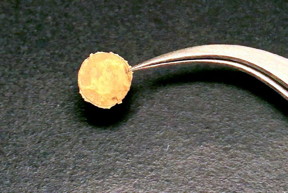 |
| This gold "coin" was made from nanoparticle building blocks, thanks to a new technique developed by Brown University researchers. Making bulk metals this way allows for precise of the metal's microstructure, which enhances its mechanical properties. CREDIT Chen Lab / Brown University |
Abstract:
Metallurgists have all kinds of ways to make a chunk of metal harder. They can bend it, twist it, run it between two rollers or pound it with a hammer. These methods work by breaking up the metal's grain structure -- the microscopic crystalline domains that form a bulk piece of metal. Smaller grains make for harder metals.
New technique builds super-hard metals from nanoparticles
Providence, RI | Posted on January 22nd, 2021Now, a group of Brown University researchers has found a way to customize metallic grain structures from the bottom up. In a paper published in the journal Chem, the researchers show a method for smashing individual metal nanoclusters together to form solid macro-scale hunks of solid metal. Mechanical testing of the metals manufactured using the technique showed that they were up to four times harder than naturally occurring metal structures.
"Hammering and other hardening methods are all top-down ways of altering grain structure, and it's very hard to control the grain size you end up with," said Ou Chen, an assistant professor of chemistry at Brown and corresponding author of the new research. "What we've done is create nanoparticle building blocks that fuse together when you squeeze them. This way we can have uniform grain sizes that can be precisely tuned for enhanced properties."
For this study, the researchers made centimeter-scale "coins" using nanoparticles of gold, silver, palladium and other metals. Items of this size could be useful for making high-performance coating materials, electrodes or thermoelectric generators (devices that convert heat fluxes into electricity). But the researchers think the process could easily be scaled up to make super-hard metal coatings or larger industrial components.
The key to the process, Chen says, is the chemical treatment given to the nanoparticle building blocks. Metal nanoparticles are typically covered with organic molecules called ligands, which generally prevent the formation of metal-metal bonds between particles. Chen and his team found a way to strip those ligands away chemically, allowing the clusters to fuse together with just a bit of pressure.
The metal coins made with the technique were substantially harder than standard metal, the research showed. The gold coins, for example, were two to four times harder than normal. Other properties like electrical conduction and light reflectance were virtually identical to standard metals, the researchers found.
The optical properties of the gold coins were fascinating, Chen says, as there was a dramatic color change when the nanoparticles were compressed into bulk metal.
"Because of what's known as the plasmonic effect, gold nanoparticles are actually purplish-black in color," Chen said. "But when we applied pressure, we see these purplish clusters suddenly turn to a bright gold color. That's one of the ways we knew we had actually formed bulk gold."
In theory, Chen says, the technique could be used to make any kind of metal. In fact, Chen and his team showed that they could make an exotic form of metal known as a metallic glass. Metallic glasses are amorphous, meaning they lack the regularly repeating crystalline structure of normal metals. That gives rise to remarkable properties. Metallic glasses are more easily molded than traditional metals, can be much stronger and more crack-resistant, and exhibit superconductivity at low temperatures.
"Making metallic glass from a single component is notoriously hard to do, so most metallic glasses are alloys," Chen said. "But we were able to start with amorphous palladium nanoparticles and use our technique to make a palladium metallic glass."
Chen says he's hopeful that the technique could one day be widely used for commercial products. The chemical treatment used on the nanoclusters is fairly simple, and the pressures used to squeeze them together are well within the range of standard industrial equipment. Chen has patented the technique and hopes to continue studying it.
"We think there's a lot of potential here, both for industry and for the scientific research community," Chen said.
###
Chen's coauthors on the paper were Yasutaka Nagaoka, Masayuki Suda, Insun Yoon, Na Chen, Hanjun Yang, Yuzi Liu, Brendan A. Anzures, Stephen W. Parman, Zhongwu Wang, Michael Grünwald and Hiroshi M. Yamamoto. The research was supported by the National Science Foundation (CMMI-1934314, DMR-1332208, DMR-1848499) and the U.S. Department of Energy (DE-AC02-06CH11357).
####
For more information, please click here
Contacts:
Kevin Stacey
401-863-3766
@brownuniversity
Copyright © Brown University
If you have a comment, please Contact us.Issuers of news releases, not 7th Wave, Inc. or Nanotechnology Now, are solely responsible for the accuracy of the content.
Bookmark:


| Related Links |
| Related News Press |
News and information
 Quantum computer improves AI predictions April 17th, 2026
Flexible sensor gains sensitivity under pressure April 17th, 2026
A reusable chip for particulate matter sensing April 17th, 2026
Detecting vibrational quantum beating in the predissociation dynamics of SF6 using time-resolved photoelectron spectroscopy April 17th, 2026
Govt.-Legislation/Regulation/Funding/Policy
Quantum computer improves AI predictions April 17th, 2026
Metasurfaces smooth light to boost magnetic sensing precision January 30th, 2026
New imaging approach transforms study of bacterial biofilms August 8th, 2025
Possible Futures
A fundamentally new therapeutic approach to cystic fibrosis: Nanobody repairs cellular defect April 17th, 2026
UC Irvine physicists discover method to reverse ‘quantum scrambling’ : The work addresses the problem of information loss in quantum computing system April 17th, 2026
Discoveries
Quantum computer improves AI predictions April 17th, 2026
Flexible sensor gains sensitivity under pressure April 17th, 2026
A reusable chip for particulate matter sensing April 17th, 2026
Detecting vibrational quantum beating in the predissociation dynamics of SF6 using time-resolved photoelectron spectroscopy April 17th, 2026
Materials/Metamaterials/Magnetoresistance
First real-time observation of two-dimensional melting process: Researchers at Mainz University unveil new insights into magnetic vortex structures August 8th, 2025
Researchers unveil a groundbreaking clay-based solution to capture carbon dioxide and combat climate change June 6th, 2025
A 1960s idea inspires NBI researchers to study hitherto inaccessible quantum states June 6th, 2025
Institute for Nanoscience hosts annual proposal planning meeting May 16th, 2025
Announcements
A fundamentally new therapeutic approach to cystic fibrosis: Nanobody repairs cellular defect April 17th, 2026
UC Irvine physicists discover method to reverse ‘quantum scrambling’ : The work addresses the problem of information loss in quantum computing system April 17th, 2026
Interviews/Book Reviews/Essays/Reports/Podcasts/Journals/White papers/Posters
A fundamentally new therapeutic approach to cystic fibrosis: Nanobody repairs cellular defect April 17th, 2026
UC Irvine physicists discover method to reverse ‘quantum scrambling’ : The work addresses the problem of information loss in quantum computing system April 17th, 2026
Industrial
Tiny nanosheets, big leap: A new sensor detects ethanol at ultra-low levels January 30th, 2026
Quantum interference in molecule-surface collisions February 28th, 2025
Boron nitride nanotube fibers get real: Rice lab creates first heat-tolerant, stable fibers from wet-spinning process June 24th, 2022
Battery Technology/Capacitors/Generators/Piezoelectrics/Thermoelectrics/Energy storage
Decoding hydrogen‑bond network of electrolyte for cryogenic durable aqueous zinc‑ion batteries January 30th, 2026
COF scaffold membrane with gate‑lane nanostructure for efficient Li+/Mg2+ separation January 30th, 2026
MXene nanomaterials enter a new dimension Multilayer nanomaterial: MXene flakes created at Drexel University show new promise as 1D scrolls January 30th, 2026
 |
||
 |
||
| The latest news from around the world, FREE | ||
 |
||
|
|
||
| Premium Products | ||
 |
||
|
Only the news you want to read!
Learn More |
||
 |
||
|
Full-service, expert consulting
Learn More |
||
|
|
||