Home > Press > Gentle probes could enable massive brain data collection: National Institutes of Health backing Rice’s Chong Xie to refine flexible nanoelectronics thread
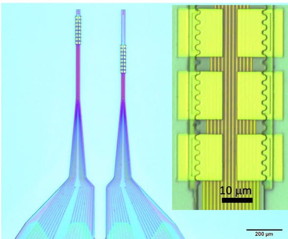 |
| The National Institutes of Health is backing a Rice University project to continue the development of flexible nanoelectronic thread to gather information from neurons. The miniaturized implants could ultimately help find therapies for neurological disorders. (Credit: Xie Laboratory/Rice University) |
Abstract:
University engineers will gain a better understanding of brain activity over time with the support of the National Institutes of Health.
Gentle probes could enable massive brain data collection: National Institutes of Health backing Rice’s Chong Xie to refine flexible nanoelectronics thread
Houston, TX | Posted on September 14th, 2020The agency has awarded a four-year grant of $4.15 million to Chong Xie of the Brown School of Engineering’s Neuroengineering Initiative to maximize the use of devices based on the flexible nanoelectronic thread (NET) he has developed. The information they gather could be critical to future treatment of neurological disease.
The biocompatible probes have the unique ability to stably record electrical information from individual neurons. They will be designed to record neuronal activity in different parts of the brain to help researchers understand complex, three-dimensional patterns that occur on a millisecond time scale but evolve over days, months and years.
Xie said current probes are often rigid electrodes that lack the necessary lifetimes to collect dynamic information over the long term and are ill-suited to use with imaging techniques. Micron-thick NET probes, each with 128 contacts, can be implanted in various regions of the brain by attaching them to more rigid tungsten wires of the same size with a water-soluble adhesive. When the glue melts, the wires are withdrawn, leaving the probes in place.
“In order to do this at a large scale so we can analyze neural dynamics, we do need to get closer to the scale, to a certain extent, of the nervous system, which we know is huge,” said Xie, an associate professor of electrical and computer engineering and of bioengineering who joined Rice this year.
“This project is designed to extend the current spatiotemporal scales we have in neuroscience studies by making smaller and more flexible electrodes and with longer-lasting recording capabilities,” he said. “We’ve also engaged a neuroscientist in this project -- co-principal investigator Loren Frank of the University of California, San Francisco -- so we have direct knowledge of what these scientists need.”
The probes enabled a study published earlier this year by his collaborator, Lan Luan, who used the technology to discover that blood flow recovers faster than the brain in microscopic strokes. In that study, NET probes were combined with optical lines that measured blood flow by laser speckle patterns for as long as eight weeks.
“Our electrodes in that study were really limited to just a few dozen,” said Luan, an assistant professor of electrical and computer engineering and co-investigator on the project. “But with the new technology development, we’re hoping to be able to test these bi-model types of measurements with larger-scale recordings in different regions of the brain.”
The researchers plan to optimize NET probes to gather high-density information in animal models for various brain regions and species.
The current technology is just a start, according to Xie. “We have parallel efforts to design electrodes that may eventually be used in humans,” he said.
Alex Huk of the University of Texas at Austin and Mattias Karlsson at SpikeGadgets Inc. are also co-investigators on the project. The grant is being administered by the National Institute of Neurological Disorders and Stroke.
####
About Rice University
Located on a 300-acre forested campus in Houston, Rice University is consistently ranked among the nation’s top 20 universities by U.S. News & World Report. Rice has highly respected schools of Architecture, Business, Continuing Studies, Engineering, Humanities, Music, Natural Sciences and Social Sciences and is home to the Baker Institute for Public Policy. With 3,962 undergraduates and 3,027 graduate students, Rice’s undergraduate student-to-faculty ratio is just under 6-to-1. Its residential college system builds close-knit communities and lifelong friendships, just one reason why Rice is ranked No. 1 for quality of life and No. 1 for lots of race/class interaction by the Princeton Review. Rice is also rated as a best value among private universities by Kiplinger’s Personal Finance.
Follow Rice News and Media Relations via Twitter @RiceUNews.
For more information, please click here
Contacts:
Jeff Falk
713-348-6775
Mike Williams
713-348-6728
Copyright © Rice University
If you have a comment, please Contact us.Issuers of news releases, not 7th Wave, Inc. or Nanotechnology Now, are solely responsible for the accuracy of the content.
Bookmark:


| Related Links |
 ow recovers faster than brain in micro strokes:
Xie lab of the Nanoscale Neural Interface:
George R. Brown School of Engineering:
| Related News Press |
News and information
Quantum computer improves AI predictions April 17th, 2026
Flexible sensor gains sensitivity under pressure April 17th, 2026
A reusable chip for particulate matter sensing April 17th, 2026
Detecting vibrational quantum beating in the predissociation dynamics of SF6 using time-resolved photoelectron spectroscopy April 17th, 2026
Brain-Computer Interfaces
Taking salt out of the water equation October 7th, 2022
New brain-like computing device simulates human learning: Researchers conditioned device to learn by association, like Pavlov's dog April 30th, 2021
Govt.-Legislation/Regulation/Funding/Policy
Quantum computer improves AI predictions April 17th, 2026
Metasurfaces smooth light to boost magnetic sensing precision January 30th, 2026
New imaging approach transforms study of bacterial biofilms August 8th, 2025
Possible Futures
A fundamentally new therapeutic approach to cystic fibrosis: Nanobody repairs cellular defect April 17th, 2026
UC Irvine physicists discover method to reverse ‘quantum scrambling’ : The work addresses the problem of information loss in quantum computing system April 17th, 2026
Nanomedicine
A fundamentally new therapeutic approach to cystic fibrosis: Nanobody repairs cellular defect April 17th, 2026
New molecular technology targets tumors and simultaneously silences two ‘undruggable’ cancer genes August 8th, 2025
New imaging approach transforms study of bacterial biofilms August 8th, 2025
Electrifying results shed light on graphene foam as a potential material for lab grown cartilage June 6th, 2025
Discoveries
Quantum computer improves AI predictions April 17th, 2026
Flexible sensor gains sensitivity under pressure April 17th, 2026
A reusable chip for particulate matter sensing April 17th, 2026
Detecting vibrational quantum beating in the predissociation dynamics of SF6 using time-resolved photoelectron spectroscopy April 17th, 2026
Announcements
A fundamentally new therapeutic approach to cystic fibrosis: Nanobody repairs cellular defect April 17th, 2026
UC Irvine physicists discover method to reverse ‘quantum scrambling’ : The work addresses the problem of information loss in quantum computing system April 17th, 2026
Grants/Sponsored Research/Awards/Scholarships/Gifts/Contests/Honors/Records
Quantum computer improves AI predictions April 17th, 2026
Detecting vibrational quantum beating in the predissociation dynamics of SF6 using time-resolved photoelectron spectroscopy April 17th, 2026
Metasurfaces smooth light to boost magnetic sensing precision January 30th, 2026
Nanobiotechnology
A fundamentally new therapeutic approach to cystic fibrosis: Nanobody repairs cellular defect April 17th, 2026
New molecular technology targets tumors and simultaneously silences two ‘undruggable’ cancer genes August 8th, 2025
New imaging approach transforms study of bacterial biofilms August 8th, 2025
Electrifying results shed light on graphene foam as a potential material for lab grown cartilage June 6th, 2025
Research partnerships
Lab to industry: InSe wafer-scale breakthrough for future electronics August 8th, 2025
HKU physicists uncover hidden order in the quantum world through deconfined quantum critical points April 25th, 2025
 |
||
 |
||
| The latest news from around the world, FREE | ||
 |
||
|
|
||
| Premium Products | ||
 |
||
|
Only the news you want to read!
Learn More |
||
 |
||
|
Full-service, expert consulting
Learn More |
||
|
|
||