Home > Press > Researchers demonstrate size quantization of Dirac fermions in graphene: Characterization of high-quality material reveals important details relevant to next generation nanoelectronic devices
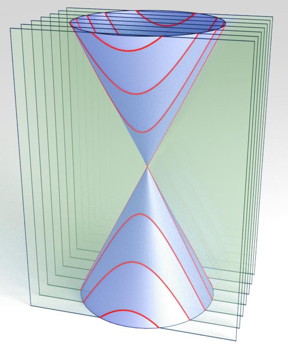 |
| This is a dirac cone showing a typical dispersion relation (energy vs. momentum) for 2-D graphene material. Red cross-sectional lines represent quantization of the energy (and momentum) due to a finite size constriction. CREDIT: B. Terrés, L. A. Chizhova, F. Libisch, J. Peiro, D. Jörger, S. Engels, A. Girschik, K. Watanabe, T. Taniguchi, S. V. Rotkin, J. Burgdörfer, C. Stampfer |
Abstract:
Quantum mechanics is the field of physics governing the behavior of things on atomic scales, where things work very differently from our everyday world.
Researchers demonstrate size quantization of Dirac fermions in graphene: Characterization of high-quality material reveals important details relevant to next generation nanoelectronic devices
Bethlehem, PA | Posted on May 20th, 2016One of the most direct manifestations of quantum mechanics is quantization. Quantization results in the discrete character of physical properties at small scales, which could be the radius of an atomic orbit or the resistance of a molecular wire. The most famous one, which won Albert Einstein the Nobel Prize, is the quantization of the photon energy in the photoelectric effect-- the observation that many metals emit electrons when light shines upon them.
Quantization occurs when a quantum particle is confined to a small space. Its wave function develops a standing wave pattern, like waves in a small puddle. Physicists then speak of size quantization: the energy of the particle may only take those values where the nodal pattern of the standing wave matches the system boundary.
A striking consequence of size quantization is quantized conductance: the number of particles that can simultaneously traverse a narrow corridor, a so-called nanoconstriction, become discrete. As a result the current through such a constriction is an integer multiple of the quantum of conductance.
In a recent joint experimental and theoretical work, an international group of physicists demonstrated size quantization of charge carriers, i.e. quantized conductance in nanoscale samples of graphene. The results have been published in an article called "Size quantization of Dirac fermions in graphene constrictions" in Nature Communications.
The high-quality material graphene, a single-atomic layer of carbon, embedded in hexagonal boron nitride demonstrates unusual physics due to the hexagonal--or honey comb--symmetry of its lattice. However, observing size quantization of charge carriers in graphene nanoconstrictions has, until now, proved elusive due to the high sensitivity of the electron wave to disorder.
The researchers demonstrated quantization effects at very low temperatures (liquid Helium), where the influence of thermal disorder ceases. This new approach--of encapsulating graphene constrictions between layers of boron nitride--allowed for exceptionally clean samples, and thus highly accurate measurements.
At zero magnetic field, the measured current shows clear signatures of size quantization, closely following theoretical predictions. For increasing magnetic field, these structures gradually evolve into the Landau levels of the quantum Hall effect.
"The high sensitivity of this transition to scattering at the constriction edges reveals indispensable details about the role of edge scattering in future graphene nanoelectronic devices," said Slava V. Rotkin, professor of physics and materials science & engineering at Lehigh University and a co-author of the study.
####
For more information, please click here
Contacts:
Lori Friedman
610-758-3224
Copyright © Lehigh University
If you have a comment, please Contact us.Issuers of news releases, not 7th Wave, Inc. or Nanotechnology Now, are solely responsible for the accuracy of the content.
Bookmark:


| Related Links |
| Related News Press |
News and information
 Quantum computer improves AI predictions April 17th, 2026
Flexible sensor gains sensitivity under pressure April 17th, 2026
A reusable chip for particulate matter sensing April 17th, 2026
Detecting vibrational quantum beating in the predissociation dynamics of SF6 using time-resolved photoelectron spectroscopy April 17th, 2026
Quantum Physics
Detecting vibrational quantum beating in the predissociation dynamics of SF6 using time-resolved photoelectron spectroscopy April 17th, 2026
Beyond silicon: Electronics at the scale of a single molecule January 30th, 2026
MXene nanomaterials enter a new dimension Multilayer nanomaterial: MXene flakes created at Drexel University show new promise as 1D scrolls January 30th, 2026
Magnetism/Magnons
Metasurfaces smooth light to boost magnetic sensing precision January 30th, 2026
Researchers develop molecular qubits that communicate at telecom frequencies October 3rd, 2025
Magnetism in new exotic material opens the way for robust quantum computers June 4th, 2025
Graphene/ Graphite
Electrifying results shed light on graphene foam as a potential material for lab grown cartilage June 6th, 2025
Possible Futures
A fundamentally new therapeutic approach to cystic fibrosis: Nanobody repairs cellular defect April 17th, 2026
UC Irvine physicists discover method to reverse ‘quantum scrambling’ : The work addresses the problem of information loss in quantum computing system April 17th, 2026
Chip Technology
A reusable chip for particulate matter sensing April 17th, 2026
Metasurfaces smooth light to boost magnetic sensing precision January 30th, 2026
Nanoelectronics
Lab to industry: InSe wafer-scale breakthrough for future electronics August 8th, 2025
Interdisciplinary: Rice team tackles the future of semiconductors Multiferroics could be the key to ultralow-energy computing October 6th, 2023
Key element for a scalable quantum computer: Physicists from Forschungszentrum Jülich and RWTH Aachen University demonstrate electron transport on a quantum chip September 23rd, 2022
Reduced power consumption in semiconductor devices September 23rd, 2022
Discoveries
Quantum computer improves AI predictions April 17th, 2026
Flexible sensor gains sensitivity under pressure April 17th, 2026
A reusable chip for particulate matter sensing April 17th, 2026
Detecting vibrational quantum beating in the predissociation dynamics of SF6 using time-resolved photoelectron spectroscopy April 17th, 2026
Materials/Metamaterials/Magnetoresistance
First real-time observation of two-dimensional melting process: Researchers at Mainz University unveil new insights into magnetic vortex structures August 8th, 2025
Researchers unveil a groundbreaking clay-based solution to capture carbon dioxide and combat climate change June 6th, 2025
A 1960s idea inspires NBI researchers to study hitherto inaccessible quantum states June 6th, 2025
Institute for Nanoscience hosts annual proposal planning meeting May 16th, 2025
Announcements
A fundamentally new therapeutic approach to cystic fibrosis: Nanobody repairs cellular defect April 17th, 2026
UC Irvine physicists discover method to reverse ‘quantum scrambling’ : The work addresses the problem of information loss in quantum computing system April 17th, 2026
Interviews/Book Reviews/Essays/Reports/Podcasts/Journals/White papers/Posters
A fundamentally new therapeutic approach to cystic fibrosis: Nanobody repairs cellular defect April 17th, 2026
UC Irvine physicists discover method to reverse ‘quantum scrambling’ : The work addresses the problem of information loss in quantum computing system April 17th, 2026
Quantum nanoscience
Beyond silicon: Electronics at the scale of a single molecule January 30th, 2026
MXene nanomaterials enter a new dimension Multilayer nanomaterial: MXene flakes created at Drexel University show new promise as 1D scrolls January 30th, 2026
ICFO researchers overcome long-standing bottleneck in single photon detection with twisted 2D materials August 8th, 2025
 |
||
 |
||
| The latest news from around the world, FREE | ||
 |
||
|
|
||
| Premium Products | ||
 |
||
|
Only the news you want to read!
Learn More |
||
 |
||
|
Full-service, expert consulting
Learn More |
||
|
|
||