Home > Press > X-ray microscopy technique makes fluctuations inside of materials visible: Microscopic X-ray view
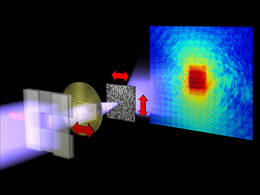 |
| Experimental setup: The test object is moved with nanometer precision through the X-ray beam. The scattered X-rays are captured by a detector. The scattering images are then reconstructed to an image of the sample. |
Abstract:
X-ray microscopy requires radiation of extremely high quality. In order to obtain sharp images instrument and sample must stay absolutely immobile even at the nanometer scale during the recording. Researchers at the Technische Universitaet Muenchen and the Paul Scherrer Institute in Villigen (Switzerland), have now developed a method that relaxes these hard restrictions. Even fluctuations in the material can be visualized. The renowned journal Nature now reports on their results.
X-ray microscopy technique makes fluctuations inside of materials visible: Microscopic X-ray view
Munich, Germany | Posted on February 6th, 2013For more than 100 years radiography meant: don't move! In order to visualize nanostructures such as biological cells, the porous structure of cement or storage fields of magnetic disks, the experimentators had to avoid any kind of vibration of X-ray microscope and sample. In addition, only a small percentage fraction of the incoming X-ray radiation could be used. Using special filters, they had to select exactly the fraction with the right properties - for example, the right wavelength.
Contributions of different wavelengths separated
Pierre Thibault of the Technische Universitaet Muenchen and Andreas Menzel, scientist at the Paul Scherrer Institute (Villigen, Switzerland) have now developed an interpretation method that produces reliable images in spite of vibrations or fluctuations. The method is based on a technique called "ptychography", developed in the 1960s for electron microscopy. Thibault and Menzel's advancements now make it possible to distinguish effects originating from the contribution of different types of X-ray waves.
Fluctuations visualized
Probably the most significant result of the study is that it gives access to a whole class of objects that previously could hardly be investigated. "We now not only can compensate for the vibrations in the microscope," says Andreas Menzel. "We can even characterize fluctuations of the sample itself, even if they are much too fast to be seen with individual snapshots."
"We needed to convince ourselves that the images we produced did indeed reflect accurately the samples and their dynamics," says Pierre Thibault. "So we carried out computer simulations. They confirmed that effects of the instrument as well as of the sample itself, such as flows, switching events or mixed quantum states, can be characterized."
Microscopic view inside
The new method combines the characterization of dynamical states with high-resolution X-ray microscopy. One possible application is to analyze the changing magnetization of individual bits in magnetic storage media with high storage density. The interactions of such single magnetic bits or their thermal fluctuations, which ultimately determine the lifetime of magnetic data storage, could be visualized.
"In addition to its use in imaging," explains Pierre Thibault, "our analysis method also reveals a fundamental relationship to other disciplines: Microscopy and scientific disciplines such as quantum computing, previously regarded as independent, can benefit from each other here."
####
For more information, please click here
Contacts:
Andreas Battenberg
49-892-891-0510
Dr. Pierre Thibault
Technische Universität München
Physik-Department, Lehrstuhl für Angewandte Biophysik (E 17)
85747 Garching, Germany
Tel.: +49 89 289 14397
Copyright © Technische Universitaet Muenchen
If you have a comment, please Contact us.Issuers of news releases, not 7th Wave, Inc. or Nanotechnology Now, are solely responsible for the accuracy of the content.
Bookmark:


| Related Links |
| Related News Press |
News and information
 Simulating magnetization in a Heisenberg quantum spin chain April 5th, 2024
NRL charters Navy’s quantum inertial navigation path to reduce drift April 5th, 2024
Discovery points path to flash-like memory for storing qubits: Rice find could hasten development of nonvolatile quantum memory April 5th, 2024
Imaging
Nanoscale CL thermometry with lanthanide-doped heavy-metal oxide in TEM March 8th, 2024
Laboratories
A battery’s hopping ions remember where they’ve been: Seen in atomic detail, the seemingly smooth flow of ions through a battery’s electrolyte is surprisingly complicated February 16th, 2024
NRL discovers two-dimensional waveguides February 16th, 2024
Memory Technology
Utilizing palladium for addressing contact issues of buried oxide thin film transistors April 5th, 2024
Interdisciplinary: Rice team tackles the future of semiconductors Multiferroics could be the key to ultralow-energy computing October 6th, 2023
Researchers discover materials exhibiting huge magnetoresistance June 9th, 2023
Quantum Computing
Simulating magnetization in a Heisenberg quantum spin chain April 5th, 2024
Discovery points path to flash-like memory for storing qubits: Rice find could hasten development of nonvolatile quantum memory April 5th, 2024
With VECSELs towards the quantum internet Fraunhofer: IAF achieves record output power with VECSEL for quantum frequency converters April 5th, 2024
Chemical reactions can scramble quantum information as well as black holes April 5th, 2024
Discoveries
Chemical reactions can scramble quantum information as well as black holes April 5th, 2024
New micromaterial releases nanoparticles that selectively destroy cancer cells April 5th, 2024
Utilizing palladium for addressing contact issues of buried oxide thin film transistors April 5th, 2024
Announcements
NRL charters Navy’s quantum inertial navigation path to reduce drift April 5th, 2024
Discovery points path to flash-like memory for storing qubits: Rice find could hasten development of nonvolatile quantum memory April 5th, 2024
Tools
Ferroelectrically modulate the Fermi level of graphene oxide to enhance SERS response November 3rd, 2023
The USTC realizes In situ electron paramagnetic resonance spectroscopy using single nanodiamond sensors November 3rd, 2023
 |
||
 |
||
| The latest news from around the world, FREE | ||
 |
||
|
|
||
| Premium Products | ||
 |
||
|
Only the news you want to read!
Learn More |
||
 |
||
|
Full-service, expert consulting
Learn More |
||
|
|
||