Home > Press > ArduSat, the first open source microsatellite, accessible platform with open access to the public!
 |
Abstract:
How would you like to have direct, personal access to a satellite in space? Take your own pictures of the Earth from space or write your own cool science project to hunt for meteorites? Or play a true space game with your friends, steering the satellite? That and much more are the kind of space exploration that NanoSatisfi LLC will make possible with ArduSat, the first open source satellite with open access to the public.
ArduSat, the first open source microsatellite, accessible platform with open access to the public!
San Jose, CA | Posted on July 11th, 2012Just imagine: you could be at the helm of a machine that flies away over the horizon at over 18 times the speed of sound, detects meteors vaporizing in the skies over Europe, photographs the sunset over the horn of Africa, maps the Earth's magnetic field cruising over the Indian Ocean, snaps a picture of the Southern Lights dancing underneath off the coast of Australia, samples the upper atmosphere for biomarkers and other signs of life, flies effortlessly over a hurricane to look straight down its eye, maps the emitted spectrum of the sun, and is back over your head in an hour and half.
And you can do all of that starting at $325.
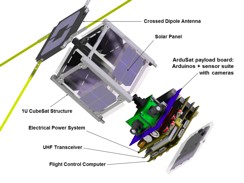
The ArduSat is a standard microsatellite based off the Calpoly CubeSat standard, relying on off-the-shelf technology and space-proven components. The key innovation, however, is the architecture of the payload: it carries a suite of over 25 unique sensors and a purpose built payload computer based off the ubiquitous Arduino standard, which enables anyone to easily write their own code and use the satellite. By supporting an open-source, accessible platform with reliable space hardware, the satellite removed the technical barriers to spaceflight and gives affordable access to space exploration to everyone, even those without a space background.
The ArduSat project is currently featured on Kickstarter, where it is raises funds to upgrade the performance of satellite with better sensors and cameras. By supporting the project now, you would not only be preordering a slot as one of the first to use the system, but would be making the satellite more advanced and capable of better applications and experiments when it launches.
Support the project now and join the DIY space revolution that has made headlines with Engaget, DVICE, Citizen Scientists League, UK Guardian, the Space Fellowship, and more!
####
About NanoSatisfi LLC
http://www.nanosatisfi.com/
For more information, please click here
Copyright © NanoSatisfi LLC
If you have a comment, please Contact us.Issuers of news releases, not 7th Wave, Inc. or Nanotechnology Now, are solely responsible for the accuracy of the content.
Bookmark:


| Related News Press |
News and information
 Quantum computer improves AI predictions April 17th, 2026
Flexible sensor gains sensitivity under pressure April 17th, 2026
A reusable chip for particulate matter sensing April 17th, 2026
Detecting vibrational quantum beating in the predissociation dynamics of SF6 using time-resolved photoelectron spectroscopy April 17th, 2026
Announcements
A fundamentally new therapeutic approach to cystic fibrosis: Nanobody repairs cellular defect April 17th, 2026
UC Irvine physicists discover method to reverse ‘quantum scrambling’ : The work addresses the problem of information loss in quantum computing system April 17th, 2026
Aerospace/Space
Decoding hydrogen‑bond network of electrolyte for cryogenic durable aqueous zinc‑ion batteries January 30th, 2026
ICFO researchers overcome long-standing bottleneck in single photon detection with twisted 2D materials August 8th, 2025
Onion-like nanoparticles found in aircraft exhaust May 14th, 2025
Human Interest/Art
New 2D multifractal tools delve into Pollock's expressionism January 17th, 2025
Drawing data in nanometer scale September 30th, 2022
Scientists prepare for the world’s smallest race: Nanocar Race II March 18th, 2022
Graphene nanotubes revolutionize touch screen use for prosthetic hands August 3rd, 2021
 |
||
 |
||
| The latest news from around the world, FREE | ||
 |
||
|
|
||
| Premium Products | ||
 |
||
|
Only the news you want to read!
Learn More |
||
 |
||
|
Full-service, expert consulting
Learn More |
||
|
|
||