Home > Press > Building Artificial Brains: Nanotechology to Mimic Synapses
 |
Abstract:
The synapse is the basic unit of neural communication. Representing a synapse by a single device is a challenging task that lies at the intersection of neuroscience and artificial intelligence. The structure of a biological synapse is very complex, with hundreds of proteins and other chemicals interacting in a complicated manner; nevertheless, there is always a gap (synaptic cleft) across which a signal is transmitted
Building Artificial Brains: Nanotechology to Mimic Synapses
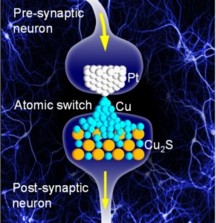
Germany | Posted on June 8th, 2012Now, new research seeks to reproduce a synapse using a single solid-state electrochemical nanodevice called a Cu2S-gap type atomic switch. In this device, there is a gap which is bridged by a copper filament under a voltage pulse stimulation. This causes a change in conductance which is time-dependent. The change in conductance can be considered to be analogous to the change in strength of a biological synaptic connection.
Therefore, this device can be considered to mimic the major features of the human memory; namely, the sensory, short-term, and long-term memories. In addition, the fact that it responses to the presence of air and the change in temperature enables it to be distinguished as an advanced synthetic synapse with the potential to perceive environment, just like the human brain.
####
For more information, please click here
Copyright © Wiley-VCH Materials Science Journals
If you have a comment, please Contact us.Issuers of news releases, not 7th Wave, Inc. or Nanotechnology Now, are solely responsible for the accuracy of the content.
Bookmark:


| Related Links |
 Link to the original paper on Wiley Online Library:
| Related News Press |
News and information
Quantum computer improves AI predictions April 17th, 2026
Flexible sensor gains sensitivity under pressure April 17th, 2026
A reusable chip for particulate matter sensing April 17th, 2026
Detecting vibrational quantum beating in the predissociation dynamics of SF6 using time-resolved photoelectron spectroscopy April 17th, 2026
Brain-Computer Interfaces
Taking salt out of the water equation October 7th, 2022
New brain-like computing device simulates human learning: Researchers conditioned device to learn by association, like Pavlov's dog April 30th, 2021
Memory Technology
Researchers tackle the memory bottleneck stalling quantum computing October 3rd, 2025
First real-time observation of two-dimensional melting process: Researchers at Mainz University unveil new insights into magnetic vortex structures August 8th, 2025
Utilizing palladium for addressing contact issues of buried oxide thin film transistors April 5th, 2024
Discoveries
Quantum computer improves AI predictions April 17th, 2026
Flexible sensor gains sensitivity under pressure April 17th, 2026
A reusable chip for particulate matter sensing April 17th, 2026
Detecting vibrational quantum beating in the predissociation dynamics of SF6 using time-resolved photoelectron spectroscopy April 17th, 2026
Announcements
A fundamentally new therapeutic approach to cystic fibrosis: Nanobody repairs cellular defect April 17th, 2026
UC Irvine physicists discover method to reverse ‘quantum scrambling’ : The work addresses the problem of information loss in quantum computing system April 17th, 2026
 |
||
 |
||
| The latest news from around the world, FREE | ||
 |
||
|
|
||
| Premium Products | ||
 |
||
|
Only the news you want to read!
Learn More |
||
 |
||
|
Full-service, expert consulting
Learn More |
||
|
|
||