Home > Press > Ever-Sharp Urchin Teeth May Yield Tools That Never Need Honing
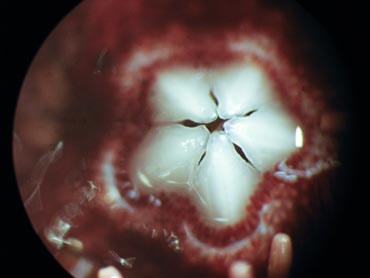 |
| Sea urchin teeth are pictured in situ. New research by Pupa Gilbert, a physics professor at the University of Wisconsin-Madison, and her colleagues reveals how the sea urchin's teeth are always sharp, despite constant grinding and scraping to create the nooks that protect the marine animal from predators and crashing waves. Photo courtesy Pupa Gilbert |
Abstract:
Writing today (Dec. 22, 2010) in the journal Advanced Functional Materials, a team led by UW-Madison professor of physics Pupa Gilbert describes the self-sharpening mechanism used by the California purple sea urchin to keep a razor-sharp edge on its choppers.
Ever-Sharp Urchin Teeth May Yield Tools That Never Need Honing
Madison, WI | Posted on December 22nd, 2010To survive in a tumultuous environment, sea urchins literally eat through stone, using their teeth to carve out nooks where the spiny creatures hide from predators and protect themselves from the crashing surf on the rocky shores and tide pools where they live.
The rock-boring behavior is astonishing, scientists agree, but what is truly remarkable is that, despite constant grinding and scraping on stone, urchin teeth never, ever get dull. The secret of their ever-sharp qualities has puzzled scientists for decades, but now a new report by scientists from the University of Wisconsin-Madison and their colleagues has peeled back the toothy mystery.
Writing today (Dec. 22, 2010) in the journal Advanced Functional Materials, a team led by UW-Madison professor of physics Pupa Gilbert describes the self-sharpening mechanism used by the California purple sea urchin to keep a razor-sharp edge on its choppers.
The urchin's self-sharpening trick, notes Gilbert, is something that could be mimicked by humans to make tools that never need honing.
"The sea urchin tooth is complicated in its design. It is one of the very few structures in nature that self-sharpen," says Gilbert, explaining that the sea urchin tooth, which is always growing, is a biomineral mosaic composed of calcite crystals with two forms - plates and fibers - arranged crosswise and cemented together with super-hard calcite nanocement. Between the crystals are layers of organic materials that are not as sturdy as the calcite crystals.
"The organic layers are the weak links in the chain," Gilbert explains. "There are breaking points at predetermined locations built into the teeth. It is a concept similar to perforated paper in the sense that the material breaks at these predetermined weak spots."
The crystalline nature of sea urchin dentition is, on the surface, different from other crystals found in nature. It lacks the obvious facets characteristic of familiar crystals, but at the very deepest levels the properties of crystals are evident in the orderly arrangement of the atoms that make up the biomineral mosaic teeth of the sea urchin.
To delve into the fundamental nature of the crystals that form sea urchin teeth, Gilbert and her colleagues used a variety of techniques from the materials scientist's toolbox. These include microscopy methods that depend on X-rays to illuminate how nanocrystals are arranged in teeth to make the sea urchins capable of grinding rock. Gilbert and her colleagues used these techniques to deduce how the crystals are organized and melded into a tough and durable biomineral.
Knowing the secret of the ever-sharp sea urchin tooth, says Gilbert, could one day have practical applications for human toolmakers. "Now that we know how it works, the knowledge could be used to develop methods to fabricate tools that could actually sharpen themselves with use," notes Gilbert. "The mechanism used by the urchin is the key. By shaping the object appropriately and using the same strategy the urchin employs, a tool with a self-sharpening edge could, in theory, be created."
The new research was supported by grants from the U.S. Department of Energy and the National Science Foundation. In addition to Gilbert, researchers from the University of California, Berkeley; Argonne National Laboratory; the Weizmann Institute of Science; and the Lawrence Berkeley National Laboratory contributed to the report.
####
For more information, please click here
Contacts:
Terry Devitt
(608) 262-8282
Pupa Gilbert
(608) 358-0164
Copyright © University of Wisconsin-Madison
If you have a comment, please Contact us.Issuers of news releases, not 7th Wave, Inc. or Nanotechnology Now, are solely responsible for the accuracy of the content.
Bookmark:


| Related News Press |
News and information
 Simulating magnetization in a Heisenberg quantum spin chain April 5th, 2024
NRL charters Navy’s quantum inertial navigation path to reduce drift April 5th, 2024
Discovery points path to flash-like memory for storing qubits: Rice find could hasten development of nonvolatile quantum memory April 5th, 2024
Possible Futures
Discovery points path to flash-like memory for storing qubits: Rice find could hasten development of nonvolatile quantum memory April 5th, 2024
With VECSELs towards the quantum internet Fraunhofer: IAF achieves record output power with VECSEL for quantum frequency converters April 5th, 2024
Academic/Education
Rice University launches Rice Synthetic Biology Institute to improve lives January 12th, 2024
Multi-institution, $4.6 million NSF grant to fund nanotechnology training September 9th, 2022
Materials/Metamaterials/Magnetoresistance
Nanoscale CL thermometry with lanthanide-doped heavy-metal oxide in TEM March 8th, 2024
Focused ion beam technology: A single tool for a wide range of applications January 12th, 2024
Announcements
NRL charters Navy’s quantum inertial navigation path to reduce drift April 5th, 2024
Discovery points path to flash-like memory for storing qubits: Rice find could hasten development of nonvolatile quantum memory April 5th, 2024
 |
||
 |
||
| The latest news from around the world, FREE | ||
 |
||
|
|
||
| Premium Products | ||
 |
||
|
Only the news you want to read!
Learn More |
||
 |
||
|
Full-service, expert consulting
Learn More |
||
|
|
||