Home > Press > Johns Hopkins University uses NanoSight to study self-assembled polymer/DNA particles
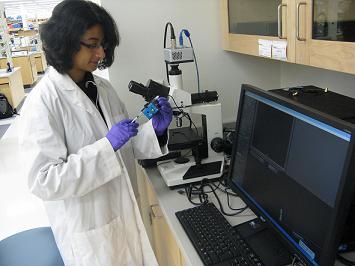 |
| Nupura Bhise of the Jordan group at JHU using the NanoSight LM10 |
Abstract:
The Department of Biomedical Engineering, Johns Hopkins University School of Medicine is using the NanoSight LM10-HS system to study self-assembled polymer/DNA particles for drug delivery.
Johns Hopkins University uses NanoSight to study self-assembled polymer/DNA particles
Salisbury, UK | Posted on October 29th, 2010The main research interests of Dr Jordan Green of the Biomaterials and Drug Delivery Laboratory are in cellular engineering and nanobiotechnology. Knowledge of particle size is of particular value in the characterization of different drug delivery systems. Having had previous experience using dynamic light scattering techniques, Dr Green and his team now also use the complementary technique of nanoparticle tracking analysis from NanoSight. NTA provides insight into their samples particularly those with polydisperse behavior.
The laboratory chose the NanoSight LM10-HS system equipped with an EMCCD high sensitivity camera and a 404 nm laser for particle sizing analysis. In a typical study, particle solutions were diluted in DI water to adjust the sample concentration to a level such that there were approximately 30-60 light scattering centers in the visual analysis window. A sixty second movie containing the Brownian motion tracking of each individual particle was recorded. The movie was processed to enable detection of a least 250 particle tracks per sample. The NTA analysis gives a direct number-averaged distribution of the particle size as well as absolute particle concentration. The mean, standard deviation and mode of the particles is then calculated.
In this method, each individual particle is independently sized so that a direct number-averaged mean can be calculated. As each particle is counted, a mode, or the peak in the number distribution, can also be calculated. For monodisperse particle populations, both DLS and NTA measured the same values for particle size. However, NTA allowed finer distinction between peaks in samples that were polydisperse. The uniformity of polymeric nanoparticle distribution is thought to be a property of the polymer structure, and in particular, of the polymer terminal group. Changes to polymer terminal group were also found to dramatically change gene delivery efficacy of these nanoparticles in 2-D and 3-D cell systems.
Dr Green said that "To our knowledge, this is the first time that NTA has been used for self-assembled polymer/DNA particles. Our results highlight its utility, especially when combined with traditional DLS analysis."
To learn more about nanoparticle characterization using Nanoparticle Tracking Analysis, NTA, please visit the company website (www.nanosight.com) and register for the latest issue of NanoTrail, the company's electronic newsletter.
Reference:
This work was reported in the paper by N.S. Bhise et al. in Biomaterials 31 (2010) pp 8088 to 8096
####
About NanoSight
NanoSight Limited, of Salisbury, UK, provides unique nanoparticle characterization technology. “Nanoparticle Tracking Analysis” (NTA) detects and visualizes populations of nanoparticles in liquids down to 10nm (material dependent) and measures the size of each particle from direct observations of diffusion. This particle-by-particle methodology goes beyond traditional light scattering techniques such as Dynamic Light Scattering (DLS), or Photon Correlation Spectroscopy (PCS), in providing high-resolution particle size distributions. Additionally NanoSight measures concentration and validates all data with video of particles moving under Brownian motion.
This characterization information is highly informative in understanding the more complex suspensions in biological systems, hence its wide application in development of drug delivery systems, viral vaccines, the study of toxicology of nanoparticles and their environmental fate and in biomarker detection. This real-time data also provides insight into the kinetics of protein aggregation and other time-dependent phenomena in a quantitative manner, at deeply sub-micron sizes.
NanoSight has more than 250 systems installed worldwide with users including BASF, BP, GlaxoSmithKline, Novartis, 3M Corp., Roche, Solvay and Unilever together with many universities and research institutes. There are currently 100+ third party papers citing NanoSight results, with this reference base growing very rapidly as NanoSight consolidates its key contribution to nanoparticle characterization. For more information, visit the NanoSight website (www.nanosight.com).
For more information, please click here
Contacts:
NetDyaLog Limited
39 de Bohun Court
Saffron Walden
Essex CB10 2BA
T +44 (0) 1799 521881
www.netdyalog.com
Copyright © NanoSight
If you have a comment, please Contact us.Issuers of news releases, not 7th Wave, Inc. or Nanotechnology Now, are solely responsible for the accuracy of the content.
Bookmark:


| Related News Press |
News and information
 Simulating magnetization in a Heisenberg quantum spin chain April 5th, 2024
NRL charters Navy’s quantum inertial navigation path to reduce drift April 5th, 2024
Discovery points path to flash-like memory for storing qubits: Rice find could hasten development of nonvolatile quantum memory April 5th, 2024
Academic/Education
Rice University launches Rice Synthetic Biology Institute to improve lives January 12th, 2024
Multi-institution, $4.6 million NSF grant to fund nanotechnology training September 9th, 2022
Self Assembly
Liquid crystal templated chiral nanomaterials October 14th, 2022
Nanoclusters self-organize into centimeter-scale hierarchical assemblies April 22nd, 2022
Atom by atom: building precise smaller nanoparticles with templates March 4th, 2022
Nanostructures get complex with electron equivalents: Nanoparticles of two different sizes break away from symmetrical designs January 14th, 2022
Nanomedicine
New micromaterial releases nanoparticles that selectively destroy cancer cells April 5th, 2024
Good as gold - improving infectious disease testing with gold nanoparticles April 5th, 2024
Researchers develop artificial building blocks of life March 8th, 2024
Announcements
NRL charters Navy’s quantum inertial navigation path to reduce drift April 5th, 2024
Discovery points path to flash-like memory for storing qubits: Rice find could hasten development of nonvolatile quantum memory April 5th, 2024
Tools
Ferroelectrically modulate the Fermi level of graphene oxide to enhance SERS response November 3rd, 2023
The USTC realizes In situ electron paramagnetic resonance spectroscopy using single nanodiamond sensors November 3rd, 2023
Nanobiotechnology
New micromaterial releases nanoparticles that selectively destroy cancer cells April 5th, 2024
Good as gold - improving infectious disease testing with gold nanoparticles April 5th, 2024
Researchers develop artificial building blocks of life March 8th, 2024
 |
||
 |
||
| The latest news from around the world, FREE | ||
 |
||
|
|
||
| Premium Products | ||
 |
||
|
Only the news you want to read!
Learn More |
||
 |
||
|
Full-service, expert consulting
Learn More |
||
|
|
||