Home > Press > Marshall University receives $4.7 million for Center for Diagnostic Nanosystems
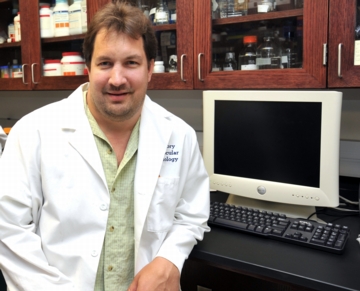 |
| Dr. Eric Blough, director of the Center for Diagnostic Nanosystems at Marshall University. |
Abstract:
Marshall University has received $4.7 million in federal funding to support the new Center for Diagnostic Nanosystems at the university's Robert C. Byrd Biotechnology Science Center.
Marshall University receives $4.7 million for Center for Diagnostic Nanosystems
Huntington, WV | Posted on September 23rd, 2010The funding, which was announced yesterday by U.S. Senators Jay Rockefeller and Carte Goodwin and U.S. Congressman Nick Rahall, was added to Fiscal Year 2009 and 2010 Senate Appropriations bills at the request of the late Senator Robert C. Byrd. U.S. Department of Energy officials have formally released $2.9 million, with an additional $1.8 million expected soon.
Marshall President Dr. Stephen J. Kopp applauded the announcement and expressed appreciation to the Congressional delegation for their support of the new center and research at the university.
"Our Congressional delegation believes very strongly in the potential of the Center for Diagnostic Nanosystems, because advances in the center's labs can make a real difference in the health and welfare of our citizens," Kopp said. "Senator Rockefeller's leadership in helping to fulfill Senator Byrd's intentions regarding the center, along with the whole-hearted support of Senator Goodwin and Congressman Rahall, continue to be invaluable as we build our research programs. We salute them for their dedication to Marshall University and our entire region."
Researchers at the Center for Diagnostic Nanosystems will focus on designing, developing and fabricating state-of-the-art diagnostic devices for cancer, cardiovascular disorders, diabetes, dementia, infant care, and air and water quality.
Center Director Dr. Eric Blough said, "Work at the center will help scientists, physicians and the public better understand and integrate the implications and applications of nanotechnologies, particularly as they unfold over the next decade. The center also will play an important role in stimulating unprecedented interdisciplinary collaboration nationally among faculty members and students in the medical, biological, chemical, physical and life sciences, and engineering."
Dr. Chuck Somerville, dean of the Marshall University College of Science, congratulated Blough and his colleagues, saying, "During the last seven years Dr. Blough's research program has benefited from significant investment from both federal and state sources, as well as local resources here at Marshall. That investment has paid tremendous dividends by allowing his team to move aggressively into an area that combines the power of nanotechnology with our growing understanding of cellular and molecular biology. The research made possible through this funding will further advance our understanding of basic biology, and will lead to revolutionary changes in how we detect and treat diseases."
An additional $2 million for the center recently was approved in the Senate Appropriations process. This legislation must be passed by the full Senate and House of Representatives in the coming months before becoming law.
####
About Marshall University
The Laboratory of Molecular Physiology was developed by Dr. Eric Blough in the latter part of 2003. As a new faculty member Dr. Blough had a vision of a multifaceted laboratory that would bridge the gaps existing between traditional basic and clinical laboratories.
Over subsequent years our laboratory has expanded and become more interdisciplinary. This maturation had led to the development of the Center for Diagnostic Nanosystems. This center is divided into three major divisions:
1. Basic Research Division
2. Translational Research Division
3. Nanomedicine Division
Each division is headed by a senior scientist and is divided into several teams that encompass many different areas of inquiry. Each division utilizes a variety of molecular techniques and a number of different animal and cell culture models to investigate physiological questions at the cellular and molecular level. I hope you will enjoy learning more about the Center for Diagnostic Nanosystems and take the time to look around to see what we have to offer. We are continually looking for new scientists along with academic and industrial collaborations.
For more information, please click here
Contacts:
Office of University Communications
Marshall University
213 Old Main | Huntington, WV 25755-1090
Fax: (304) 696-3197
GInny Painter
Communications Director
Marshall University Research Corporation
304-746-1964
Copyright © Marshall University
If you have a comment, please Contact us.Issuers of news releases, not 7th Wave, Inc. or Nanotechnology Now, are solely responsible for the accuracy of the content.
Bookmark:


| Related News Press |
Openings/New facilities/Groundbreaking/Expansion
 OCSiAl expands its graphene nanotube production capacities to Europe June 17th, 2022
GLOBALFOUNDRIES Moves Corporate Headquarters to its Most Advanced Semiconductor Manufacturing Facility in New York April 27th, 2021
Oxford Instruments Plasma Technology relocates to advanced manufacturing facility: Move driven by exceptional business growth February 12th, 2021
Govt.-Legislation/Regulation/Funding/Policy
NRL charters Navy’s quantum inertial navigation path to reduce drift April 5th, 2024
Discovery points path to flash-like memory for storing qubits: Rice find could hasten development of nonvolatile quantum memory April 5th, 2024
Chemical reactions can scramble quantum information as well as black holes April 5th, 2024
Academic/Education
Rice University launches Rice Synthetic Biology Institute to improve lives January 12th, 2024
Multi-institution, $4.6 million NSF grant to fund nanotechnology training September 9th, 2022
Announcements
NRL charters Navy’s quantum inertial navigation path to reduce drift April 5th, 2024
Discovery points path to flash-like memory for storing qubits: Rice find could hasten development of nonvolatile quantum memory April 5th, 2024
Grants/Sponsored Research/Awards/Scholarships/Gifts/Contests/Honors/Records
Discovery points path to flash-like memory for storing qubits: Rice find could hasten development of nonvolatile quantum memory April 5th, 2024
Chemical reactions can scramble quantum information as well as black holes April 5th, 2024
 |
||
 |
||
| The latest news from around the world, FREE | ||
 |
||
|
|
||
| Premium Products | ||
 |
||
|
Only the news you want to read!
Learn More |
||
 |
||
|
Full-service, expert consulting
Learn More |
||
|
|
||