Home > Press > Computer Scientists Leverage Dark Silicon to Improve Smartphone Battery Life
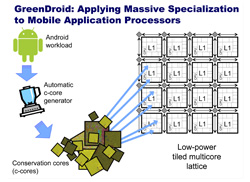 |
| An overview of the GreenDroid project from computer scientists at UC San Diego. |
Abstract:
GreenDroid chip prototype will deliver improved performance through specialized processors
By Daniel Kane
Computer Scientists Leverage Dark Silicon to Improve Smartphone Battery Life
La Jolla, CA | Posted on September 2nd, 2010A new smartphone chip prototype under development at the University of California, San Diego will improve smartphone efficiency by making use of "dark silicon" - the underused transistors in modern microprocessors. On August 23, UC San Diego computer scientists presented GreenDroid, the new smartphone chip prototype at the HotChips symposium in Palo Alto, CA.
Dark silicon refers to the huge swaths of silicon transistors on today's chips that are underused because there is not enough power to utilize all the transistors at the same time. The new GreenDroid chip prototype from computer scientists at UC San Diego will deliver improved performance through specialized processors fashioned from dark silicon. These processors are designed to run heavily used chunks of code, called "hot code," in Google's Android smartphone platform.
Computer science professors Michael Taylor and Steven Swanson from the Department of Computer Science and Engineering (CSE) at the UC San Diego Jacobs School of Engineering are leading the project.
"This is an exciting time for UCSD. Our students are designing a real multicore processing chip, in an advanced technology, that is simultaneously advancing the state-of-the art in both smartphone and processor design. This marks the first of what I hope is many such chips that will come out of the UCSD research community," said Taylor.
The GreenDroid presentation at HotChips caught the attention of IEEE Spectrum, EETimes and LightReading, which all ran stories.
While chip makers can now make similar types of specialized processors by hand, the UC San Diego computer scientists developed a fully automated system. It generates blueprints for specialized processors, called conservation cores, from source code extracted from applications.
GreenDroid conservation cores use 11 times less energy per instruction than an aggressive mobile application processor. Accounting for code running outside the conservation core still results in an increase in efficiency of 7.5 times compared to an aggressive mobile application processor, according to the computer scientists' HotChips presentation.
"Smartphones are a perfect match for our approach, since users spend most of their time running a core set of applications, and they demand long battery life. As mobile applications become more sophisticated, it's going to be harder and harder to meet that challenge. Conservation cores offer a solution that exploits a resource that will soon be quite plentiful - dark silicon," said Swanson.
Conservation cores also incorporate focused reconfigurability that allows them to adapt to small changes in the target application while still delivering efficiency gains.
Dark Silicon
This work is motivated by the growing problem of dark silicon, which refers to transistors on microprocessors that are forced to remain off most of the time because of power constraints.
"We don't have enough power to use all the transistors at once - that is the ‘utilization wall,'" said UC San Diego computer science graduate student Nathan Goulding who presented the team's GreenDroid chip at HotChips. Goulding led GreenDroid development, which is one part of the larger conservation core project.
"The utilization wall will change the way everyone builds processors," the computer scientists reported in their HotChips talk.
If this utilization wall problem is not solved, more transistors on computer chips will not necessarily lead to improved performance or problem solving capacity in each new chip generation.
Automated Hardware Maker
As a real-world prototype, the computer scientists from the UC San Diego Jacobs School of Engineering used dark silicon to build specialized circuits for specific tasks frequently performed by popular smartphone applications such as Web browsers, email software and music players. The computer scientists asked ‘where does most of the computation happen?'
They took answers to this question, and fed the relevant code into their automated tool chain.
"A chip that does MP3 decoding…people can build specialized logic for this by hand, but it's an enormous amount of effort and this doesn't scale well. Our approach is automated," said Goulding.
The computer scientists input pieces of code shared by multiple software applications for Android phones. The output at the end of the automated chain is a blueprint for specialized hardware. This specialized hardware will only execute some regions of the software code. The rest of the code, known as "cold code", is executed by the phone's general processor.
The computer scientists chose a smartphone for their chip prototype because mobile handsets are the new dominant computing platform. "Smartphones are going to be everywhere," said Goulding, "We said to ourselves, ‘let's make a prototype chip that saves energy on Android phones.'"
Learn more about GreenDroid at greendroid.ucsd.edu
####
For more information, please click here
Contacts:
Media Contact
Daniel Kane
(858)534-3262
Copyright © University of California, San Diego
If you have a comment, please Contact us.Issuers of news releases, not 7th Wave, Inc. or Nanotechnology Now, are solely responsible for the accuracy of the content.
Bookmark:


| Related News Press |
News and information
 Quantum computer improves AI predictions April 17th, 2026
Flexible sensor gains sensitivity under pressure April 17th, 2026
A reusable chip for particulate matter sensing April 17th, 2026
Detecting vibrational quantum beating in the predissociation dynamics of SF6 using time-resolved photoelectron spectroscopy April 17th, 2026
Possible Futures
A fundamentally new therapeutic approach to cystic fibrosis: Nanobody repairs cellular defect April 17th, 2026
UC Irvine physicists discover method to reverse ‘quantum scrambling’ : The work addresses the problem of information loss in quantum computing system April 17th, 2026
Chip Technology
A reusable chip for particulate matter sensing April 17th, 2026
Metasurfaces smooth light to boost magnetic sensing precision January 30th, 2026
Nanoelectronics
Lab to industry: InSe wafer-scale breakthrough for future electronics August 8th, 2025
Interdisciplinary: Rice team tackles the future of semiconductors Multiferroics could be the key to ultralow-energy computing October 6th, 2023
Key element for a scalable quantum computer: Physicists from Forschungszentrum Jülich and RWTH Aachen University demonstrate electron transport on a quantum chip September 23rd, 2022
Reduced power consumption in semiconductor devices September 23rd, 2022
Announcements
A fundamentally new therapeutic approach to cystic fibrosis: Nanobody repairs cellular defect April 17th, 2026
UC Irvine physicists discover method to reverse ‘quantum scrambling’ : The work addresses the problem of information loss in quantum computing system April 17th, 2026
Battery Technology/Capacitors/Generators/Piezoelectrics/Thermoelectrics/Energy storage
Decoding hydrogen‑bond network of electrolyte for cryogenic durable aqueous zinc‑ion batteries January 30th, 2026
COF scaffold membrane with gate‑lane nanostructure for efficient Li+/Mg2+ separation January 30th, 2026
MXene nanomaterials enter a new dimension Multilayer nanomaterial: MXene flakes created at Drexel University show new promise as 1D scrolls January 30th, 2026
 |
||
 |
||
| The latest news from around the world, FREE | ||
 |
||
|
|
||
| Premium Products | ||
 |
||
|
Only the news you want to read!
Learn More |
||
 |
||
|
Full-service, expert consulting
Learn More |
||
|
|
||