Home > Press > Researchers Control Collective Spin States Electrically at Room Temperature
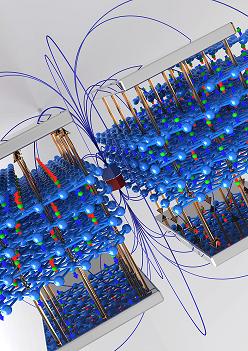 |
| This image is an artistic visualization of the atomic and magnetic moment structure of chromia. The presence of the permanent magnet in the center of the figure, with its magnetic stray-fields acting simultaneously with electric fields on chromia, captures the idea behind spintronics. Promising spintronic device concepts use an electrically controlled interface and surface magnetization. Surfaces of magnetoelectric materials such as chromia show roughness-insensitive, electrically switchable magnetization in the presence of a small symmetry breaking magnetic field opening up exciting prospects for spintronic applications. Credit: Christian Binek, Department of Physics and Astronomy, University of Nebraska-Lincoln |
Abstract:
Breakthrough paves way to store and process information in novel spin-electronics
Researchers Control Collective Spin States Electrically at Room Temperature
Arlington, VA | Posted on August 18th, 2010Processing large amounts of information in today's electronics requires large amounts of power, which results in heating. Heat can ruin modern electronics by potentially damaging the stuff that makes them work--the ever smaller and denser structures in a computer's "brain," the microprocessor that incorporates all of its logic functions.
So, researchers have been investigating something called "spintronics," a field of research that uses the spin state of electrons to pave the way for a future generation of advanced, fast, low-power, heat-limiting devices that perform memory and logic functions beyond today's microprocessors. The challenge: controlling electron spins with low power at room temperature instead of temperatures approaching absolute zero (-273 degrees Celsius) so their resulting technologies can carry out tasks in normal-use environments.
Now, new lab work at the University of Nebraska Lincoln (UNL) Materials Science and Engineering Center (MRSEC) may have made a significant breakthrough in the field of spintronics. Physicists there, led by professor Christian Binek, for the first time changed the orientation of a very large number of electron spins collectively at room temperature by pure electrical means, a feat that eventually could make devices that use spintronics more readily available for everyday uses.
Their method could revolutionize information technology by reducing power consumption, providing faster processing speeds and improving device function as compared to today's electronics.
How Spintronics Works
Spintronics works by collectively and uniformly controlling electron spin to encode information, that is, to convert information into digital code. Because devices derived from spintronics rely on electron spin, more devices can fit on a single chip. The UNL researchers found a new approach to collectively and uniformly manipulate electron spin that relies solely on pure voltage. By doing so, they were able to process magnetically encoded information by electrical means instead of using current, silicon-based, transistor technologies.
"Because potential devices developed on the basis of spintronics produce little to no heat, higher integration becomes feasible, allowing for more devices on a single chip, leading to faster speeds and more computing power," said Binek, lead researcher and an associate professor of physics at UNL.
The general rapid progress of information technology has been hampered by energy consumption and temperature concerns, he said. But spintronics presents a potential solution by making it possible to put more electronic microprocessors on a single "chip" without high-temperature effects.
The Breakthrough
The UNL MRSEC's team of scientists demonstrated a method that uses voltage to control electron spins at room temperature by growing a material that is easily magnetized on top of another exotic material called chromia.
The easily magnetized material, also called a "ferromagnetic film," carried the magnetization researchers wanted to use to electrically control the collective electron spin state. But since ferromagnets do not directly respond to electric fields, chromia--which produces excess magnetization when exposed to an electric field--was used to help transfer the influence of the electric field on the ferromagnetic film.
The UNL researchers controlled the collective spin state by applying a voltage with zero current to the chromia. They also were able to reverse the direction of all the spins in the ferromagnetic film. By doing this, they showed they could control electron spins in two distinct states, which is necessary to encode a "bit" of information, the basic unit of information in computing.
Information stored this way can be accessed immediately and processed with little to zero electric power consumption and vastly reduced heat.
"We changed the magnetic orientation by purely electrical means," said Binek. "That is to say applying a voltage and nothing more complicated is required. This makes it easy to store a 'bit' of information, and the information is not lost when power is lost to the device."
Next the research team will attempt to achieve the same effect with the help of chromia thin films in order to integrate their findings into micro or nanoelectronic devices. Once this is accomplished, the researchers want to make sure the effect can be made stable far above room temperature.
"We want to realize the variety of spintronic applications we have conceptually thought about for years," said Binek.
UNL Physics professor Peter Dowben along with assistant Physics professor and theorist Kirill Belashchenko contributed to the research by providing advanced spectroscopy methodology and major theoretical insights. They were helped by UNL graduate students Xi He, Yi Wang and UNL postdoctoral researcher Ning Wu. Anthony Caruso from the University of Missouri-Kansas City and Elio Vescovo from Brookhaven National Laboratory also contributed important research to the project.
The journal Nature Materials published the findings online June 20; the research was funded by UNL's Materials Research Science and Engineering Center (MRSEC), which is supported by the National Science Foundation's Division of Materials Research.
Investigators
Christian Binek
Peter Dowben
Kirill Belashchenko
Anthony Caruso
Elio Vescovo
Related Institutions/Organizations
University of Nebraska-Lincoln
University of Missouri-Kansas City
Brookhaven National Laboratory
Locations
Nebraska
Missouri
New York
Related Awards
#0547887 CAREER: Education and Research on Nanoscale Spintronic Systems and Heterostructures
www.nsf.gov/awardsearch/showAward.do?AwardNumber=0547887
Total Grants
$500,000
Related Websites
Robust isothermal electric control of exchange bias at room temperature:
www.nature.com/nmat/journal/v9/n7/full/nmat2785.html
####
For more information, please click here
Copyright © National Science Foundation
If you have a comment, please Contact us.Issuers of news releases, not 7th Wave, Inc. or Nanotechnology Now, are solely responsible for the accuracy of the content.
Bookmark:


| Related News Press |
News and information
 Quantum computer improves AI predictions April 17th, 2026
Flexible sensor gains sensitivity under pressure April 17th, 2026
A reusable chip for particulate matter sensing April 17th, 2026
Detecting vibrational quantum beating in the predissociation dynamics of SF6 using time-resolved photoelectron spectroscopy April 17th, 2026
Possible Futures
A fundamentally new therapeutic approach to cystic fibrosis: Nanobody repairs cellular defect April 17th, 2026
UC Irvine physicists discover method to reverse ‘quantum scrambling’ : The work addresses the problem of information loss in quantum computing system April 17th, 2026
Academic/Education
Rice University launches Rice Synthetic Biology Institute to improve lives January 12th, 2024
Multi-institution, $4.6 million NSF grant to fund nanotechnology training September 9th, 2022
Spintronics
Quantum materials: Electron spin measured for the first time June 9th, 2023
Nanoelectronics
Lab to industry: InSe wafer-scale breakthrough for future electronics August 8th, 2025
Interdisciplinary: Rice team tackles the future of semiconductors Multiferroics could be the key to ultralow-energy computing October 6th, 2023
Key element for a scalable quantum computer: Physicists from Forschungszentrum Jülich and RWTH Aachen University demonstrate electron transport on a quantum chip September 23rd, 2022
Reduced power consumption in semiconductor devices September 23rd, 2022
Announcements
A fundamentally new therapeutic approach to cystic fibrosis: Nanobody repairs cellular defect April 17th, 2026
UC Irvine physicists discover method to reverse ‘quantum scrambling’ : The work addresses the problem of information loss in quantum computing system April 17th, 2026
Grants/Sponsored Research/Awards/Scholarships/Gifts/Contests/Honors/Records
Quantum computer improves AI predictions April 17th, 2026
Detecting vibrational quantum beating in the predissociation dynamics of SF6 using time-resolved photoelectron spectroscopy April 17th, 2026
Metasurfaces smooth light to boost magnetic sensing precision January 30th, 2026
Research partnerships
Lab to industry: InSe wafer-scale breakthrough for future electronics August 8th, 2025
HKU physicists uncover hidden order in the quantum world through deconfined quantum critical points April 25th, 2025
 |
||
 |
||
| The latest news from around the world, FREE | ||
 |
||
|
|
||
| Premium Products | ||
 |
||
|
Only the news you want to read!
Learn More |
||
 |
||
|
Full-service, expert consulting
Learn More |
||
|
|
||