Home > Press > Shocking results from diamond anvil cell experiments
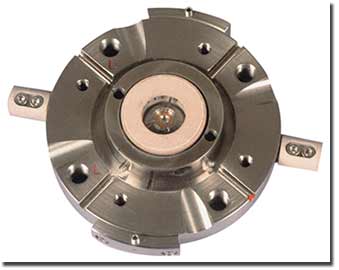 |
| The diamond anvil cell is small enough to fit in the palm of one’s hand, but it can compress a sample to extreme pressures up to about 3.6 million atmospheres at room temperature and 1.7 million atmospheres at 3,000°C. |
Abstract:
At first, nanoshocks may seem like something to describe the millions of aftershocks of a large earthquake. But Lawrence Livermore National Laboratory physicists are using an ultra-fast laser-based technique they dubbed "nanoshocks" for something entirely different.
Shocking results from diamond anvil cell experiments
Livermore, CA | Posted on July 7th, 2010In fact, the "nanoshocks" have such a small spatial scale that scientists can use them to study shock behavior in tiny samples such as thin films or other systems with microscopic dimensions (a few tens of micrometers). In particular they have used the technique to shock materials under high static pressure in a diamond anvil cell (DAC).
Using a DAC, which probes the behavior of materials under ultra-high pressures (and which requires small samples), the team statically compressed a sample of argon up to 78,000 atmospheres of pressure and then further shock compressed it up to a total of 280,000 atmospheres. They analyzed the propagating shock waves using an ultra-fast interferometric technique. They achieved combinations of pressures, temperatures and time scales that are otherwise inaccessible.
In some experiments they observed a metastable argon state that may have been superheated -- a state at a pressure and temperature at which argon would normally be liquid but because of the ultra-short time scale does not have enough time to melt.
"It can be used to study fundamental physical and chemical processes as well as improve our understanding of a wide range of real-world problems ranging from detonation phenomena to the interiors of planets," said LLNL physicist Jonathan Crowhurst, a co-author of a paper, which will appear in the July 15 edition of the Journal of Applied Physics.
The time scale is short enough to permit direct comparison with molecular dynamics simulations, which usually run for less than a nanosecond (one billionth of a second).
Shocked behavior in microscopic samples can consist of the behavior of shocked explosives before chemistry begins or the high density, low temperature states of light materials such as those that are found in giant gas planets, according to LLNL lead author Michael Armstrong.
"Essentially, this allows us to examine a very broad range of thermodynamic states, including states corresponding to planetary interiors and high density, low-temperature states that have been predicted to exhibit unobserved exotic behavior," Armstrong said.
For decades, compression experiments have been used to determine the thermodynamic states of materials at high pressures and temperatures. The results are necessary to correctly interpret seismic data, understand planetary composition and the evolution of the early solar system, shock-wave induced chemistry and fundamental issues in condensed matter physics.
Armstrong said their technique for launching and analyzing nanoshocks was so fast they were able to see behavior in microscopic samples that is inaccessible in experiments using static or single-shock wave compression.
Other LLNL team members include Sorin Bastea and Joseph Zaug.
####
About Lawrence Livermore National Laboratory
Founded in 1952, Lawrence Livermore National Laboratory is a national security laboratory, with a mission to ensure national security and apply science and technology to the important issues of our time. Lawrence Livermore National Laboratory is managed by Lawrence Livermore National Security, LLC for the U.S. Department of Energy's National Nuclear Security Administration.
For more information, please click here
Contacts:
Anne M. Stark
(925) 422-9799
Copyright © Lawrence Livermore National Laboratory
If you have a comment, please Contact us.Issuers of news releases, not 7th Wave, Inc. or Nanotechnology Now, are solely responsible for the accuracy of the content.
Bookmark:


| Related News Press |
Physics
 Simulating magnetization in a Heisenberg quantum spin chain April 5th, 2024
Nanoscale CL thermometry with lanthanide-doped heavy-metal oxide in TEM March 8th, 2024
News and information
Simulating magnetization in a Heisenberg quantum spin chain April 5th, 2024
NRL charters Navy’s quantum inertial navigation path to reduce drift April 5th, 2024
Discovery points path to flash-like memory for storing qubits: Rice find could hasten development of nonvolatile quantum memory April 5th, 2024
Chemistry
What heat can tell us about battery chemistry: using the Peltier effect to study lithium-ion cells March 8th, 2024
Nanoscale CL thermometry with lanthanide-doped heavy-metal oxide in TEM March 8th, 2024
Announcements
NRL charters Navy’s quantum inertial navigation path to reduce drift April 5th, 2024
Discovery points path to flash-like memory for storing qubits: Rice find could hasten development of nonvolatile quantum memory April 5th, 2024
Tools
Ferroelectrically modulate the Fermi level of graphene oxide to enhance SERS response November 3rd, 2023
The USTC realizes In situ electron paramagnetic resonance spectroscopy using single nanodiamond sensors November 3rd, 2023
Photonics/Optics/Lasers
With VECSELs towards the quantum internet Fraunhofer: IAF achieves record output power with VECSEL for quantum frequency converters April 5th, 2024
Nanoscale CL thermometry with lanthanide-doped heavy-metal oxide in TEM March 8th, 2024
Optically trapped quantum droplets of light can bind together to form macroscopic complexes March 8th, 2024
HKUST researchers develop new integration technique for efficient coupling of III-V and silicon February 16th, 2024
 |
||
 |
||
| The latest news from around the world, FREE | ||
 |
||
|
|
||
| Premium Products | ||
 |
||
|
Only the news you want to read!
Learn More |
||
 |
||
|
Full-service, expert consulting
Learn More |
||
|
|
||