Home > Press > Insights on quantum mechanics
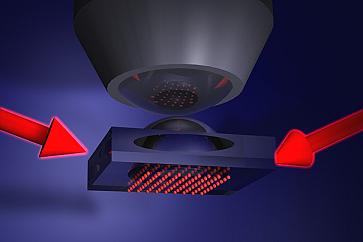 |
| This sketch shows how a quantum gas microscope hones in on individual atoms in the gas. |
Abstract:
Harvard physicists create simulative process to gauge unseen forces
By Steve Bradt, Harvard Staff Writer
Insights on quantum mechanics
Cambridge, MA | Posted on June 19th, 2010For the first time, physicists at Harvard University have tracked individual atoms in a gas cooled to extreme temperatures as the particles reorganized into a crystal, a process driven by quantum mechanics. The research, described in the journal Science, opens new possibilities for particle-by-particle study and engineering of artificial quantum materials.
"Much of modern technology is driven by engineering materials with novel properties, and the bizarre world of quantum mechanics can contribute to this engineering toolbox," said Markus Greiner, an assistant professor of physics at Harvard, who led the research team. "For example, quantum materials could be used to turn heat into electricity, or in cables that transport electricity very efficiently in a power grid."
"The challenge in understanding the behavior of such materials is that although we have many ideas about how they might work, we lack the tools to verify these theories by looking at and manipulating these materials at the most basic atomic level," Greiner said. "This is the problem we have set out to tackle."
To circumvent the challenges of studying such materials, Greiner and his colleagues created an artificial quantum material, a cold gas of rubidium atoms moving in a lattice made of light. This pancake-shaped cloud, known as a Bose-Einstein condensate, allowed them to study the physics of quantum materials at a much larger scale, essentially simulating what happens in a real material.
The physicists watched individual atoms participate in a dramatic collective transition between two states of matter, similar to the transition that happens when water freezes into ice. But this transition was driven not by temperature but by the researchers' manipulation of interactions between the atoms.
"We counted the number of atoms at each site of the lattice," said co-author Waseem Bakr, a graduate student in Harvard's Department of Physics. "When the interactions between the atoms are weak, the number of atoms varies significantly in different sites due to uncertainty that is intrinsic to quantum mechanics. When we increase the interactions, these fluctuations vanish, and the atoms arrange into an almost perfect crystal."
Such a transition from a superfluid state — in which particles can move with no resistance — to an insulating Mott state — where the atoms can no longer move — was first observed by Greiner and colleagues in 2001. However, a quantum gas microscope developed last year by Greiner's group now allows observation of individual atoms as they undergo this transition.
"This microscope is a versatile tool which should be able to shed light on many other phenomena related to quantum materials, such as magnetic materials," Greiner said. "It could even be used for computations that require enormous resources on current computers."
While a simulation similar to the current experiment could, in principle, be carried out on a computer, Greiner said that such an approach would quickly become infeasible for a system with more than a few dozen atoms.
Greiner and Bakr's co-authors in Harvard's Department of Physics and at the Harvard-MIT Center for Ultracold Atoms are Amy Peng, Eric Tai, Ruichao Ma, Jonathan Simon, Jonathon Gillen, and Lode Pollet, as well as Simon Foelling of Harvard and Ludwig-Maximilians-Universität in Munich. Their work was supported by the Army Research Office, the Defense Advanced Research Projects Agency, the Air Force Office of Scientific Research, the National Science Foundation, the Swiss National Science Foundation, and the Alfred P. Sloan Foundation.
####
For more information, please click here
Contacts:
Tel: 617.495.1000
Copyright © Harvard University
If you have a comment, please Contact us.Issuers of news releases, not 7th Wave, Inc. or Nanotechnology Now, are solely responsible for the accuracy of the content.
Bookmark:


| Related News Press |
Physics
 Simulating magnetization in a Heisenberg quantum spin chain April 5th, 2024
Chemical reactions can scramble quantum information as well as black holes April 5th, 2024
Nanoscale CL thermometry with lanthanide-doped heavy-metal oxide in TEM March 8th, 2024
Optically trapped quantum droplets of light can bind together to form macroscopic complexes March 8th, 2024
Govt.-Legislation/Regulation/Funding/Policy
NRL charters Navy’s quantum inertial navigation path to reduce drift April 5th, 2024
Discovery points path to flash-like memory for storing qubits: Rice find could hasten development of nonvolatile quantum memory April 5th, 2024
Chemical reactions can scramble quantum information as well as black holes April 5th, 2024
Possible Futures
Discovery points path to flash-like memory for storing qubits: Rice find could hasten development of nonvolatile quantum memory April 5th, 2024
With VECSELs towards the quantum internet Fraunhofer: IAF achieves record output power with VECSEL for quantum frequency converters April 5th, 2024
Academic/Education
Rice University launches Rice Synthetic Biology Institute to improve lives January 12th, 2024
Multi-institution, $4.6 million NSF grant to fund nanotechnology training September 9th, 2022
Announcements
NRL charters Navy’s quantum inertial navigation path to reduce drift April 5th, 2024
Discovery points path to flash-like memory for storing qubits: Rice find could hasten development of nonvolatile quantum memory April 5th, 2024
Tools
Ferroelectrically modulate the Fermi level of graphene oxide to enhance SERS response November 3rd, 2023
The USTC realizes In situ electron paramagnetic resonance spectroscopy using single nanodiamond sensors November 3rd, 2023
Research partnerships
Discovery points path to flash-like memory for storing qubits: Rice find could hasten development of nonvolatile quantum memory April 5th, 2024
Researchers’ approach may protect quantum computers from attacks March 8th, 2024
'Sudden death' of quantum fluctuations defies current theories of superconductivity: Study challenges the conventional wisdom of superconducting quantum transitions January 12th, 2024
Quantum nanoscience
Simulating magnetization in a Heisenberg quantum spin chain April 5th, 2024
Optically trapped quantum droplets of light can bind together to form macroscopic complexes March 8th, 2024
Bridging light and electrons January 12th, 2024
'Sudden death' of quantum fluctuations defies current theories of superconductivity: Study challenges the conventional wisdom of superconducting quantum transitions January 12th, 2024
 |
||
 |
||
| The latest news from around the world, FREE | ||
 |
||
|
|
||
| Premium Products | ||
 |
||
|
Only the news you want to read!
Learn More |
||
 |
||
|
Full-service, expert consulting
Learn More |
||
|
|
||