Home > Press > University of Leicester uses NanoSight to characterize marine viruses & bacteriophages
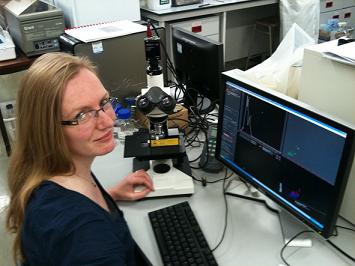 |
| The University of Leicester’s Dr Martha Clokie with her NanoSight LM10 system |
Abstract:
The Department of Infection, Immunity and Inflammation at the University of Leicester is using the NanoSight nanoparticle characterization system to count bacteriophage and marine viruses.
University of Leicester uses NanoSight to characterize marine viruses & bacteriophages
Salisbury, UK | Posted on June 8th, 2010Dr. Martha Clokie is a lecturer in microbiology. Her interests are focussed on the ecology and molecular biology of bacteriophages and their relationship with bacterial hosts; ranging from bacterial pathogens to environmentally important cyanobacteria; exploiting bacteriophages and phage-derived products as an alternative to treating antibiotic resistant bacterial infections.
Dr. Clokie has been using the NanoSight system to study cyanobacteria and their viruses which involves the accurate enumeration of viral particles. Prior to the use of the NanoSight system, Dr. Clokie would use time-consuming plaque assays to count viruses, this involves relatively large volumes of cyanobacterial culture and takes up to four weeks to obtain results. Now using NanoSight's unique nanoparticle tracking analysis, she is able to produce data in minutes and with no culturing required. Data from the NanoSight appears to correlate well with data from conventional plaque assays. With the typical viruses in the 100-300nm range and marine samples already being in the concentration range of 106 - 107 parts/ml, this is utilizing the sweet spot of the NanoSight technology which tracks and counts light scattered particle by particle.
Of her results to date, Dr. Clokie says it looks to provide a very promising method with significant ease of use, time-saving advantages. "Being able to visualise the sample without dilution gives me confidence in the results. The NanoSight has also shown advantages over flow cytometry where signal to noise issues can sometimes be a problem for us. This speed of data collection will allow me to probe far more data than I could do otherwise and should really allow the cyanobacterial/phage dynamic to be probed."
To learn more about nanoparticle characterization using Nanoparticle Tracking Analysis (NTA), please visit the company's website (www.nanosight.com) and register for the latest issue of NanoTrail, the company's electronic newsletter.
####
About NanoSight
NanoSight Limited, of Salisbury, UK, provides unique nanoparticle characterization technology. “Nanoparticle Tracking Analysis” (NTA) detects and visualizes populations of nanoparticles in liquids down to 10nm (material dependent) and measures the size of each particle from direct observations of diffusion. This particle-by-particle methodology goes beyond traditional light scattering techniques such as Dynamic Light Scattering (DLS), or Photon Correlation Spectroscopy (PCS), in providing high-resolution particle size distributions. Additionally NanoSight measures concentration and validates all data with video of particles moving under Brownian motion.
This characterization information is highly informative in understanding the more complex suspensions in biological systems, hence its wide application in development of drug delivery systems, viral vaccines, the study of toxicology of nanoparticles and their environmental fate and in biomarker detection. This real-time data also provides insight into the kinetics of protein aggregation and other time-dependent phenomena in a quantitative manner, at deeply sub-micron sizes.
NanoSight has more than 250 systems installed worldwide with users including BASF, BP, GlaxoSmithKline, Novartis, 3M Corp., Roche, Solvay and Unilever together with many universities and research institutes. There are currently 100+ third party papers citing NanoSight results, with this reference base growing very rapidly as NanoSight consolidates its key contribution to nanoparticle characterization.
For more information, please click here
Contacts:
Jezz Leckenby
+44 (0) 1799 521881
Copyright © NanoSight
If you have a comment, please Contact us.Issuers of news releases, not 7th Wave, Inc. or Nanotechnology Now, are solely responsible for the accuracy of the content.
Bookmark:


| Related News Press |
News and information
 Quantum computer improves AI predictions April 17th, 2026
Flexible sensor gains sensitivity under pressure April 17th, 2026
A reusable chip for particulate matter sensing April 17th, 2026
Detecting vibrational quantum beating in the predissociation dynamics of SF6 using time-resolved photoelectron spectroscopy April 17th, 2026
Marine/Watercraft
Strain-sensing smart skin ready to deploy: Nanotube-embedded coating detects threats from wear and tear in large structures July 15th, 2022
A sunlight-driven “self-healing” anti-corrosion coating May 27th, 2022
Quantum tech in space? Scientists design remote monitoring system for inaccessible quantum devices February 11th, 2022
Announcements
A fundamentally new therapeutic approach to cystic fibrosis: Nanobody repairs cellular defect April 17th, 2026
UC Irvine physicists discover method to reverse ‘quantum scrambling’ : The work addresses the problem of information loss in quantum computing system April 17th, 2026
Tools
Metasurfaces smooth light to boost magnetic sensing precision January 30th, 2026
From sensors to smart systems: the rise of AI-driven photonic noses January 30th, 2026
Japan launches fully domestically produced quantum computer: Expo visitors to experience quantum computing firsthand August 8th, 2025
New-Contracts/Sales/Customers
Bruker Light-Sheet Microscopes at Major Comprehensive Cancer Center: New Advanced Imaging Center Powered by Two MuVi and LCS SPIM Microscopes March 25th, 2021
Arrowhead Pharmaceuticals Announces Closing of Agreement with Takeda November 27th, 2020
Veeco Announces Aledia Order of 300mm MOCVD Equipment for microLED Displays: Propel™ Platform First 300mm System with EFEM Designed for Advanced Display Applications October 20th, 2020
GREENWAVES TECHNOLOGIES Announces Next Generation GAP9 Hearables Platform Using GLOBALFOUNDRIES 22FDX Solution October 16th, 2020
 |
||
 |
||
| The latest news from around the world, FREE | ||
 |
||
|
|
||
| Premium Products | ||
 |
||
|
Only the news you want to read!
Learn More |
||
 |
||
|
Full-service, expert consulting
Learn More |
||
|
|
||