Home > Press > Small, Fast, and High Contrast
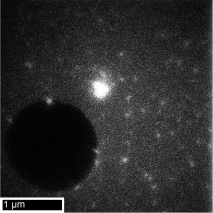 |
| Annular dark field dynamic transmission electron microscopy (ADF-DTEM) can produce high-contrast images of catalyst nanoparticles with 15 ns temporal resolution (see picture). The contrast improvement provided by this technique enables imaging studies on the dynamics of heterogeneous catalysts at unprecedented spatial and temporal resolution. |
Abstract:
Imaging technique enables studies on the dynamics of nanocatalysts at unprecedented spatial and temporal resolution
Small, Fast, and High Contrast
Weinheim, Germany | Posted on June 2nd, 2010Tiny catalyst materials may take part in a rich variety of very fast physical and chemical processes which can now be revealed more precisely thanks to a new imaging mode for dynamic transmission electron microscopes (DTEMs) developed by US scientists. "Our group has developed a dark-field imaging mode for DTEM that enables the highest combined spatial and temporal resolution imaging of nanoparticles achieved thus far", says Daniel Masiel of the University of California (Davis) and lead author of the work, which was published online in ChemPhysChem. According to Masiel, annular dark-field DTEM (ADF-DTEM) could, for the first time, enable direct time-resolved observation of processes such as nanowire growth, catalyst poisoning, and Ostwald ripening at nanosecond timescales.
A DTEM is a transmission electron microscope that has been modified to include a laser-driven photocathode that can produce a single intense pulse of electrons with a duration of only 15 ns. While the instrument has the potential to provide insight into nanoparticle catalyst dynamics by enabling direct imaging with high spatial and temporal resolution, the limited signal-to-background ratios attainable for dispersed nanoparticle samples have made such studies difficult to perform at optimal resolutions. To overcome these limitations, Masiel and co-workers have fabricated an annular objective lens aperture that permits images to be obtained with a threefold increase in the signal-to-background ratio. This annular dark-field imaging mode improves the contrast attainable in 15 ns-pulsed electron images and allows particles as small as 30 nm in diameter to be observed (see picture: single-shot pulsed dark-field DTEM image of tiny gold particles dispersed on a holey carbon film at 15 ns time resolution.)
Other techniques such as coherent diffractive imaging (using coherent X-rays) or in situ TEM offer direct imaging data but at the cost of either spatial or temporal resolution. This is not the case for ADF-DTEM, the researchers say—and they are sure that the new method will find applications in important fields of research: "By enabling the scientific community direct experimental insight into the behavior of nanometer-scale systems at nanosecond time intervals, ADF-DTEM promises to give engineers and scientists a powerful method for exploring systems that are at the core of some of the most crucial energy technologies of both today and tomorrow", Masiel says.
Author: Daniel Masiel, Ting Guo, University of California, Davis (USA), nanofast.ucdavis.edu/
Title: Time-Resolved Annular Dark Field Imaging of Catalyst Nanoparticles
ChemPhysChem 2010, 11, No. 10, Permalink to the article: dx.doi.org/10.1002/cphc.201000274
####
For more information, please click here
Copyright © ChemPhysChem
If you have a comment, please Contact us.Issuers of news releases, not 7th Wave, Inc. or Nanotechnology Now, are solely responsible for the accuracy of the content.
Bookmark:


| Related News Press |
News and information
 Simulating magnetization in a Heisenberg quantum spin chain April 5th, 2024
NRL charters Navy’s quantum inertial navigation path to reduce drift April 5th, 2024
Discovery points path to flash-like memory for storing qubits: Rice find could hasten development of nonvolatile quantum memory April 5th, 2024
Chemistry
What heat can tell us about battery chemistry: using the Peltier effect to study lithium-ion cells March 8th, 2024
Nanoscale CL thermometry with lanthanide-doped heavy-metal oxide in TEM March 8th, 2024
Announcements
NRL charters Navy’s quantum inertial navigation path to reduce drift April 5th, 2024
Discovery points path to flash-like memory for storing qubits: Rice find could hasten development of nonvolatile quantum memory April 5th, 2024
Tools
Ferroelectrically modulate the Fermi level of graphene oxide to enhance SERS response November 3rd, 2023
The USTC realizes In situ electron paramagnetic resonance spectroscopy using single nanodiamond sensors November 3rd, 2023
 |
||
 |
||
| The latest news from around the world, FREE | ||
 |
||
|
|
||
| Premium Products | ||
 |
||
|
Only the news you want to read!
Learn More |
||
 |
||
|
Full-service, expert consulting
Learn More |
||
|
|
||