Home > Press > Penn-Led Collaboration Mimics Library of Bio-Membranes for Use In Nanomedicine, Drug Delivery
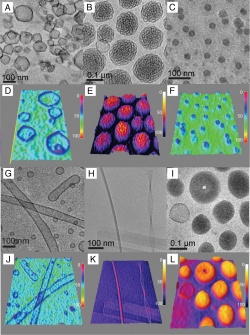 |
| Cryo-TEM and 3-D intensity profiles of (A and D) polygonal dendrimersomes. (B and E) Bicontinuous cubic particles co-exist with low concentration of spherical dendrimersomes. (C and F) Micelles. (G and J) Tubular dendrimersomes. (H and K) Rodlike, ribbon and helical micelles. (I and L) Disk-like micelles and toroids. Credit: University of Pennsylvania |
Abstract:
An international collaboration led by chemists and engineers from the University of Pennsylvania has prepared a library of synthetic biomaterials that mimic cellular membranes and that show promise in targeted delivery of cancer drugs, gene therapy, proteins, imaging and diagnostic agents and cosmetics safely to the body in the emerging field called nanomedicine.
The study appears in the current issue of the journal Science.
Penn-Led Collaboration Mimics Library of Bio-Membranes for Use In Nanomedicine, Drug Delivery
Philadelphia, PA | Posted on May 22nd, 2010The research provides the first description of the preparation, structure, self-assembly and mechanical properties of vesicles and other selected complex nano-assemblies made from Janus dendrimers.
The so-called dendrimersomes are stable, bilayer vesicles that spontaneously form from the exact chemical composition of Janus dendrimers. The team reported a myriad of bilayer capsule populations, uniform in size, stable in time in a large variety of media and temperatures, that are tunable by temperature and chemistry with superior mechanical properties to regular liposomes and impermeable to encapsulated compounds. They are capable of incorporating pore-forming proteins, can assemble with structure-directing phospholipids and block copolymers and offer a molecular periphery suitable for chemical functionalization without affecting their self-assembly.
Co-authors Virgil Percec of Penn's Department of Chemistry and Daniel A. Hammer of Penn's Department of Bioengineering, joined by Frank Bates and Timothy Lodge of the University of Minnesota, Michael Klein of Temple University and Kari Rissanen of the Jyväskylä University, in Finland, have chemically coupled hydrophilic and hydrophobic dendrons to create amphiphilic Janus dendrimers with a rich palette of morphologies including cubosomes, disks, tubular vesicles and helical ribbons and confirmed the assembled structures using cryogenic transmission electron microscopy and fluorescence microscopy.
"Dendrimersomes marry the stability and mechanical strength obtainable from polymersomes, vesicles made from block copolymers, with the biological function of stabilized phospholipid liposomes," said Percec, the P. Roy Vagelos Chair and Professor of Chemistry at Penn, "but with superior uniformity of size, ease of formation and chemical functionalization."
"These materials show special promise because their membranes are the thickness of natural bilayer membranes, but they have superior and tunable materials properties," said Hammer, the Alfred G. and Meta A. Ennis Professor of Bioengineering at Penn. "Because of their membrane thickness, it will be more straightforward to incorporate biological components into the vesicle membranes, such as receptors and channels."
"No other single class of molecules including block copolymers and lipids is known to assemble in water into such a diversity of supramolecular structures," said Bates, the Regents Professor and Head of the Chemical Engineering and Materials Science Department at the University of Minnesota.
Self-assembled nanostructures, obtained from natural and synthetic amphiphiles, increasingly serve as mimics of biological membranes and enable the targeted delivery of drugs, nucleic acids, proteins, gene therapy and imaging agents for diagnostic medicine. The challenge for researchers is creating these precise molecular arrangements that combine to function as safe biological carriers while carrying payload within.
Janus dendrimer assemblies offer several advantages to other competing technologies for nano-particle delivery. Liposomes are mimics of cell membranes assembled from natural phospholipids or from synthetic amphiphiles, including polymersomes. But, liposomes are not stable, even at room temperature, and vary widely in size, requiring tedious stabilization and fractionation for all practical applications. Polymersomes, on the other hand, are stable but polydisperse, and most of them are not biocompatible, requiring scientific intervention to combine the best properties of both for nanomedicine. Dendrimersomes offer stability, monodispersity, tenability and versatility, and they significantly advance the science of self-assembled nanostructures for biological and medical applications.
The study was conducted by Percec, Daniela A. Wilson, Pawaret Leowanawat, Christopher J. Wilson, Andrew D. Hughes, Emad Aqad, Brad M. Rosen, Andreea O. Argintaru, Monika J. Sienkowska and Mark S. Kaucher of Penn's Department of Chemistry; Hammer of the Department of Bioengineering, the Department of Chemical and Biomolecular Engineering and the Institute for Medicine and Engineering at Penn; Dalia H. Levine and Anthony J. Kim of Penn's Department of Chemical and Biomolecular Engineering; Bates, Kevin P. Davis and Timothy P. Lodge of the University of Minnesota; Michael L. Klein and Russell H. DeVane of Temple University; Kari Rissanen and Jarmo Ropponen of the University of Jyväskylä in Finland; and Sami Nummelin of the University of Jyväskylä and Aalto University, both in Finland.
Research was funded by National Science Foundation-funded grants at the University of Pennsylvania and the University of Minnesota, as well as by the Academy of Finland, Temple University and the P. Roy Vagelos Chair at the University of Pennsylvania.
####
For more information, please click here
Contacts:
Media Contact:
Jordan Reese
215-573-6604
Copyright © University of Pennsylvania
If you have a comment, please Contact us.Issuers of news releases, not 7th Wave, Inc. or Nanotechnology Now, are solely responsible for the accuracy of the content.
Bookmark:


| Related News Press |
News and information
 Quantum computer improves AI predictions April 17th, 2026
Flexible sensor gains sensitivity under pressure April 17th, 2026
A reusable chip for particulate matter sensing April 17th, 2026
Detecting vibrational quantum beating in the predissociation dynamics of SF6 using time-resolved photoelectron spectroscopy April 17th, 2026
Synthetic Biology
New micromaterial releases nanoparticles that selectively destroy cancer cells April 5th, 2024
Rice University launches Rice Synthetic Biology Institute to improve lives January 12th, 2024
Govt.-Legislation/Regulation/Funding/Policy
Quantum computer improves AI predictions April 17th, 2026
Metasurfaces smooth light to boost magnetic sensing precision January 30th, 2026
New imaging approach transforms study of bacterial biofilms August 8th, 2025
Possible Futures
A fundamentally new therapeutic approach to cystic fibrosis: Nanobody repairs cellular defect April 17th, 2026
UC Irvine physicists discover method to reverse ‘quantum scrambling’ : The work addresses the problem of information loss in quantum computing system April 17th, 2026
Academic/Education
Rice University launches Rice Synthetic Biology Institute to improve lives January 12th, 2024
Multi-institution, $4.6 million NSF grant to fund nanotechnology training September 9th, 2022
Self Assembly
Diamond glitter: A play of colors with artificial DNA crystals May 17th, 2024
Liquid crystal templated chiral nanomaterials October 14th, 2022
Nanoclusters self-organize into centimeter-scale hierarchical assemblies April 22nd, 2022
Atom by atom: building precise smaller nanoparticles with templates March 4th, 2022
Nanomedicine
A fundamentally new therapeutic approach to cystic fibrosis: Nanobody repairs cellular defect April 17th, 2026
New molecular technology targets tumors and simultaneously silences two ‘undruggable’ cancer genes August 8th, 2025
New imaging approach transforms study of bacterial biofilms August 8th, 2025
Electrifying results shed light on graphene foam as a potential material for lab grown cartilage June 6th, 2025
Announcements
A fundamentally new therapeutic approach to cystic fibrosis: Nanobody repairs cellular defect April 17th, 2026
UC Irvine physicists discover method to reverse ‘quantum scrambling’ : The work addresses the problem of information loss in quantum computing system April 17th, 2026
Personal Care/Cosmetics
DGIST and New Life Group launched a research project on "Functional beauty and health products using the latest nanotechnology" May 12th, 2023
A Comprehensive Guide: The Future of Nanotechnology September 13th, 2018
Graphene finds new application as anti-static hair dye: New formula works as well as commercial permanent dyes without chemically altering hairs March 22nd, 2018
Programmable materials find strength in molecular repetition May 23rd, 2016
Safety-Nanoparticles/Risk management
Tiny nanosheets, big leap: A new sensor detects ethanol at ultra-low levels January 30th, 2026
Onion-like nanoparticles found in aircraft exhaust May 14th, 2025
Closing the gaps — MXene-coating filters can enhance performance and reusability February 28th, 2025
Nanobiotechnology
A fundamentally new therapeutic approach to cystic fibrosis: Nanobody repairs cellular defect April 17th, 2026
New molecular technology targets tumors and simultaneously silences two ‘undruggable’ cancer genes August 8th, 2025
New imaging approach transforms study of bacterial biofilms August 8th, 2025
Electrifying results shed light on graphene foam as a potential material for lab grown cartilage June 6th, 2025
Research partnerships
Lab to industry: InSe wafer-scale breakthrough for future electronics August 8th, 2025
HKU physicists uncover hidden order in the quantum world through deconfined quantum critical points April 25th, 2025
 |
||
 |
||
| The latest news from around the world, FREE | ||
 |
||
|
|
||
| Premium Products | ||
 |
||
|
Only the news you want to read!
Learn More |
||
 |
||
|
Full-service, expert consulting
Learn More |
||
|
|
||