Home > Press > Mysterious quantum forces unraveled
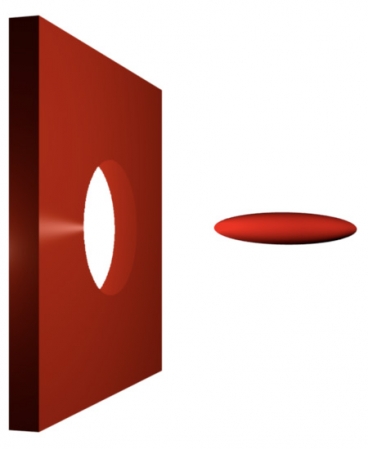 |
| New computational techniques developed at MIT confirmed that the complex quantum effects known as Casimir forces would cause tiny objects with the shapes shown here to repel each other rather than attract. Image courtesy of Alejandro Rodriguez. |
Abstract:
MIT researchers find a way to calculate the effects of Casimir forces, offering a way to keep micromachines' parts from sticking together.
By Larry Hardesty, MIT News Office
Mysterious quantum forces unraveled
Cambridge, MA | Posted on May 12th, 2010Discovered in 1948, Casimir forces are complicated quantum forces that affect only objects that are very, very close together. They're so subtle that for most of the 60-odd years since their discovery, engineers have safely ignored them. But in the age of tiny electromechanical devices like the accelerometers in the iPhone or the micromirrors in digital projectors, Casimir forces have emerged as troublemakers, since they can cause micromachines' tiny moving parts to stick together.
MIT researchers have developed a powerful new tool for calculating the effects of Casimir forces, with ramifications for both basic physics and the design of microelectromechanical systems (MEMS). One of the researchers' most recent discoveries using the new tool was a way to arrange tiny objects so that the ordinarily attractive Casimir forces become repulsive. If engineers can design MEMS so that the Casimir forces actually prevent their moving parts from sticking together — rather than causing them to stick — it could cut down substantially on the failure rate of existing MEMS. It could also help enable new, affordable MEMS devices, like tiny medical or scientific sensors, or microfluidics devices that enable hundreds of chemical or biological experiments to be performed in parallel.
Ghostly presence
Quantum mechanics has bequeathed a very weird picture of the universe to modern physicists. One of its features is a cadre of new subatomic particles that are constantly flashing in and out of existence in an almost undetectably short span of time. (The Higgs boson, a theoretically predicted particle that the Large Hadron Collider in Switzerland is trying to detect for the first time, is expected to appear for only a few sextillionths of a second.) There are so many of these transient particles in space — even in a vacuum — moving in so many different directions that the forces they exert generally balance each other out. For most purposes, the particles can be ignored. But when objects get very close together, there's little room for particles to flash into existence between them. Consequently, there are fewer transient particles in between the objects to offset the forces exerted by the transient particles around them, and the difference in pressure ends up pushing the objects toward each other.
In the 1960s, physicists developed a mathematical formula that, in principle, describes the effects of Casimir forces on any number of tiny objects, with any shape. But in the vast majority of cases, that formula remained impossibly hard to solve. "People think that if you have a formula, then you can evaluate it. That's not true at all," says Steven Johnson, an associate professor of applied mathematics, who helped develop the new tools. "There was a formula that was written down by Einstein that describes gravity. They still don't know what all the consequences of this formula are." For decades, the formula for Casimir forces was in the same boat. Physicists could solve it for only a small number of cases, such as that of two parallel plates. Then, in 2006, came a breakthrough: MIT Professor of Physics Mehran Kardar demonstrated a way to solve the formula for a plate and a cylinder.
Calculating the incalculable
In a paper appearing this week in Proceedings of the National Academy of Sciences, Johnson, physics PhD students Alexander McCauley and Alejandro Rodriguez (the paper's lead author), and John Joannopoulos, the Francis Wright Davis Professor of Physics, describe a way to solve Casimir-force equations for any number of objects, with any conceivable shape.
The researchers' insight is that the effects of Casimir forces on objects 100 nanometers apart can be precisely modeled using objects 100,000 times as big, 100,000 times as far apart, immersed in a fluid that conducts electricity. Instead of calculating the forces exerted by tiny particles flashing into existence around the tiny objects, the researchers calculate the strength of an electromagnetic field at various points around the much larger ones. In their paper, they prove that these computations are mathematically equivalent.
For objects with odd shapes, calculating electromagnetic-field strength in a conducting fluid is still fairly complicated. But it's eminently feasible using off-the-shelf engineering software.
"Analytically," says Diego Dalvit, a specialist in Casimir forces at the Los Alamos National Laboratory, "it's almost impossible to do exact calculations of the Casimir force, unless you have some very special geometries." With the MIT researchers' technique, however, "in principle, you can tackle any geometry. And this is useful. Very useful."
Since Casimir forces can cause the moving parts of MEMS to stick together, Dalvit says, "One of the holy grails in Casimir physics is to find geometries where you can get repulsion" rather than attraction. And that's exactly what the new techniques allowed the MIT researchers to do. In a separate paper published in March, physicist Michael Levin of Harvard University's Society of Fellows, together with the MIT researchers, described the first arrangement of materials that enable Casimir forces to cause repulsion in a vacuum.
Dalvit points out, however, that physicists using the new technique must still rely on intuition when devising systems of tiny objects with useful properties. "Once you have an intuition of what geometries will cause repulsion, then the [technique] can tell you whether there is repulsion or not," Dalvit says. But by themselves, the tools cannot identify geometries that cause repulsion.
####
For more information, please click here
Copyright © MIT
If you have a comment, please Contact us.Issuers of news releases, not 7th Wave, Inc. or Nanotechnology Now, are solely responsible for the accuracy of the content.
Bookmark:


| Related News Press |
News and information
 Simulating magnetization in a Heisenberg quantum spin chain April 5th, 2024
NRL charters Navy’s quantum inertial navigation path to reduce drift April 5th, 2024
Discovery points path to flash-like memory for storing qubits: Rice find could hasten development of nonvolatile quantum memory April 5th, 2024
Microfluidics/Nanofluidics
Implantable device shrinks pancreatic tumors: Taming pancreatic cancer with intratumoral immunotherapy April 14th, 2023
Researchers design new inks for 3D-printable wearable bioelectronics: Potential uses include printing electronic tattoos for medical tracking applications August 19th, 2022
Oregon State University research pushes closer to new therapy for pancreatic cancer May 6th, 2022
Possible Futures
Discovery points path to flash-like memory for storing qubits: Rice find could hasten development of nonvolatile quantum memory April 5th, 2024
With VECSELs towards the quantum internet Fraunhofer: IAF achieves record output power with VECSEL for quantum frequency converters April 5th, 2024
Academic/Education
Rice University launches Rice Synthetic Biology Institute to improve lives January 12th, 2024
Multi-institution, $4.6 million NSF grant to fund nanotechnology training September 9th, 2022
MEMS
Nanomedicine
New micromaterial releases nanoparticles that selectively destroy cancer cells April 5th, 2024
Good as gold - improving infectious disease testing with gold nanoparticles April 5th, 2024
Researchers develop artificial building blocks of life March 8th, 2024
Sensors
Discoveries
Chemical reactions can scramble quantum information as well as black holes April 5th, 2024
New micromaterial releases nanoparticles that selectively destroy cancer cells April 5th, 2024
Utilizing palladium for addressing contact issues of buried oxide thin film transistors April 5th, 2024
Announcements
NRL charters Navy’s quantum inertial navigation path to reduce drift April 5th, 2024
Discovery points path to flash-like memory for storing qubits: Rice find could hasten development of nonvolatile quantum memory April 5th, 2024
Nanobiotechnology
New micromaterial releases nanoparticles that selectively destroy cancer cells April 5th, 2024
Good as gold - improving infectious disease testing with gold nanoparticles April 5th, 2024
Researchers develop artificial building blocks of life March 8th, 2024
Quantum nanoscience
Simulating magnetization in a Heisenberg quantum spin chain April 5th, 2024
Optically trapped quantum droplets of light can bind together to form macroscopic complexes March 8th, 2024
Bridging light and electrons January 12th, 2024
'Sudden death' of quantum fluctuations defies current theories of superconductivity: Study challenges the conventional wisdom of superconducting quantum transitions January 12th, 2024
 |
||
 |
||
| The latest news from around the world, FREE | ||
 |
||
|
|
||
| Premium Products | ||
 |
||
|
Only the news you want to read!
Learn More |
||
 |
||
|
Full-service, expert consulting
Learn More |
||
|
|
||