Home > Press > Survey: Hiding Risks Can Hurt Public Support For Nanotechnology
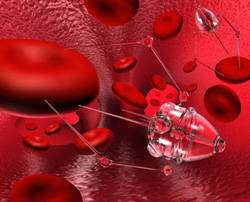 |
| This illustration was used to represent a nanoscale medical device in the national survey on public attitudes towards the use of nanotechnology for human enhancement. |
Abstract:
A new national survey on public attitudes toward medical applications and physical enhancements that rely on nanotechnology shows that support for the technology increases when the public is informed of the technology's risks as well as its benefits - at least among those people who have heard of nanotechnology.
By Matt Shipman
Survey: Hiding Risks Can Hurt Public Support For Nanotechnology
Raleigh, NC | Posted on May 4th, 2010The survey, which was conducted by researchers at North Carolina State University and Arizona State University (ASU), also found that discussing risks decreased support among those people who had never previously heard of nanotechnology - but not by much.
"The survey suggests that researchers, industries and policymakers should not be afraid to display the risks as well as the benefits of nanotechnology," says Dr. Michael Cobb, an associate professor of political science at NC State who conducted the survey. "We found that when people know something about nanotechnologies for human enhancement, they are more supportive of it when they are presented with balanced information about its risks and benefits."
The survey was conducted by Cobb in collaboration with Drs. Clark Miller and Sean Hays of ASU, and was funded by the Center for Nanotechnology in Society at ASU.
However, talking about risks did not boost support among all segments of the population. Those who had never heard of nanotechnology prior to the survey were slightly less supportive when told of its potential risks.
In addition to asking participants how much they supported the use of nanotechnology for human enhancements, they were also asked how beneficial and risky they thought these technologies would be, whether they were worried about not getting access to them, and who should pay for them - health insurance companies or individuals paying out-of-pocket. The potential enhancements addressed in the survey run the gamut from advanced cancer treatments to bionic limbs designed to impart greater physical strength.
One segment of participants was shown an image of an unrealistic illustration meant to represent a nanoscale medical device. A second segment was shown the image and given a "therapeutic" framing statement that described the technology as being able to restore an ill person to full health. A third segment was given the image, along with an "enhancement" framing statement that described the technology as being able to make humans faster, stronger and smarter. Two additional segments were given the image, the framing statements and information about potential health risks. And a final segment of participants was not given the image, a framing statement or risk information.
The survey found that describing the technology as therapeutic resulted in much greater public support for the technology, as well as a greater perception of its potential benefits. The therapeutic frame also resulted in increased support for health insurance coverage of nanotech treatments once they become available, and increased concerns that people wouldn't be able to afford such treatments without insurance coverage.
"These findings suggest that researchers, policymakers and industries would be well advised to focus their research efforts on developing therapeutic technologies, rather than enhancements, because that is the area with the greatest public support," Cobb says.
The use of the nanotech image did not have a significant overall impact on participants' support, but did alarm people who were not previously familiar with nanotechnology - making them less likely to support it.
The survey was conducted by Knowledge Networks between April 2-13. The survey included 849 participants, and has a margin of error of plus or minus 3.3 percent.
NC State's Department of Political Science is part of the university's College of Humanities and Social Sciences.
####
For more information, please click here
Contacts:
Matt Shipman
News Services
919.515.6386
Dr. Michael Cobb
919.513.3709
Copyright © North Carolina State University
If you have a comment, please Contact us.Issuers of news releases, not 7th Wave, Inc. or Nanotechnology Now, are solely responsible for the accuracy of the content.
Bookmark:


| Related News Press |
News and information
 Simulating magnetization in a Heisenberg quantum spin chain April 5th, 2024
NRL charters Navy’s quantum inertial navigation path to reduce drift April 5th, 2024
Discovery points path to flash-like memory for storing qubits: Rice find could hasten development of nonvolatile quantum memory April 5th, 2024
Ethics
Artificial Intelligence Centered Cancer Nanomedicine: Diagnostics, Therapeutics and Bioethics June 3rd, 2022
Iran to hold intl. school on application of nanomaterials in medicine September 20th, 2016
Synthetic biology needs robust safety mechanisms before real world application: Ethics and technology hold the key to the success of synthetic biology September 17th, 2015
March 2016; 6th Int'l Conference on Nanostructures in Iran July 29th, 2015
Preparing for Nano
Disruptive by Design: Nano Now February 1st, 2019
How nanoscience will improve our health and lives in the coming years: Targeted medicine deliveries and increased energy efficiency are just two of many ways October 26th, 2016
Searching for a nanotech self-organizing principle May 1st, 2016
Govt.-Legislation/Regulation/Funding/Policy
NRL charters Navy’s quantum inertial navigation path to reduce drift April 5th, 2024
Discovery points path to flash-like memory for storing qubits: Rice find could hasten development of nonvolatile quantum memory April 5th, 2024
Chemical reactions can scramble quantum information as well as black holes April 5th, 2024
Possible Futures
Discovery points path to flash-like memory for storing qubits: Rice find could hasten development of nonvolatile quantum memory April 5th, 2024
With VECSELs towards the quantum internet Fraunhofer: IAF achieves record output power with VECSEL for quantum frequency converters April 5th, 2024
Nanomedicine
New micromaterial releases nanoparticles that selectively destroy cancer cells April 5th, 2024
Good as gold - improving infectious disease testing with gold nanoparticles April 5th, 2024
Researchers develop artificial building blocks of life March 8th, 2024
Announcements
NRL charters Navy’s quantum inertial navigation path to reduce drift April 5th, 2024
Discovery points path to flash-like memory for storing qubits: Rice find could hasten development of nonvolatile quantum memory April 5th, 2024
Nanobiotechnology
New micromaterial releases nanoparticles that selectively destroy cancer cells April 5th, 2024
Good as gold - improving infectious disease testing with gold nanoparticles April 5th, 2024
Researchers develop artificial building blocks of life March 8th, 2024
 |
||
 |
||
| The latest news from around the world, FREE | ||
 |
||
|
|
||
| Premium Products | ||
 |
||
|
Only the news you want to read!
Learn More |
||
 |
||
|
Full-service, expert consulting
Learn More |
||
|
|
||