Home > Press > Liquid-solid interactions, as never before seen
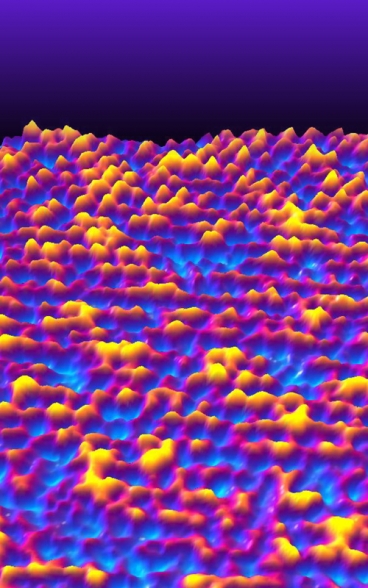 |
| Images taken through the Atomic Force Microscope using the MIT team’s new technique can show details of individual atoms and molecules at the interface between a liquid and a solid surface. Micrograph courtesy of Francesco Stellacci and Kislon Voitchovsky |
Abstract:
New technique improves researchers' ability to measure a key property of material surfaces.
By David L. Chandler, MIT News Office
Liquid-solid interactions, as never before seen
Cambridge, MA | Posted on April 26th, 2010Wettability — the degree to which a liquid either spreads out over a surface or forms into droplets — is crucial to a wide variety of processes. It influences, for example, how easily a car's windshield fogs up, and also affects the functioning of advanced batteries and fuel-cell systems.
Until now, the only way to quantify this important characteristic of a material's surface has been to measure the shapes of the droplets that form on it, and this method has very limited resolution. But a team of MIT researchers has found a way to obtain images that improves the resolution of such measurements by a factor of 10,000 or more, allowing for unprecedented precision in determining the details of the interactions between liquids and solid surfaces. In addition, the new method can be used to study curved, textured or complex solid surfaces, something that could not be done previously.
"This is something that was unthinkable before," says Francesco Stellacci, the Paul M. Cook Career Development Associate Professor of Materials Science and Engineering at MIT, leader of the team that developed the new method. "It allows us to make a map of the wetting," that is, a detailed view of exactly how the liquid interacts with the surface down to the level of individual molecules or atoms, as opposed to just the average interaction of the whole droplet.
The new method is described in a paper appearing on April 25 in the journal Nature Nanotechnology. The lead author is postdoctoral fellow Kislon Voïtchovsky, and the paper is coauthored by Stellacci and others at MIT, in England, and in Italy. Stellacci explains that the ability to get such detailed images is important for the study of such processes as catalysis, corrosion and the internal functioning of batteries and fuel cells, and many biological processes such as interactions between proteins.
For example, Voïtchovsky says, in biological research, "you may have a very inhomogeneous sample, with all sorts of reactions going on all over the place. Now we can identify certain specific areas that trigger a reaction."
The method, developed with support from the Swiss National Science Foundation and the Packard Foundation, works by changing the programming that controls an Atomic Force Microscope (AFM). This device uses a sharp point mounted on a vibrating cantilever, which scans the surface of a sample and reacts to topology and the properties of the sample to provide highly detailed images. Stellacci and his team have varied a key imaging parameter: They cause the point to vibrate only a few nanometers (as opposed to tens to hundred of nanometers, which is typical).
"By doing so, you actually improve the resolution of the AFM," Stellacci explains. The resulting resolution, fine enough to map the positions of individual atoms or molecules, is "unmatched before with commercial instruments," he says. Such resolution had been achievable before with very expensive specialized AFMs, of which only a few exist in the world, but can now be equaled by the much more common commercial models, of which there are thousands. Stellacci and his colleagues think the improved resolution results from the way the vibrating tip causes the water to repeatedly push against the surface and dissipate its energy there, but this explanation remains to be tested and confirmed by other researchers.
With their demonstration of both a 10,000-fold improvement in resolution for the specific function of measuring the wetting of surfaces and a 20-fold improvement in overall resolution of the lower-cost AFM, Stellacci says it's not clear which of these applications will end up having more impact.
Arvind Raman, a professor and university faculty scholar in mechanical engineering at Purdue University, agrees that these advances have significant potential. The method demonstrated by this team, which Raman was not involved in, "can routinely achieve atomic resolution on hard surfaces even with commercial AFM systems, and it provides great physical insight into the optimum conditions under which this can be achieved, both of which are very significant achievements," he says. "I really think many in the AFM field will jump on this and try to use the technique."
Raman adds that while the team's interpretation of why the method works as it does offers "one possible mechanism behind the image formation, other plausible mechanisms also exist and will need to be studied in the future to confirm the finding."
####
For more information, please click here
Copyright © MIT
If you have a comment, please Contact us.Issuers of news releases, not 7th Wave, Inc. or Nanotechnology Now, are solely responsible for the accuracy of the content.
Bookmark:


| Related News Press |
News and information
 Simulating magnetization in a Heisenberg quantum spin chain April 5th, 2024
NRL charters Navy’s quantum inertial navigation path to reduce drift April 5th, 2024
Discovery points path to flash-like memory for storing qubits: Rice find could hasten development of nonvolatile quantum memory April 5th, 2024
Govt.-Legislation/Regulation/Funding/Policy
NRL charters Navy’s quantum inertial navigation path to reduce drift April 5th, 2024
Discovery points path to flash-like memory for storing qubits: Rice find could hasten development of nonvolatile quantum memory April 5th, 2024
Chemical reactions can scramble quantum information as well as black holes April 5th, 2024
Possible Futures
Discovery points path to flash-like memory for storing qubits: Rice find could hasten development of nonvolatile quantum memory April 5th, 2024
With VECSELs towards the quantum internet Fraunhofer: IAF achieves record output power with VECSEL for quantum frequency converters April 5th, 2024
Academic/Education
Rice University launches Rice Synthetic Biology Institute to improve lives January 12th, 2024
Multi-institution, $4.6 million NSF grant to fund nanotechnology training September 9th, 2022
Announcements
NRL charters Navy’s quantum inertial navigation path to reduce drift April 5th, 2024
Discovery points path to flash-like memory for storing qubits: Rice find could hasten development of nonvolatile quantum memory April 5th, 2024
Tools
Ferroelectrically modulate the Fermi level of graphene oxide to enhance SERS response November 3rd, 2023
The USTC realizes In situ electron paramagnetic resonance spectroscopy using single nanodiamond sensors November 3rd, 2023
Battery Technology/Capacitors/Generators/Piezoelectrics/Thermoelectrics/Energy storage
What heat can tell us about battery chemistry: using the Peltier effect to study lithium-ion cells March 8th, 2024
A battery’s hopping ions remember where they’ve been: Seen in atomic detail, the seemingly smooth flow of ions through a battery’s electrolyte is surprisingly complicated February 16th, 2024
Fuel Cells
Current and Future Developments in Nanomaterials and Carbon Nanotubes: Applications of Nanomaterials in Energy Storage and Electronics October 28th, 2022
 |
||
 |
||
| The latest news from around the world, FREE | ||
 |
||
|
|
||
| Premium Products | ||
 |
||
|
Only the news you want to read!
Learn More |
||
 |
||
|
Full-service, expert consulting
Learn More |
||
|
|
||