Home > Press > Researchers Demonstrate New Understanding of Nanotube Growth
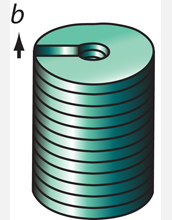 |
| A schematic illustration showing the formation of nanotubes driven by screw dislocations. Credit: Song Jin, University of Wisconsin-Madison |
Abstract:
Scientists take first step toward controlling the growth of nanomaterials without catalysts
Researchers Demonstrate New Understanding of Nanotube Growth
Arlington, VA | Posted on April 26th, 2010Researchers at the University of Wisconsin-Madison recently made a significant first step toward understanding how to control the growth of the nanotubes, nanowires and nanorods needed for renewable energy and other technology applications.
These nanocrystalline materials, or nanomaterials, possess unique chemical and physical properties that can be used in solar energy panels, high energy density batteries, or better electronics. But, writing in the April 23 edition of the journal Science, a UW-Madison research team notes that the formation of these materials is often not well understood.
In particular, the question of how one-dimensional (1D) crystals grow sometimes without catalysts has been troublesome for scientists and engineers who need to produce large amounts of nanomaterials for specific applications. Working with zinc oxide, a common semiconductor widely used as a nanomaterial, assistant professor of chemistry Song Jin and his students demonstrated a new understanding of the subject by showing that nanotubes can be formed solely due to the strain energy and screw dislocations that drive their growth.
Screw dislocations are frequently observed defects in crystalline materials that can be thought of as a screw or a helical staircase that can drive fast 1D crystal growth. But these defects produce strain and stress during nanotube formation.
"The strain energy within dislocation-driven nanomaterials dictates if the material will be hollow or solid," explained Jin. "Tubes are formed when strain energy gets large enough and the center of the nanostructure hollows out to relieve the stress and strain."
Jin and his students investigated the possibility of dislocation-driven growth by carefully regulating the amount of available nanotube building blocks in a solution. Essentially, the team controllably oversaturated or supersaturated a vat of water with zinc salts to favor dislocation-driven growth and observe the formation of solid nanowires and hollow nanotubes.
This mechanism differs from previous growth strategies in that it doesn't require a catalyst or a template to produce nanotubes, but relies solely on a dislocation and the strain energy associated with it. A catalyst is usually another metal nanoparticle such as gold added to the growth process, which in turn drives 1D growth.
"Once we understand that the growth of these 1D nanomaterials can be driven by screw dislocations, we can see nanotubes and nanowires are related." said Jin. "Furthermore, we've shown that growth of nanotubes or nanowires without the use of a catalyst in solutions can be rationally designed by following a fundamental understanding of crystal growth theories and the concept of dislocation-driven nanomaterial growth.
"For more practical purposes, we think that this work provides a general theoretical framework for controlling solution nanowire/nanotube growth that can be applicable to many other materials," Jin said.
Growing large amounts of nanotubes or nanowires from water-based solutions without a catalyst would be much more cost-effective. "This could open up the exploitation of large scale/low cost solution growth for rational catalyst-free synthesis of 1D nanomaterials," said Jin.
The National Science Foundation's Division of Materials Research supports the work.
####
About National Science Foundation
The National Science Foundation (NSF) is an independent federal agency that supports fundamental research and education across all fields of science and engineering. In fiscal year (FY) 2010, its budget is about $6.9 billion. NSF funds reach all 50 states through grants to nearly 2,000 universities and institutions. Each year, NSF receives over 45,000 competitive requests for funding, and makes over 11,500 new funding awards. NSF also awards over $400 million in professional and service contracts yearly.
For more information, please click here
Contacts:
Media Contacts
Bobbie Mixon, NSF (703) 292-8485
Program Contacts
Linda S Sapochak, NSF (703) 292-4932
Principal Investigators
Song Jin, University of Wisconsin-Madison (608) 262-1562
Related Websites
The Jin Group webpage: jin.chem.wisc.edu/
Copyright © National Science Foundation
If you have a comment, please Contact us.Issuers of news releases, not 7th Wave, Inc. or Nanotechnology Now, are solely responsible for the accuracy of the content.
Bookmark:


| Related News Press |
News and information
 Quantum computer improves AI predictions April 17th, 2026
Flexible sensor gains sensitivity under pressure April 17th, 2026
A reusable chip for particulate matter sensing April 17th, 2026
Detecting vibrational quantum beating in the predissociation dynamics of SF6 using time-resolved photoelectron spectroscopy April 17th, 2026
Chemistry
Projecting light to dispense liquids: A new route to ultra-precise microdroplets January 30th, 2026
From sensors to smart systems: the rise of AI-driven photonic noses January 30th, 2026
"Nanoreactor" cage uses visible light for catalytic and ultra-selective cross-cycloadditions October 3rd, 2025
Cambridge chemists discover simple way to build bigger molecules – one carbon at a time June 6th, 2025
Govt.-Legislation/Regulation/Funding/Policy
Quantum computer improves AI predictions April 17th, 2026
Metasurfaces smooth light to boost magnetic sensing precision January 30th, 2026
New imaging approach transforms study of bacterial biofilms August 8th, 2025
Possible Futures
A fundamentally new therapeutic approach to cystic fibrosis: Nanobody repairs cellular defect April 17th, 2026
UC Irvine physicists discover method to reverse ‘quantum scrambling’ : The work addresses the problem of information loss in quantum computing system April 17th, 2026
Academic/Education
Rice University launches Rice Synthetic Biology Institute to improve lives January 12th, 2024
Multi-institution, $4.6 million NSF grant to fund nanotechnology training September 9th, 2022
Chip Technology
A reusable chip for particulate matter sensing April 17th, 2026
Metasurfaces smooth light to boost magnetic sensing precision January 30th, 2026
Nanotubes/Buckyballs/Fullerenes/Nanorods/Nanostrings/Nanosheets
Tiny nanosheets, big leap: A new sensor detects ethanol at ultra-low levels January 30th, 2026
Enhancing power factor of p- and n-type single-walled carbon nanotubes April 25th, 2025
Chainmail-like material could be the future of armor: First 2D mechanically interlocked polymer exhibits exceptional flexibility and strength January 17th, 2025
Innovative biomimetic superhydrophobic coating combines repair and buffering properties for superior anti-erosion December 13th, 2024
Nanoelectronics
Lab to industry: InSe wafer-scale breakthrough for future electronics August 8th, 2025
Interdisciplinary: Rice team tackles the future of semiconductors Multiferroics could be the key to ultralow-energy computing October 6th, 2023
Key element for a scalable quantum computer: Physicists from Forschungszentrum Jülich and RWTH Aachen University demonstrate electron transport on a quantum chip September 23rd, 2022
Reduced power consumption in semiconductor devices September 23rd, 2022
Announcements
A fundamentally new therapeutic approach to cystic fibrosis: Nanobody repairs cellular defect April 17th, 2026
UC Irvine physicists discover method to reverse ‘quantum scrambling’ : The work addresses the problem of information loss in quantum computing system April 17th, 2026
Energy
Sensors innovations for smart lithium-based batteries: advancements, opportunities, and potential challenges August 8th, 2025
Simple algorithm paired with standard imaging tool could predict failure in lithium metal batteries August 8th, 2025
Battery Technology/Capacitors/Generators/Piezoelectrics/Thermoelectrics/Energy storage
Decoding hydrogen‑bond network of electrolyte for cryogenic durable aqueous zinc‑ion batteries January 30th, 2026
COF scaffold membrane with gate‑lane nanostructure for efficient Li+/Mg2+ separation January 30th, 2026
MXene nanomaterials enter a new dimension Multilayer nanomaterial: MXene flakes created at Drexel University show new promise as 1D scrolls January 30th, 2026
Solar/Photovoltaic
Spinel-type sulfide semiconductors to operate the next-generation LEDs and solar cells For solar-cell absorbers and green-LED source October 3rd, 2025
KAIST researchers introduce new and improved, next-generation perovskite solar cell November 8th, 2024
Groundbreaking precision in single-molecule optoelectronics August 16th, 2024
Development of zinc oxide nanopagoda array photoelectrode: photoelectrochemical water-splitting hydrogen production January 12th, 2024
 |
||
 |
||
| The latest news from around the world, FREE | ||
 |
||
|
|
||
| Premium Products | ||
 |
||
|
Only the news you want to read!
Learn More |
||
 |
||
|
Full-service, expert consulting
Learn More |
||
|
|
||