Home > Press > A Little Less Force: Making Atomic Force Microscopy Work for Cells
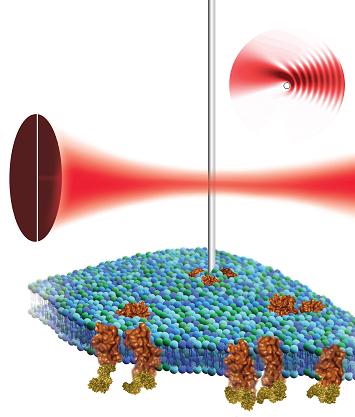 |
| By placing a nanowire cantilever in the focus of a laser beam and detecting the resulting light pattern, scientists at the Molecular Foundry believe atomic force microscopy can be used to non-destructively image the surface of a biological cell (green-blue structure) and its proteins (shown in brown). (Illustration by Flavio Robles, Berkeley Lab Public Affairs) |
Abstract:
Atomic force microscopy, a tactile-based probe technique, provides a three-dimensional nanoscale image of a material by gliding a needle-like arm across the material's surface. The core of this AFM imaging workhorse is a cantilever with a sharp tip that deflects as it encounters undulations across a surface. Due to a minimum force required for imaging, conventional AFM cantilevers can deform or even tear apart living cells and other biological materials. While scientists have made strides in reducing this minimum force by making smaller cantilevers, the force is still too great to image cells with high resolution. Indeed, for imaging objects smaller than the diffraction limit of light—that is, nanometer dimensions—this approach hits a roadblock as the instrument can no longer sense minute forces.
A Little Less Force: Making Atomic Force Microscopy Work for Cells
Berkeley, CA | Posted on April 22nd, 2010Now, however, scientists with the Molecular Foundry, a U.S. Department of Energy User Facility located at Berkeley Lab, have developed nano-sized cantilevers whose gentle touch could help discern the workings of living cells and other soft materials in their natural, liquid environment. Used in combination with a revolutionary detection mechanism, this new imaging tool is sensitive enough to investigate soft materials without the limitations present in other cantilevers.
"Whether we are considering biological systems or other complex, self-assembling nanostructures, this organization will be done in a liquid," says Paul Ashby, a Molecular Foundry staff scientist who led this research in the Foundry's Imaging and Manipulation of Nanostructures Facility. "If we have an investigative probe that excels in this environment, we could image individual proteins as they function on the cell surface."
Says Babak Sanii, a post-doctoral researcher in the Foundry, "Shrinking the cantilever down to nanoscale dimensions dramatically reduces the force it applies, but to monitor the movements of such a small cantilever, we needed a new detection scheme."
Rather than measuring the cantilever's deflection by bouncing a laser off it, Ashby and Sanii place the nanowire cantilever in the focus of a laser beam and detect the resulting light pattern, pinpointing the nanowire's position with high resolution. The duo say this work provides a launching pad for building a nanowire-based atomic force microscopes that could be used to study biological cells and model cellular components such as vesicles or bilayers. In particular, Ashby and Sanii hope to learn more about integrins, proteins found on the surface of cells that mediate adhesion and are part of signaling pathways linked to cell growth and migration.
"No present technique probes the assembly and dynamics of protein complexes in the cell membrane," adds Ashby. "A dynamic probe is the holy grail of soft matter imaging, and would help determine how protein complexes associate and disassociate."
"High sensitivity deflection detection of nanowires," by Babak Sanii and Paul D. Ashby, appears in Physical Review Letters and is available in Physical Review Letters online.
This work at the Molecular Foundry was supported by the DOE's Office of Science.
####
About Berkeley Lab
Berkeley Lab is a U.S. Department of Energy national laboratory located in Berkeley, California. It conducts unclassified scientific research and is managed by the University of California.
The Molecular Foundry is one of the five DOE Nanoscale Science Research Centers (NSRCs), premier national user facilities for interdisciplinary research at the nanoscale. Together the NSRCs comprise a suite of complementary facilities that provide researchers with state-of-the-art capabilities to fabricate, process, characterize and model nanoscale materials, and constitute the largest infrastructure investment of the National Nanotechnology Initiative. The NSRCs are located at DOE’s Argonne, Brookhaven, Lawrence Berkeley, Oak Ridge and Sandia and Los Alamos National Laboratories. For more information about the DOE NSRCs, please visit nano.energy.gov.
For more information, please click here
Contacts:
Aditi Risbud
(510)486-4861
Copyright © Berkeley Lab
If you have a comment, please Contact us.Issuers of news releases, not 7th Wave, Inc. or Nanotechnology Now, are solely responsible for the accuracy of the content.
Bookmark:


| Related News Press |
News and information
 Simulating magnetization in a Heisenberg quantum spin chain April 5th, 2024
NRL charters Navy’s quantum inertial navigation path to reduce drift April 5th, 2024
Discovery points path to flash-like memory for storing qubits: Rice find could hasten development of nonvolatile quantum memory April 5th, 2024
Govt.-Legislation/Regulation/Funding/Policy
NRL charters Navy’s quantum inertial navigation path to reduce drift April 5th, 2024
Discovery points path to flash-like memory for storing qubits: Rice find could hasten development of nonvolatile quantum memory April 5th, 2024
Chemical reactions can scramble quantum information as well as black holes April 5th, 2024
Nanomedicine
New micromaterial releases nanoparticles that selectively destroy cancer cells April 5th, 2024
Good as gold - improving infectious disease testing with gold nanoparticles April 5th, 2024
Researchers develop artificial building blocks of life March 8th, 2024
Announcements
NRL charters Navy’s quantum inertial navigation path to reduce drift April 5th, 2024
Discovery points path to flash-like memory for storing qubits: Rice find could hasten development of nonvolatile quantum memory April 5th, 2024
Tools
Ferroelectrically modulate the Fermi level of graphene oxide to enhance SERS response November 3rd, 2023
The USTC realizes In situ electron paramagnetic resonance spectroscopy using single nanodiamond sensors November 3rd, 2023
Nanobiotechnology
New micromaterial releases nanoparticles that selectively destroy cancer cells April 5th, 2024
Good as gold - improving infectious disease testing with gold nanoparticles April 5th, 2024
Researchers develop artificial building blocks of life March 8th, 2024
 |
||
 |
||
| The latest news from around the world, FREE | ||
 |
||
|
|
||
| Premium Products | ||
 |
||
|
Only the news you want to read!
Learn More |
||
 |
||
|
Full-service, expert consulting
Learn More |
||
|
|
||