Home > Press > From Lab to Fab – An HP Labs discovery demonstrates the viability – and versatility – of memristor technology
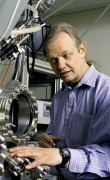 |
| Stanley Williams, director of HP’s Information & Quantum Systems Lab |
Abstract:
The HP Labs team that built the world's first memristor this week announced another significant advance in memristor research.
From Lab to Fab – An HP Labs discovery demonstrates the viability – and versatility – of memristor technology
Palo Alto, CA | Posted on April 9th, 2010In an article (*) published in the current issue of Nature, the HP researchers demonstrate that memristors - a fourth basic element in integrated circuits which only existed in theory until 2008 - are capable of performing logic functions. It's further evidence that memristors have the potential to make an impact on real world computing, says Stanley Williams, director of HP's Information & Quantum Systems Lab and lead researcher on the project.
"Our research is now moving out of the lab and towards fabrication of memristor-based circuitry," Wiliams reports. "And as we're getting closer to the practical implementation of memristor technology, we're learning more and more about it."
If memristors can perform logic, they might one day be used to create computer processors, suggests Williams. And since those processors could be made with industry-standard materials and processes, memristors might help extend Moore's Law past the point where silicon technology runs up against insurmountable technical barriers, he says.
In the much nearer term, Williams expects to see memristors used in computer memory chips within the next few years. HP Labs already has a production-ready architecture for such a chip.
Memristor chips require less energy to operate than current alternatives, such as flash memory. They also store data in approximately half the space required by flash chips and are virtually immune to interference from radiation - making them attractive to any manufacturer looking to create ever-smaller but ever-more-powerful devices.
In research published last fall, William's group suggested how memristor memory could be combined with silicon processors in a multi-dimensional processor framework to create a hybrid chip that would be significant advance towards the idea of a ‘computer on a chip.' Machines equipped with such processors would be useful for any compute- and memory-intense task, like seismic surveying, animation rendering or space research.
Eventually, memristor-based processors might replace the silicon in the smart display screens found in e-readers, says Williams, and could one day even become the successors to silicon on a larger scale.
That's the real significance of the article in this week's Nature, he says. "Memristors are allowing us to think about different ways of doing computing. And we're only just starting to really understand the long term potential that they have."
(*) www.nature.com/nature/journal/v464/n7290/full/nature08940.html
####
About HP Labs
HP is a technology company that operates in more than 170 countries around the world. We explore how technology and services can help people and companies address their problems and challenges, and realize their possibilities, aspirations and dreams. We apply new thinking and ideas to create more simple, valuable and trusted experiences with technology, continuously improving the way our customers live and work.
No other company offers as complete a technology product portfolio as HP. We provide infrastructure and business offerings that span from handheld devices to some of the world's most powerful supercomputer installations. We offer consumers a wide range of products and services from digital photography to digital entertainment and from computing to home printing. This comprehensive portfolio helps us match the right products, services and solutions to our customers' specific needs.
For more information, please click here
Copyright © HP Labs
If you have a comment, please Contact us.Issuers of news releases, not 7th Wave, Inc. or Nanotechnology Now, are solely responsible for the accuracy of the content.
Bookmark:


| Related News Press |
News and information
 Quantum computer improves AI predictions April 17th, 2026
Flexible sensor gains sensitivity under pressure April 17th, 2026
A reusable chip for particulate matter sensing April 17th, 2026
Detecting vibrational quantum beating in the predissociation dynamics of SF6 using time-resolved photoelectron spectroscopy April 17th, 2026
Possible Futures
A fundamentally new therapeutic approach to cystic fibrosis: Nanobody repairs cellular defect April 17th, 2026
UC Irvine physicists discover method to reverse ‘quantum scrambling’ : The work addresses the problem of information loss in quantum computing system April 17th, 2026
Chip Technology
A reusable chip for particulate matter sensing April 17th, 2026
Metasurfaces smooth light to boost magnetic sensing precision January 30th, 2026
Memory Technology
Researchers tackle the memory bottleneck stalling quantum computing October 3rd, 2025
First real-time observation of two-dimensional melting process: Researchers at Mainz University unveil new insights into magnetic vortex structures August 8th, 2025
Utilizing palladium for addressing contact issues of buried oxide thin film transistors April 5th, 2024
Nanoelectronics
Lab to industry: InSe wafer-scale breakthrough for future electronics August 8th, 2025
Interdisciplinary: Rice team tackles the future of semiconductors Multiferroics could be the key to ultralow-energy computing October 6th, 2023
Key element for a scalable quantum computer: Physicists from Forschungszentrum Jülich and RWTH Aachen University demonstrate electron transport on a quantum chip September 23rd, 2022
Reduced power consumption in semiconductor devices September 23rd, 2022
Announcements
A fundamentally new therapeutic approach to cystic fibrosis: Nanobody repairs cellular defect April 17th, 2026
UC Irvine physicists discover method to reverse ‘quantum scrambling’ : The work addresses the problem of information loss in quantum computing system April 17th, 2026
 |
||
 |
||
| The latest news from around the world, FREE | ||
 |
||
|
|
||
| Premium Products | ||
 |
||
|
Only the news you want to read!
Learn More |
||
 |
||
|
Full-service, expert consulting
Learn More |
||
|
|
||