Home > Press > CU Physicists Use Ultra-Fast Lasers to Open Doors to New Technologies Unheard of Just Years Ago
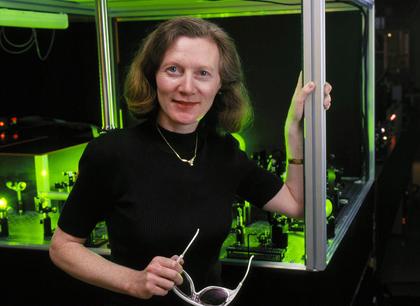 |
| Margaret Murnane |
Abstract:
For nearly half a century, scientists have been trying to figure out how to build a cost-effective and reasonably sized X-ray laser that could, among other things, provide super high-resolution imaging. And for the past two decades, University of Colorado at Boulder physics professors Margaret Murnane and Henry Kapteyn have been inching closer to that goal.
Recent breakthroughs by their team at JILA, a joint institute of CU-Boulder and the National Institute of Standards and Technology, have paved the way on how to build a tabletop X-ray laser that could be used for super high-resolution imaging, while also giving scientists a new way to peer into a single cell and gain a better understanding of the nanoworld.
CU Physicists Use Ultra-Fast Lasers to Open Doors to New Technologies Unheard of Just Years Ago
Boulder, CO | Posted on February 23rd, 2010Both of these feats could lead to major breakthroughs in many fields including medicine, biology and nanotechnology development.
"Our goal is to create a laser beam that contains a broad range of X-ray wavelengths all at once that can be focused both in time and space," Murnane said. "If we have this source of coherent light that spans a huge region of the electromagnetic spectrum, we would be able to make the highest resolution light-based tabletop microscope in existence that could capture images in 3-D and tell us exactly what we are looking at. We're very close."
Murnane and Kapteyn presented highlights of their research today at the American Association for the Advancement of Science, or AAAS, annual meeting in San Diego, during a panel discussion about the history and future of laser technology titled "Next Generation of Extreme Optical Tools and Applications."
Most of today's X-ray lasers require so much power that they rely on fusion laser facilities the size of football stadiums or larger, making their use impractical. Murnane and Kapteyn generate coherent laser-like X-ray beams by using an intense femtosecond laser and combining hundreds or thousands of visible photons together. And the key is they are doing it with a desktop-size system.
They can already generate laser-like X-ray beams in the soft X-ray region and believe they have discovered how to extend the process all the way into the hard X-ray region of the electromagnetic spectrum.
"If we can do this, it could lead to all kinds of possibilities," Kapteyn said. "It might make it possible to improve X-ray imaging resolution at your doctor's office by a thousand times. The X-rays we get in the hospital now are limited. For example, they can't detect really small cancers because the X-ray source in your doctor's office is more like a light bulb, not a laser. If you had a bright, focused laser-like X-ray beam, you could image with far higher resolution."
Their method can be thought of as a coherent version of the X-ray tube, according to Murnane. In an X-ray tube, an electron is boiled off a filament, then it is accelerated in an electric field before hitting a solid target, where the kinetic energy of the electron is converted into incoherent X-rays. These incoherent X-rays are like the incoherent light from a light bulb or flashlight -- they aren't very focused.
In the tabletop setup, instead of boiling an electron from a filament, they pluck part of the quantum wave function of an electron from an atom using a very intense laser pulse. The electron is then accelerated and slammed back into the ion, releasing its energy as an X-ray photon. Since the laser field controls the motion of the electron, the X-rays emitted can retain the coherence properties of a laser, Murnane said.
Being able to build a tabletop X-ray laser is just the beginning, said Kapteyn.
"An analogy that is pretty close to what is going on in this field is the MRI, which started as just a fundamental investigation," said Kapteyn. "People then started using it for microscopy, and then it progressed into a medical diagnostic technique."
Murnane and Kapteyn were recently recognized with the American Physical Society's Arthur L. Schawlow Prize in Laser Science for "pioneering work in the area of ultra-fast laser science, including development of ultra-fast optical and coherent soft X-ray sources." The prize, which was endowed by NEC Corporation in 1991, recognizes "outstanding contributions to basic research which uses lasers to advance our knowledge of the fundamental physical properties of materials and their interaction with light." Nobel laureates and CU-Boulder physics Professors Carl E. Wieman (1999) and John L. Hall (1993) also have won the award.
For more information about Murnane and Kapteyn's work visit their research group page at jila.colorado.edu/kmgroup/home.html.
####
For more information, please click here
Contacts:
Margaret Murnane
303-492-7839
Henry Kapteyn
303-492-8198
Greg Swenson
CU News Services
303-492-3113
Copyright © University of Colorado in Boulder
If you have a comment, please Contact us.Issuers of news releases, not 7th Wave, Inc. or Nanotechnology Now, are solely responsible for the accuracy of the content.
Bookmark:


| Related News Press |
News and information
 Simulating magnetization in a Heisenberg quantum spin chain April 5th, 2024
NRL charters Navy’s quantum inertial navigation path to reduce drift April 5th, 2024
Discovery points path to flash-like memory for storing qubits: Rice find could hasten development of nonvolatile quantum memory April 5th, 2024
Possible Futures
Discovery points path to flash-like memory for storing qubits: Rice find could hasten development of nonvolatile quantum memory April 5th, 2024
With VECSELs towards the quantum internet Fraunhofer: IAF achieves record output power with VECSEL for quantum frequency converters April 5th, 2024
Academic/Education
Rice University launches Rice Synthetic Biology Institute to improve lives January 12th, 2024
Multi-institution, $4.6 million NSF grant to fund nanotechnology training September 9th, 2022
Nanomedicine
New micromaterial releases nanoparticles that selectively destroy cancer cells April 5th, 2024
Good as gold - improving infectious disease testing with gold nanoparticles April 5th, 2024
Researchers develop artificial building blocks of life March 8th, 2024
Announcements
NRL charters Navy’s quantum inertial navigation path to reduce drift April 5th, 2024
Discovery points path to flash-like memory for storing qubits: Rice find could hasten development of nonvolatile quantum memory April 5th, 2024
Tools
Ferroelectrically modulate the Fermi level of graphene oxide to enhance SERS response November 3rd, 2023
The USTC realizes In situ electron paramagnetic resonance spectroscopy using single nanodiamond sensors November 3rd, 2023
Events/Classes
Researchers demonstrate co-propagation of quantum and classical signals: Study shows that quantum encryption can be implemented in existing fiber networks January 20th, 2023
Nanobiotechnology
New micromaterial releases nanoparticles that selectively destroy cancer cells April 5th, 2024
Good as gold - improving infectious disease testing with gold nanoparticles April 5th, 2024
Researchers develop artificial building blocks of life March 8th, 2024
Quantum nanoscience
Simulating magnetization in a Heisenberg quantum spin chain April 5th, 2024
Optically trapped quantum droplets of light can bind together to form macroscopic complexes March 8th, 2024
Bridging light and electrons January 12th, 2024
'Sudden death' of quantum fluctuations defies current theories of superconductivity: Study challenges the conventional wisdom of superconducting quantum transitions January 12th, 2024
 |
||
 |
||
| The latest news from around the world, FREE | ||
 |
||
|
|
||
| Premium Products | ||
 |
||
|
Only the news you want to read!
Learn More |
||
 |
||
|
Full-service, expert consulting
Learn More |
||
|
|
||