Home > Press > New fiber nanogenerators could lead to electric clothing
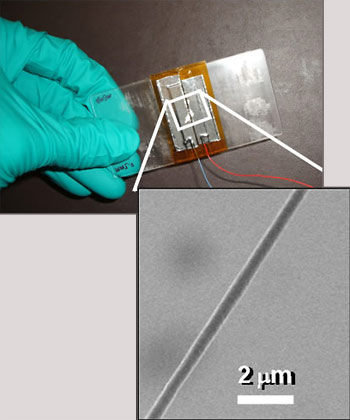 |
| Shown is a fiber nanogenerator on a plastic substrate created by UC Berkeley scientists. The nanofibers can convert energy from mechanical stresses and into electricity, and could one day be used to create clothing that can power small electronics. (Chieh Chang, UC Berkeley) |
Abstract:
In research that gives literal meaning to the term "power suit," University of California, Berkeley, engineers have created energy-scavenging nanofibers that could one day be woven into clothing and textiles.
New fiber nanogenerators could lead to electric clothing
Berkeley, CA | Posted on February 13th, 2010These nano-sized generators have "piezoelectric" properties that allow them to convert into electricity the energy created through mechanical stress, stretches and twists.
"This technology could eventually lead to wearable 'smart clothes' that can power hand-held electronics through ordinary body movements," said Liwei Lin, UC Berkeley professor of mechanical engineering and head of the international research team that developed the fiber nanogenerators.
Because the nanofibers are made from organic polyvinylidene fluoride, or PVDF, they are flexible and relatively easy and cheap to manufacture.
Although they are still working out the exact calculations, the researchers noted that more vigorous movements, such as the kind one would create while dancing the electric boogaloo, should theoretically generate more power. "And because the nanofibers are so small, we could weave them right into clothes with no perceptible change in comfort for the user," said Lin, who is also co-director of the Berkeley Sensor and Actuator Center at UC Berkeley.
The fiber nanogenerators are described in this month's issue of Nano Letters, a peer-reviewed journal published by the American Chemical Society.
The goal of harvesting energy from mechanical movements through wearable nanogenerators is not new. Other research teams have previously made nanogenerators out of inorganic semiconducting materials, such as zinc oxide or barium titanate. "Inorganic nanogenerators — in contrast to the organic nanogenerators we created — are more brittle and harder to grow in significant quantities," Lin said.
The tiny nanogenerators have diameters as small as 500 nanometers, or about 100 times thinner than a human hair and one-tenth the width of common cloth fibers. The researchers repeatedly tugged and tweaked the nanofibers, generating electrical outputs ranging from 5 to 30 millivolts and 0.5 to 3 nanoamps.
Furthermore, the researchers report no noticeable degradation after stretching and releasing the nanofibers for 100 minutes at a frequency of 0.5 hertz (cycles per second).
Lin's team at UC Berkeley pioneered the near-field electrospinning technique used to create and position the polymeric nanogenerators 50 micrometers apart in a grid pattern. The technology enables greater control of the placement of the nanofibers onto a surface, allowing researchers to properly align the fiber nanogenerators so that positive and negative poles are on opposite ends, similar to the poles on a battery.
Without this control, the researchers explained, the negative and positive poles might cancel each other out and reducing energy efficiency.
The researchers demonstrated energy conversion efficiencies as high as 21.8 percent, with an average of 12.5 percent.
"Surprisingly, the energy efficiency ratings of the nanofibers are much greater than the 0.5 to 4 percent achieved in typical power generators made from experimental piezoelectric PVDF thin films, and the 6.8 percent in nanogenerators made from zinc oxide fine wires," said the study's lead author, Chieh Chang, who conducted the experiments while he was a graduate student in mechanical engineering at UC Berkeley.
"We think the efficiency likely could be raised further," Lin said. "For our preliminary results, we see a trend that the smaller the fiber we have, the better the energy efficiency. We don't know what the limit is."
Other co-authors of the study are Yiin-Kuen Fuh, a UC Berkeley graduate student in mechanical engineering; Van H. Tran, a graduate student at the Technische Universität München (Technical University of Munich) in Germany; and Junbo Wang, a researcher at the Institute of Electronics at the Chinese Academy of Sciences in Beijing, China.
The National Science Foundation and the Defense Advanced Research Projects Agency helped support this research.
####
About University of California, Berkeley
The University of California was chartered in 1868 and its flagship campus — envisioned as a "City of Learning" — was established at Berkeley, on San Francisco Bay. Today the world's premier public university and a wellspring of innovation, UC Berkeley occupies a 1,232 acre campus with a sylvan 178-acre central core. From this home its academic community makes key contributions to the economic and social well-being of the Bay Area, California, and the nation.
For more information, please click here
Contacts:
Sarah Yang
(510) 643-7741
Liwei Lin
(510) 828-4911
Copyright © University of California, Berkeley
If you have a comment, please Contact us.Issuers of news releases, not 7th Wave, Inc. or Nanotechnology Now, are solely responsible for the accuracy of the content.
Bookmark:


| Related News Press |
News and information
 Simulating magnetization in a Heisenberg quantum spin chain April 5th, 2024
NRL charters Navy’s quantum inertial navigation path to reduce drift April 5th, 2024
Discovery points path to flash-like memory for storing qubits: Rice find could hasten development of nonvolatile quantum memory April 5th, 2024
Govt.-Legislation/Regulation/Funding/Policy
NRL charters Navy’s quantum inertial navigation path to reduce drift April 5th, 2024
Discovery points path to flash-like memory for storing qubits: Rice find could hasten development of nonvolatile quantum memory April 5th, 2024
Chemical reactions can scramble quantum information as well as black holes April 5th, 2024
Possible Futures
Discovery points path to flash-like memory for storing qubits: Rice find could hasten development of nonvolatile quantum memory April 5th, 2024
With VECSELs towards the quantum internet Fraunhofer: IAF achieves record output power with VECSEL for quantum frequency converters April 5th, 2024
Announcements
NRL charters Navy’s quantum inertial navigation path to reduce drift April 5th, 2024
Discovery points path to flash-like memory for storing qubits: Rice find could hasten development of nonvolatile quantum memory April 5th, 2024
Energy
Development of zinc oxide nanopagoda array photoelectrode: photoelectrochemical water-splitting hydrogen production January 12th, 2024
Shedding light on unique conduction mechanisms in a new type of perovskite oxide November 17th, 2023
Inverted perovskite solar cell breaks 25% efficiency record: Researchers improve cell efficiency using a combination of molecules to address different November 17th, 2023
The efficient perovskite cells with a structured anti-reflective layer – another step towards commercialization on a wider scale October 6th, 2023
Textiles/Clothing
Protective equipment with graphene nanotubes meets the strictest ESD safety standards March 25th, 2022
Polymer fibers with graphene nanotubes make it possible to heat hard-to-reach, complex-shaped items February 11th, 2022
Flexible material shows potential for use in fabrics to heat, cool July 3rd, 2020
 |
||
 |
||
| The latest news from around the world, FREE | ||
 |
||
|
|
||
| Premium Products | ||
 |
||
|
Only the news you want to read!
Learn More |
||
 |
||
|
Full-service, expert consulting
Learn More |
||
|
|
||