Home > Press > Rice physicists kill cancer with 'nanobubbles'
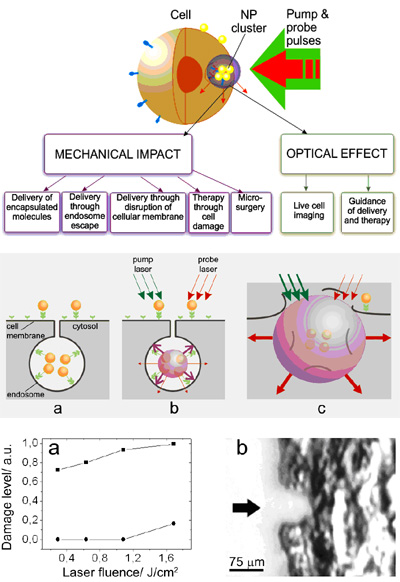 |
| • Cell theranostics: dynamically tuned intracellular plasmonic nanobubbles combine diagnosis (through optical scattering), therapy (through mechanical, nonthermal and selective damage of target cells) and optical guidance of the therapy into one fast process. • High-sensitive imaging and diagnosis of cells with plasmonic nanobubbles that may provide up to 102-3-fold increase in sensitivity compared to gold nanoparticles and 105-6 fold increase in sensitivity compared to fluorescent molecules. • Targeted therapy with plasmonic nanobubbles: LANTCET (laser activated nano-thermolysis as cell elimination technology). Applicastions: treatment of leukemia and of superficial tumors. • Controlled release and intracellular delivery of therapeutic and diagnostic agent into the cells. • Methods for imaging plasmonic nanoparticles in living cells and in tissue. • Micro-surgery with plasmonic nanobubbles: recanalization of occluded coronary arteries. |
Abstract:
Team finds method of IDing, destroying individual diseased cells
Rice physicists kill cancer with 'nanobubbles'
Houston, TX | Posted on February 4th, 2010Using lasers and nanoparticles, scientists at Rice University have discovered a new technique for singling out individual diseased cells and destroying them with tiny explosions. The scientists used lasers to make "nanobubbles" by zapping gold nanoparticles inside cells. In tests on cancer cells, they found they could tune the lasers to create either small, bright bubbles that were visible but harmless or large bubbles that burst the cells.
"Single-cell targeting is one of the most touted advantages of nanomedicine, and our approach delivers on that promise with a localized effect inside an individual cell," said Rice physicist Dmitri Lapotko, the lead researcher on the project. "The idea is to spot and treat unhealthy cells early, before a disease progresses to the point of making people extremely ill."
The research is available online in the journal Nanotechnology.
Nanobubbles are created when gold nanoparticles are struck by short laser pulses. The short-lived bubbles are very bright and can be made smaller or larger by varying the power of the laser. Because they are visible under a microscope, nanobubbles can be used to either diagnose sick cells or to track the explosions that are destroying them.
In laboratory studies published last year, Lapotko and colleagues at the Laboratory for Laser Cytotechnologies at the A.V. Lykov Heat and Mass Transfer Institute in Minsk, Belarus, applied nanobubbles to arterial plaque. They found that they could blast right through the deposits that block arteries.
"The bubbles work like a jackhammer," Lapotko said.
In the current study, Lapotko and Rice colleague Jason Hafner, associate professor of physics and astronomy and of chemistry, tested the approach on leukemia cells and cells from head and neck cancers. They attached antibodies to the nanoparticles so they would target only the cancer cells, and they found the technique was effective at locating and killing the cancer cells.
Lapotko said the nanobubble technology could be used for "theranostics," a single process that combines diagnosis and therapy. In addition, because the cell-bursting nanobubbles also show up on microscopes in real time, Lapotko said the technique can be use for post-therapeutic assessment, or what physicians often refer to as "guidance."
Hafner said, "The mechanical and optical properties of the bubbles offer unique advantages in localizing the biomedical applications to the individual cell level, or perhaps even to work within cells."
The research resulted from collaboration between Rice and the Lykov Institute of the Academy of Science of Belarus, which recently established the US-Belarus Research Lab of Fundamental and Biomedical Nanophotonics.
Co-authors of the Nanotechnology paper include Ehab Hanna of the University of Texas M.D. Anderson Cancer Center and Ekaterina Lukianova-Hleb of the Lykov Institute. The research was supported by the National Institutes of Health and the Institute of International Education's Scholar Rescue Fund.
Editor's note: more images and video here www.media.rice.edu/media/NewsBot.asp?MODE=VIEW&ID=13693
####
About Rice University
Located in Houston, Rice University is consistently ranked one of America's best teaching and research universities. Known for its "unconventional wisdom," Rice is distinguished by its: size -- 3,102 undergraduates and 2,237 graduate students; selectivity -- 12 applicants for each place in the freshman class; resources -- an undergraduate student-to-faculty ratio of 5-to-1; sixth largest endowment per student among American private research universities; residential college system, which builds communities that are both close-knit and diverse; and collaborative culture, which crosses disciplines, integrates teaching and research, and intermingles undergraduate and graduate work.
For more information, please click here
Contacts:
Jade Boyd
Associate Director and Science Editor
Office of Public Affairs/News & Media Relations
Rice University
(office) 713-348-6778
(cell) 713-302-2447
www.rice.edu
Copyright © Rice University
If you have a comment, please Contact us.Issuers of news releases, not 7th Wave, Inc. or Nanotechnology Now, are solely responsible for the accuracy of the content.
Bookmark:


| Related News Press |
News and information
 Quantum computer improves AI predictions April 17th, 2026
Flexible sensor gains sensitivity under pressure April 17th, 2026
A reusable chip for particulate matter sensing April 17th, 2026
Detecting vibrational quantum beating in the predissociation dynamics of SF6 using time-resolved photoelectron spectroscopy April 17th, 2026
Videos/Movies
ICFO researchers overcome long-standing bottleneck in single photon detection with twisted 2D materials August 8th, 2025
New X-ray imaging technique to study the transient phases of quantum materials December 29th, 2022
Solvent study solves solar cell durability puzzle: Rice-led project could make perovskite cells ready for prime time September 23rd, 2022
Scientists prepare for the world’s smallest race: Nanocar Race II March 18th, 2022
Possible Futures
A fundamentally new therapeutic approach to cystic fibrosis: Nanobody repairs cellular defect April 17th, 2026
UC Irvine physicists discover method to reverse ‘quantum scrambling’ : The work addresses the problem of information loss in quantum computing system April 17th, 2026
Nanomedicine
A fundamentally new therapeutic approach to cystic fibrosis: Nanobody repairs cellular defect April 17th, 2026
New molecular technology targets tumors and simultaneously silences two ‘undruggable’ cancer genes August 8th, 2025
New imaging approach transforms study of bacterial biofilms August 8th, 2025
Electrifying results shed light on graphene foam as a potential material for lab grown cartilage June 6th, 2025
Discoveries
Quantum computer improves AI predictions April 17th, 2026
Flexible sensor gains sensitivity under pressure April 17th, 2026
A reusable chip for particulate matter sensing April 17th, 2026
Detecting vibrational quantum beating in the predissociation dynamics of SF6 using time-resolved photoelectron spectroscopy April 17th, 2026
Announcements
A fundamentally new therapeutic approach to cystic fibrosis: Nanobody repairs cellular defect April 17th, 2026
UC Irvine physicists discover method to reverse ‘quantum scrambling’ : The work addresses the problem of information loss in quantum computing system April 17th, 2026
Nanobiotechnology
A fundamentally new therapeutic approach to cystic fibrosis: Nanobody repairs cellular defect April 17th, 2026
New molecular technology targets tumors and simultaneously silences two ‘undruggable’ cancer genes August 8th, 2025
New imaging approach transforms study of bacterial biofilms August 8th, 2025
Electrifying results shed light on graphene foam as a potential material for lab grown cartilage June 6th, 2025
 |
||
 |
||
| The latest news from around the world, FREE | ||
 |
||
|
|
||
| Premium Products | ||
 |
||
|
Only the news you want to read!
Learn More |
||
 |
||
|
Full-service, expert consulting
Learn More |
||
|
|
||