Home > Press > Future Chips to Have Layers Just Atoms Thick
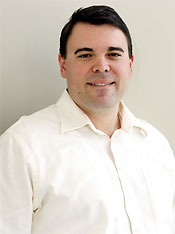 |
| Dr. Eric Vogel’s review of semiconductor technology’s current state of affairs appears in the new “Nanoscience and Technology: A Collection of Reviews from Nature Journals.” He is an associate professor of materials science and engineering. |
Abstract:
Prof's Paper Examines Measurement Challenge of New Nanoscale Devices
Future Chips to Have Layers Just Atoms Thick
Richardson, TX | Posted on November 19th, 2009New nanoscale materials and devices are required to replace the silicon transistor that's at the heart of today's semiconductors, but to build these new devices, researchers will have to be able to measure the thickness - if that's the right word - of layers consisting of only a few atoms, according to a UT Dallas researcher.
"The silicon transistor has enabled the integrated circuit technology revolution for over 30 years, but it is reaching practical and fundamental limits due to its extremely small size, now approaching 10 nanometers," said Dr. Eric Vogel, an associate professor of materials science and engineering as well as electrical engineering in the Erik Jonsson School of Engineering and Computer Science at UT Dallas. "The ability to measure the physical, chemical and electronic properties of new materials and devices will be crucial to the research and development of future electronic devices."
Vogel's review of semiconductor technology's current state of affairs appears in the new Nanoscience and Technology: A Collection of Reviews from Nature Journals."
Although all of the Nature journals (such as Nature, Nature Nanotechnology, Nature Physics and Nature Materials) publish review articles every month, and many of those are related to nanotechnology, only a select few have been chosen for this compilation, which one reviewer called "some of the latest and most advanced reports in the field of nanoscience and nanotechnology."
Titled "Technology and Metrology of New Electronic Materials and Devices," Vogel's article describes the technology and measurement challenges of new nanoscale devices and materials being considered for future electronics.
Among the most promising devices and materials being investigated to replace silicon are other semiconductors such as indium, gallium, arsenide and graphene, which consists of a single atomic layer of carbon.
Vogel himself has a wide range of research programs related to future nanoelectronic materials and devices. He leads the University's portion of the Southwest Academy for Nanoelectronics (SWAN), funded by Semiconductor Research Corp. (SRC) through The University of Texas at Austin, which involves six UT Dallas faculty. The program focuses on the materials science, processes, characterization techniques and associated understanding necessary to implement graphene-based devices.
SWAN also funds two of Vogel's graduate students in the area of nanoscale devices for neuromorphic computing, an area that uses the human brain as a model for future low-power computation.
Vogel is also part of a research program funded by numerous agencies (SRC, SEMATECH, the National Science Foundation and the National Institute of Standards and Technology, or NIST) involving the use of compound semiconductors for future transistors, and he is involved in several programs funded by Texas Instruments, one related to nanoscale silicon for biosensors and another related to metal gate electrodes.
Before joining UT Dallas in 2006, Vogel led the CMOS and Novel Devices Group at NIST and was founding director of the institute's Nanofabrication Facility.
####
For more information, please click here
Contacts:
Media Contact
David Moore
UT Dallas
(972) 883-4183
or the Office of Media Relations, UT Dallas
(972) 883-2155
Copyright © University of Texas at Dallas
If you have a comment, please Contact us.Issuers of news releases, not 7th Wave, Inc. or Nanotechnology Now, are solely responsible for the accuracy of the content.
Bookmark:


| Related News Press |
News and information
 Quantum computer improves AI predictions April 17th, 2026
Flexible sensor gains sensitivity under pressure April 17th, 2026
A reusable chip for particulate matter sensing April 17th, 2026
Detecting vibrational quantum beating in the predissociation dynamics of SF6 using time-resolved photoelectron spectroscopy April 17th, 2026
Chip Technology
A reusable chip for particulate matter sensing April 17th, 2026
Metasurfaces smooth light to boost magnetic sensing precision January 30th, 2026
Nanoelectronics
Lab to industry: InSe wafer-scale breakthrough for future electronics August 8th, 2025
Interdisciplinary: Rice team tackles the future of semiconductors Multiferroics could be the key to ultralow-energy computing October 6th, 2023
Key element for a scalable quantum computer: Physicists from Forschungszentrum Jülich and RWTH Aachen University demonstrate electron transport on a quantum chip September 23rd, 2022
Reduced power consumption in semiconductor devices September 23rd, 2022
Announcements
A fundamentally new therapeutic approach to cystic fibrosis: Nanobody repairs cellular defect April 17th, 2026
UC Irvine physicists discover method to reverse ‘quantum scrambling’ : The work addresses the problem of information loss in quantum computing system April 17th, 2026
Interviews/Book Reviews/Essays/Reports/Podcasts/Journals/White papers/Posters
A fundamentally new therapeutic approach to cystic fibrosis: Nanobody repairs cellular defect April 17th, 2026
UC Irvine physicists discover method to reverse ‘quantum scrambling’ : The work addresses the problem of information loss in quantum computing system April 17th, 2026
Tools
Metasurfaces smooth light to boost magnetic sensing precision January 30th, 2026
From sensors to smart systems: the rise of AI-driven photonic noses January 30th, 2026
Japan launches fully domestically produced quantum computer: Expo visitors to experience quantum computing firsthand August 8th, 2025
 |
||
 |
||
| The latest news from around the world, FREE | ||
 |
||
|
|
||
| Premium Products | ||
 |
||
|
Only the news you want to read!
Learn More |
||
 |
||
|
Full-service, expert consulting
Learn More |
||
|
|
||